Clear Sky Science · en
Medicinal and aromatic plants as climate-smart crops: case studies on Pelargonium graveolens and Viola odorata under Egyptian conditions
Why Fragrant Fields Matter for the Climate
Most people know geranium and violet for their pleasant scents in perfumes, soaps, and cosmetics. This study asks a less obvious question: can the plants that supply these fragrances also help fight climate change? By carefully measuring how much carbon dioxide these crops pull from the air, and how much is released when their oils are produced, the researchers show that some fragrant plants can actually act like mini climate helpers—while others become climate polluters unless their processing is cleaned up.
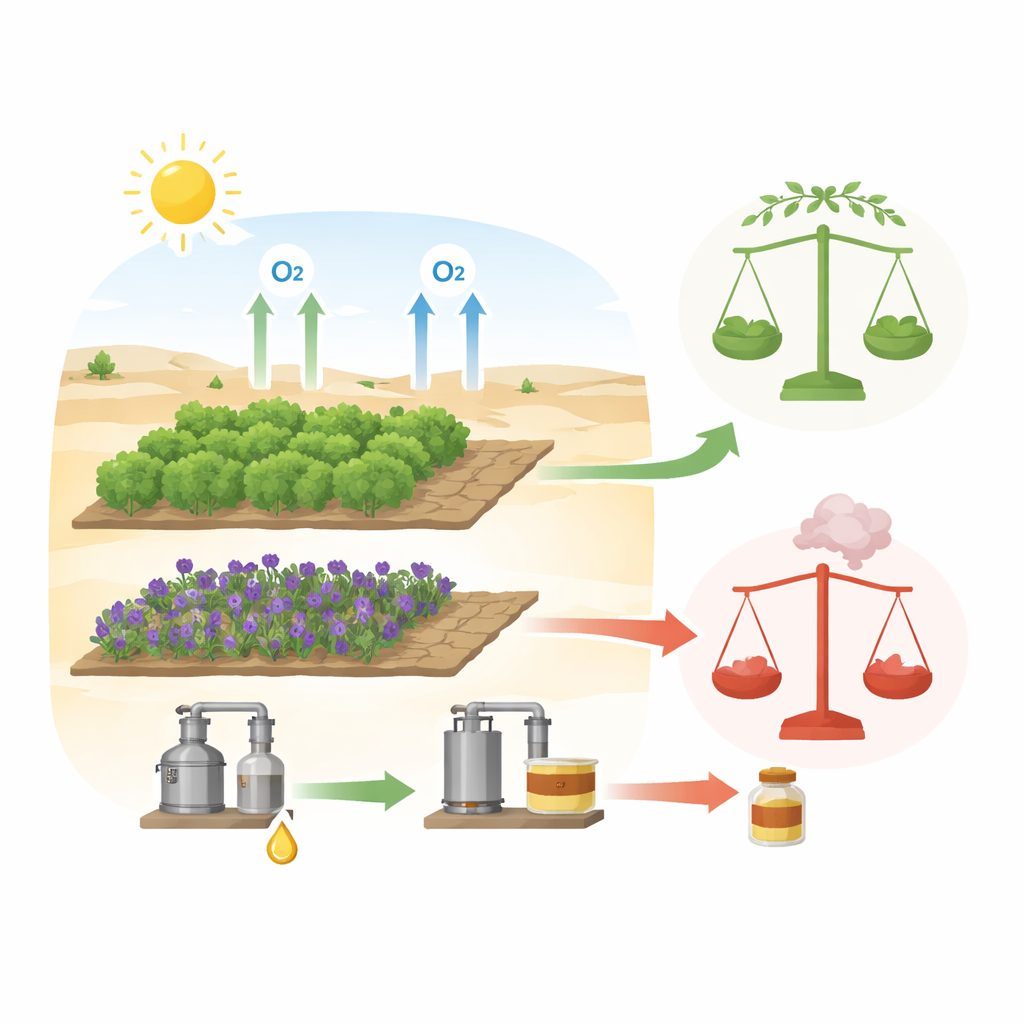
Two Scented Crops, Two Very Different Stories
The researchers focused on two important crops grown in Egypt: geranium (Pelargonium graveolens), which yields an essential oil, and violet (Viola odorata), which provides a waxy fragrance material known as a concrete. Both are high-value plants that support farmers and feed the booming global market for natural scents. Over full growing seasons on real commercial farms, the team recorded everything from how much water and fertilizer the fields used to how much fuel and electricity went into turning harvested plants into saleable fragrance products.
Following Carbon from Field to Fragrance
To see the full climate picture, the study tracked both sides of the carbon ledger. On the one hand, the plants absorb carbon dioxide and release oxygen as they grow, building up leaves, stems, and roots. On the other hand, farm machinery, irrigation pumps, fertilizers, and especially the energy-hungry extraction equipment all release greenhouse gases. Instead of ignoring the plants’ uptake, as many previous studies do, the authors treated it as a real climate service and then subtracted it from the emissions created along the way. This cradle-to-gate approach followed the journey from preparing the soil right through to the extracted oil or concrete, but not onward transport or consumer use.
Geranium as a Climate Helper
Under Egyptian conditions, geranium came out surprisingly well. Over a six‑month season, one feddan (about 0.42 hectares) of geranium produced roughly 3.7 tonnes of fresh plant material and 20 kilograms of essential oil. In doing so, the crop absorbed more than 155 tonnes of carbon dioxide and generated over 54,000 cubic meters of oxygen. Even after counting emissions from irrigation electricity, fertilizer production, fuel for steam distillation, and composting of leftovers, the balance was slightly in favor of the climate. The net result was a small negative footprint—about 375 kilograms of carbon dioxide equivalent removed per feddan—meaning geranium behaved as a modest carbon sink under current practices.
Violet as a Climate Burden
Violet told a very different story. Although a feddan of violet absorbed around 12.7 tonnes of carbon dioxide and produced over 11,000 cubic meters of oxygen in a year, its processing method undid most of that benefit. Instead of simple steam distillation, violet flowers are treated with a petroleum-based solvent in an energy-intensive process. The study found that fuel and solvent use in this step accounted for over 97 percent of the crop’s total emissions. When all sources were added up and the plant’s carbon uptake was subtracted, violet ended up with a large positive footprint of about 16 tonnes of carbon dioxide equivalent per feddan per year—more than twice the amount it had taken from the air.
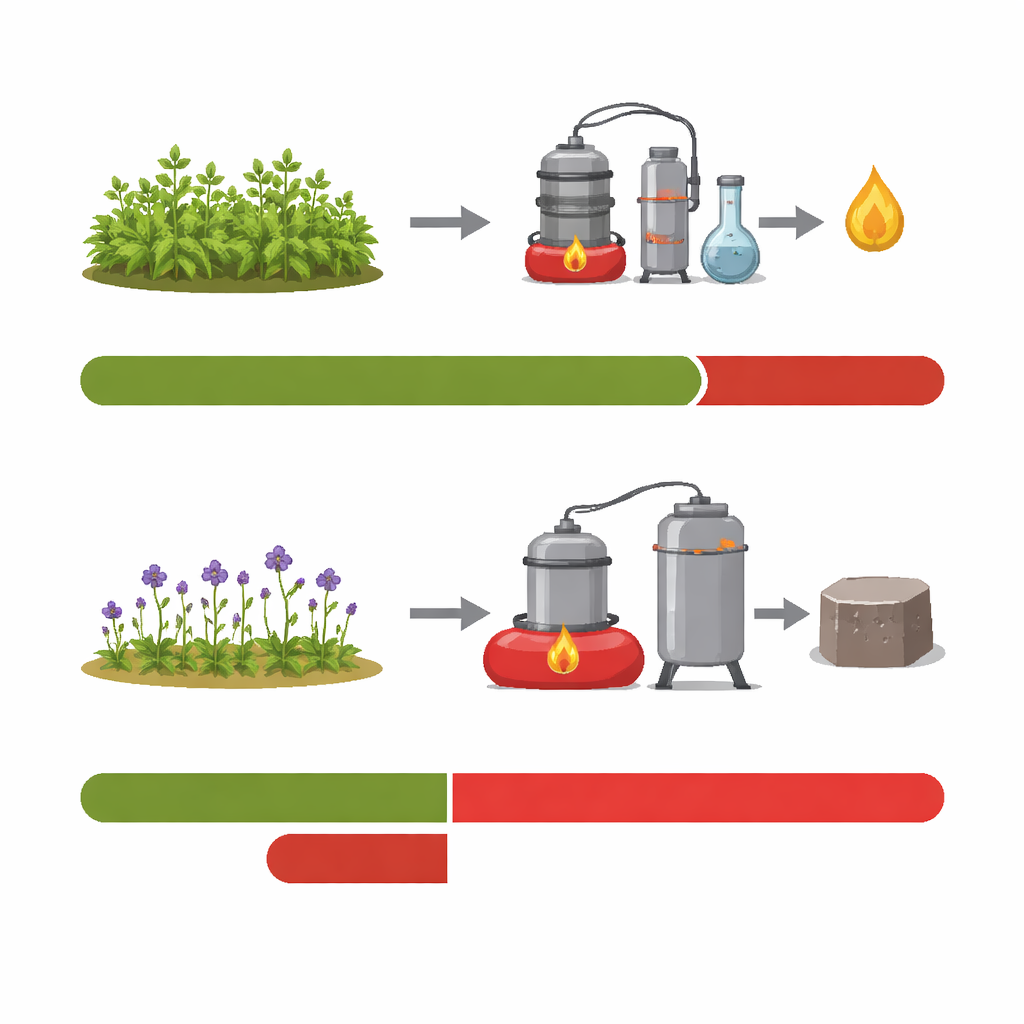
How Clean Energy Could Flip the Script
Because nearly all of violet’s climate impact comes from heating solvent during extraction, the authors tested “what if” scenarios using cleaner energy. They modeled using solar thermal systems or biogas instead of fossil fuel, at both partial and full replacement levels. Replacing just half of the fuel cut violet’s footprint by about 85 percent, while a complete switch turned it from a heavy emitter into a sizable net carbon sink. Similar upgrades, combined with more efficient irrigation and better fertilizer management, could also deepen geranium’s already favorable balance, potentially allowing farmers and processors to earn income from carbon credits as well as from oil sales.
What This Means for Everyday Products
For a non‑specialist, the key message is that not all “natural” fragrance ingredients are equally kind to the climate. Geranium, grown and processed as in this study, already offers both economic value and a small climate benefit. Violet, despite its delicate scent, currently carries a heavy carbon cost because of the way it is extracted. Yet the research also delivers good news: by pairing these crops with solar heat, biogas, and smarter water management, the same scented plants that enrich perfumes and household products could also become genuine allies in cutting greenhouse gases.
Citation: Hamed, S.A., Abo-Karima, M.K., Ali, G. et al. Medicinal and aromatic plants as climate-smart crops: case studies on Pelargonium graveolens and Viola odorata under Egyptian conditions. Sci Rep 16, 12159 (2026). https://doi.org/10.1038/s41598-026-43039-0
Keywords: essential oils, climate-smart agriculture, carbon footprint, renewable energy, Egyptian agriculture