Clear Sky Science · en
Finite element analysis of stress distributions in knee ligaments and menisci during the Taekwondo Roundhouse Kick
Why a Popular Kick Can Be Hard on the Knee
The Roundhouse kick is one of the flashiest and most frequently used techniques in Taekwondo. To fans it looks smooth and effortless, but to the athlete’s knee it can be a demanding and repetitive load. This study peered inside the joint using computer simulations to find out exactly which parts of the knee work hardest during a Roundhouse kick, and why that matters for preventing painful ligament and cartilage injuries.
Looking Inside the Athlete’s Knee
Instead of relying only on injury statistics, the researchers combined real-world motion data from elite male Taekwondo athletes with a detailed three-dimensional computer model of the knee. Twelve high-level fighters performed standardized Roundhouse kicks while cameras tracked their movements, force plates measured how hard they pushed against the ground, and muscle activity was recorded with sensors on the skin. These measurements were fed into a musculoskeletal model that estimated the overall forces passing through the knee at four key moments of the kick: lift-off, knee lift, the instant of the kick, and landing. Those joint loads were then applied to a finely detailed digital knee built from medical scans, allowing the team to map where mechanical stress concentrated in ligaments and the shock-absorbing menisci.
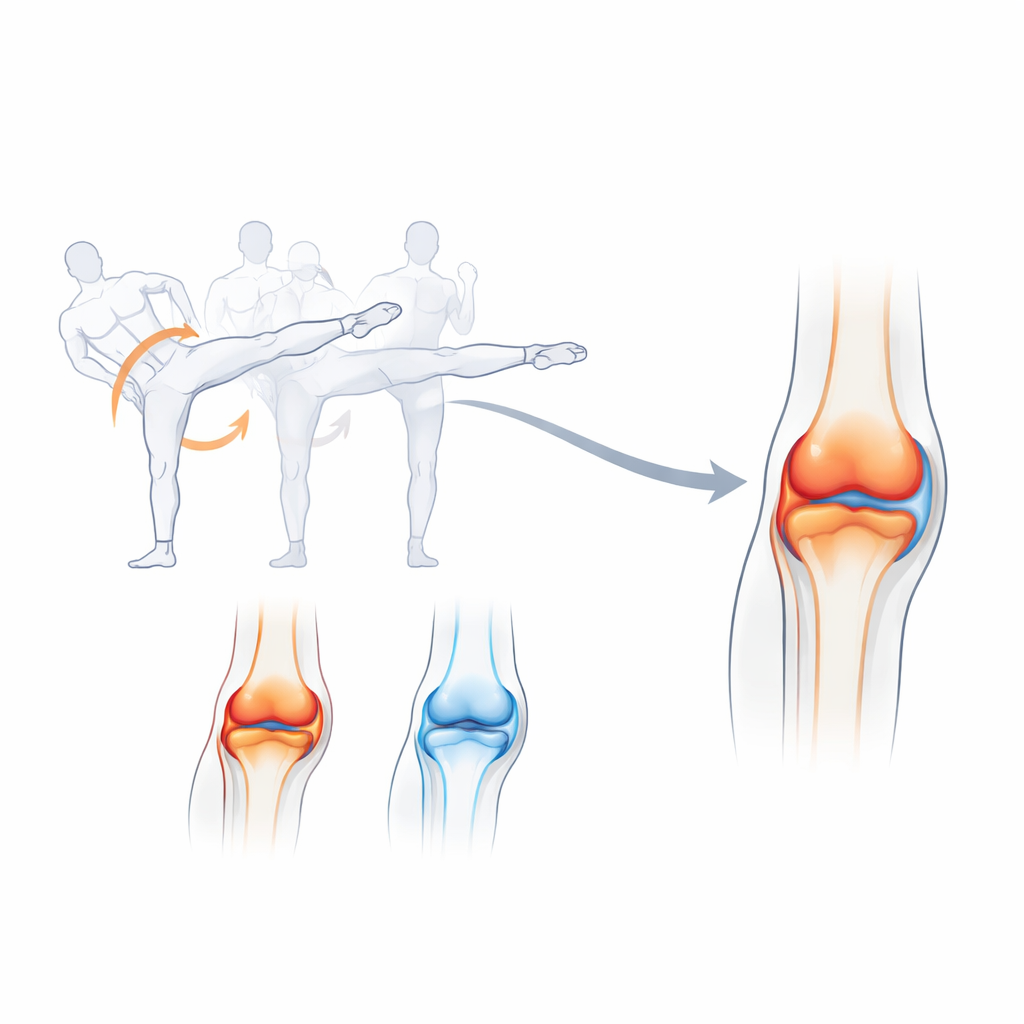
The Supporting Leg Does the Heavy Lifting
One of the clearest findings was that the leg staying on the ground, not the leg doing the kicking, bore the brunt of the mechanical demand. In the kicking leg, stresses in major stabilizing ligaments were modest and highly localized, and the menisci saw only low pressure. In contrast, the supporting knee showed much higher stress in both the front and back cruciate ligaments that control forward–backward sliding between the thigh and shin bones. These peaks appeared especially during the preparation and striking moments, when the body’s weight, trunk rotation, and rapid leg extension combine to twist and compress the supporting knee. This pattern matches broader evidence that inward bending and twisting loads are key ingredients in non-contact ligament injuries in many field and court sports.
Hidden Hotspots in the Knee’s Shock Absorbers
The stress maps also highlighted how unevenly the load was shared within the knee’s cushioning pads, the medial and lateral menisci. In the supporting leg, both menisci carried substantially higher stress than in the attacking leg, with the outer (lateral) meniscus standing out as the most heavily loaded. Hotspots clustered around the peripheral rim and the posterior horn—the same regions where tears are commonly seen in patients and cadaver studies. These areas are crucial for transferring compressive load into a ring-like pattern that protects the joint surfaces. When combined with twisting forces, as in the Roundhouse kick, repeated high stress in these zones could help explain why meniscal injuries often accompany ligament damage in combat sports.
How the Model Was Built and What It Can—and Cannot—Say
To build their virtual knee, the researchers used CT and MRI scans from one athlete whose size was close to the group average. Bones, cartilage, menisci, and major ligaments were reconstructed as three-dimensional shapes and divided into tiny elements that could be assigned material properties and loaded in a finite element analysis. The model assumed simplified, uniform tissue behavior and examined only four frozen “snapshots” of the movement rather than the continuous kick, focusing on relative patterns rather than exact real-world stress values. While these choices make the computations practical and stable, they also mean that the results should not be read as precise thresholds for injury, but as a map of where and when the knee is most mechanically challenged during the kick.
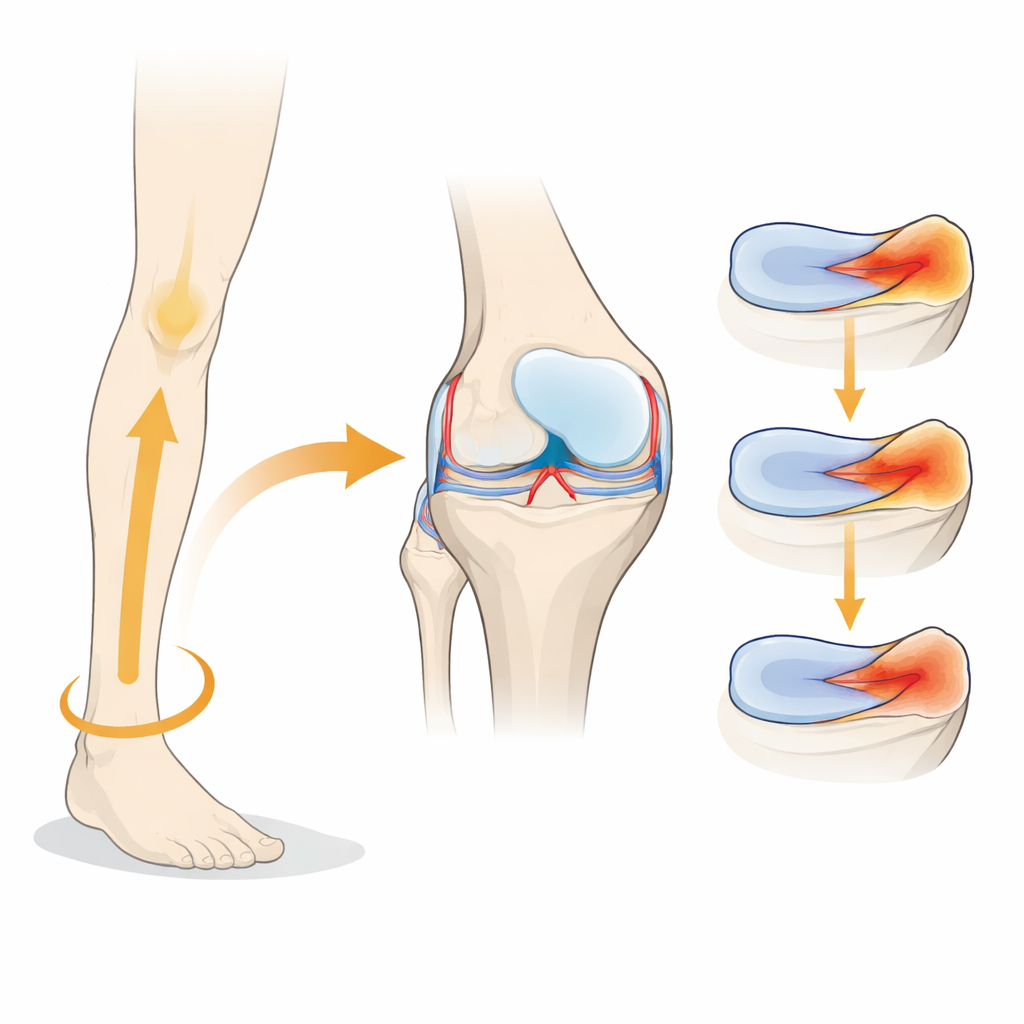
What This Means for Training and Injury Prevention
For athletes, coaches, and clinicians, the take-home message is that the quiet leg on the ground may be at greater risk than the leg that visibly strikes the target. The supporting knee repeatedly absorbs high twisting and compressive loads, concentrating stress near the attachment points of key ligaments and in the back and outer regions of the menisci. This suggests that strengthening and technique work should pay special attention to how athletes plant, rotate, and extend through the supporting leg, and that recovery and load management programs should consider cumulative stress on that joint. By showing where the Roundhouse kick taxes the knee the most, this study offers a biomechanical roadmap for designing safer training routines and targeted preventive strategies.
Citation: Jia, M., Li, D., Ma, Y. et al. Finite element analysis of stress distributions in knee ligaments and menisci during the Taekwondo Roundhouse Kick. Sci Rep 16, 13334 (2026). https://doi.org/10.1038/s41598-026-43031-8
Keywords: Taekwondo, knee injury, ligaments, meniscus, sports biomechanics