Clear Sky Science · en
Study on plastic flow of conditioned soil within pressure chamber of deeply buried EPB shields tunneling through sandy stratum
Why digging deep tunnels needs careful mud
Modern cities increasingly rely on underground rail lines bored far below busy streets. To carve out these tunnels safely, engineers use giant machines that push forward while holding back the surrounding sand and water. The material in front of the machine must flow like thick toothpaste: soft enough to be carried away, but stiff enough to keep the tunnel face from collapsing or suddenly gushing into the city above. This study asks a practical question with big safety consequences: how should that “tunnel mud” be prepared when tunnels run much deeper than usual through loose, sandy ground?
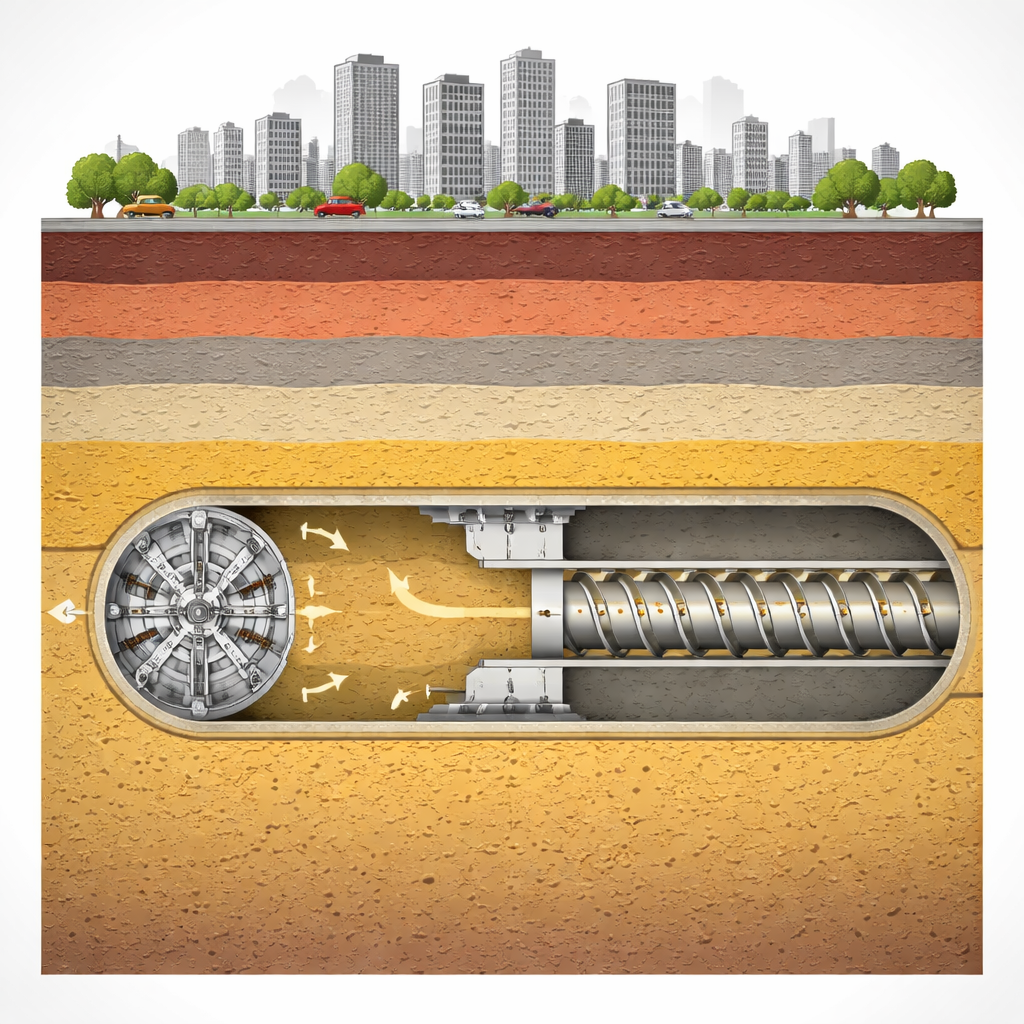
How tunnel machines lean on engineered soil
Earth pressure balance (EPB) shield machines excavate soil at the front and move it out through a screw conveyor, all while keeping a steady pressure that supports the tunnel face. In sandy ground at shallow depth, contractors often rely on experience to choose foams and slurries that turn the soil into a workable paste. A simple field test, the slump test, measures how much a cone-shaped mound of this paste collapses under its own weight. Typical guidance suggests a wide “good” range of 100–200 millimeters of slump. But for very deep tunnels in sand, such rules of thumb can fail: if the soil flows too easily, it may spew uncontrollably out of the machine; if it is too stiff, discharge slows down and the tunnel can clog.
Turning slump into a measurable flow rule
The authors recast this rule-of-thumb problem using concepts from fluid mechanics. They treat the conditioned soil as a Bingham fluid, a material that does not start to move until a certain stress is exceeded, after which it flows like a very thick liquid. Under this assumption they build a simplified mechanical model of the slump test, linking the observed collapse height directly to the soil’s “yield stress”—the stress needed to make it start flowing. Laboratory measurements with a viscometer confirm that, when sand is mixed with foam and bentonite, the resulting soil paste roughly follows this behavior at practical flow rates, and the model’s predicted slumps match the measured ones well when the soil is reasonably soft.
Making stiff soil flow with special additives
At the great depths of interest, however, engineers often need soil that hardly slumps at all, yet still behaves as a coherent, slow-moving plug in the screw conveyor. Foam and bentonite alone could not provide this combination: low-slump samples became dry and cracked, losing the needed plasticity. The team therefore tested a different recipe, adding a long-chain polymer called polyacrylamide (PAM) together with very fine particles. These additives form a microscopic three-dimensional network that bridges grains of sand while filling the gaps between them. Electron microscope images show a dense, web-like structure in the treated soil. In the lab, these mixes remained toothpaste-like even at much lower slump values, and their flow again matched the Bingham-style model, giving the researchers reliable yield stress and viscosity numbers across a wide range of stiffness.
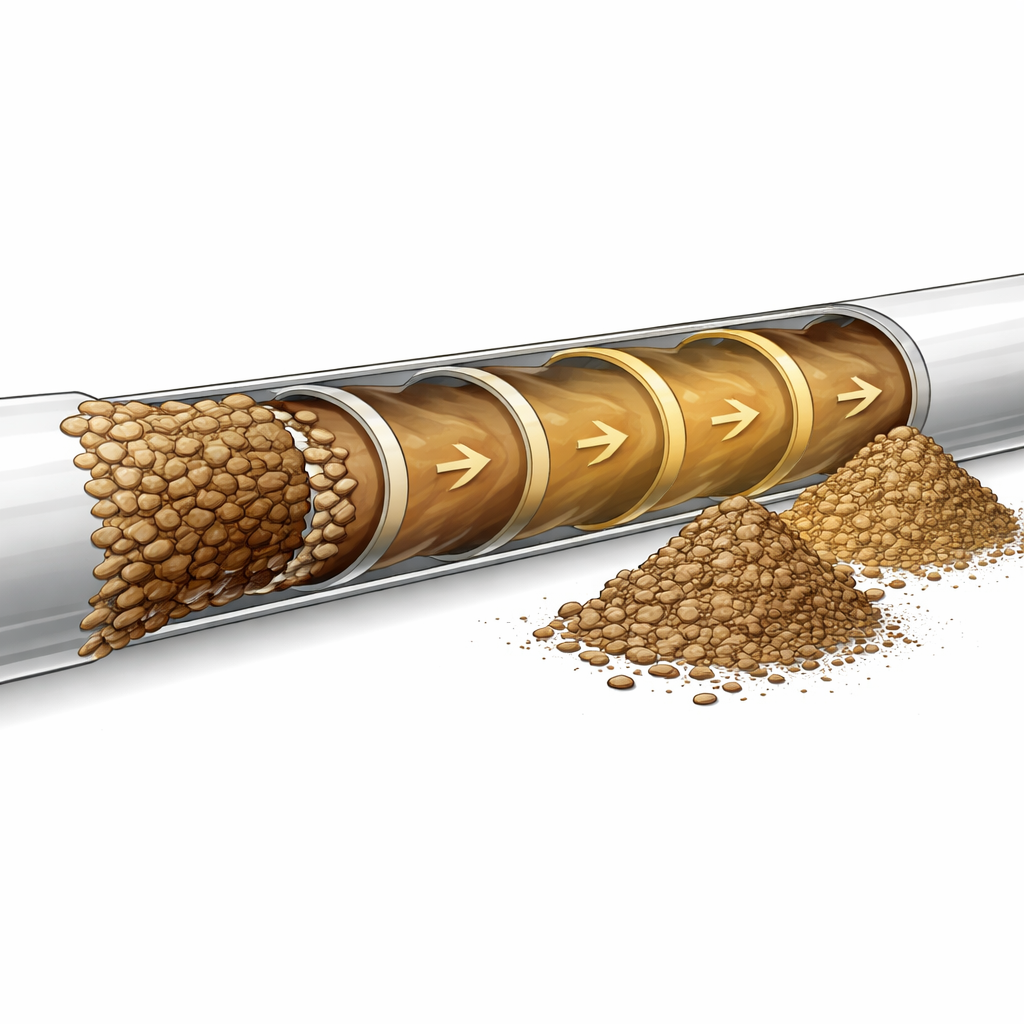
How depth and pressure reshape the ideal mud
With these measurements in hand, the authors next examined how soil should behave inside the screw conveyor when only pressure, not mechanical rotation, drives it forward. They derived a mathematical expression for how much Bingham-like soil would pass through an idealized tube under a given pressure difference, then checked this against detailed computer simulations of a real screw conveyor. The simplified model reproduced the main trend: discharge rises with chamber pressure, and falls as yield stress or viscosity increase. Using data from a real metro project in Guangzhou, where an 8.8-meter-diameter EPB shield tunneled about 30 meters below ground through sandy layers, they inverted this model to estimate the in-chamber properties of the muck that actually produced safe, balanced operation. This analysis showed that as the tunnel depth and pressure increase, the soil must become progressively stronger (higher yield stress) and therefore less slumpy to prevent uncontrolled flow.
Practical guide for deeper and safer tunneling
Finally, the authors converted these rheological targets into simple slump recommendations for different burial depths of similar EPB shields in sandy ground. For a tunnel crown 20 meters deep, they suggest a relatively soft soil with a slump around 177 millimeters. At 30 meters depth, the ideal slump tightens to about 94 millimeters, close to field experience on the Guangzhou line. By 40 and 50 meters depth, the safest mix is predicted to be very stiff, with slumps of roughly 60 and 28 millimeters, respectively. In other words, as tunnels go deeper, the “toothpaste” must become more like firm clay to maintain a stable, non-spewing earth plug, and additives like PAM and fine particles are essential to keep such stiff soil flowing in a controlled way. This work turns a largely empirical craft into a quantitative framework, giving tunnel designers a clearer safety envelope for soil conditioning in deep, sandy urban ground.
Citation: Zhong, X., Huang, S., Wang, H. et al. Study on plastic flow of conditioned soil within pressure chamber of deeply buried EPB shields tunneling through sandy stratum. Sci Rep 16, 12958 (2026). https://doi.org/10.1038/s41598-026-43016-7
Keywords: EPB shield tunneling, soil conditioning, tunnel face stability, Bingham fluid, polymer-modified soil