Clear Sky Science · en
Failure assessment and evaluation of locomotive coil spring suspension system
Why Tough Train Springs Still Break
Modern freight trains are engineering workhorses, carrying huge loads day and night. At the heart of each locomotive are sturdy metal coil springs that help smooth the ride, protect the tracks, and keep the train safely on the rails. Yet engineers have been puzzled by repeated breakages of these springs in a widely used Indian freight locomotive, the WAG‑9, sometimes long before their expected service life. This study digs into that mystery, combining lab tests, digital simulations, and real‑world vibration measurements to uncover why certain springs fail and how their design can be improved.
How Train Springs Carry the Load
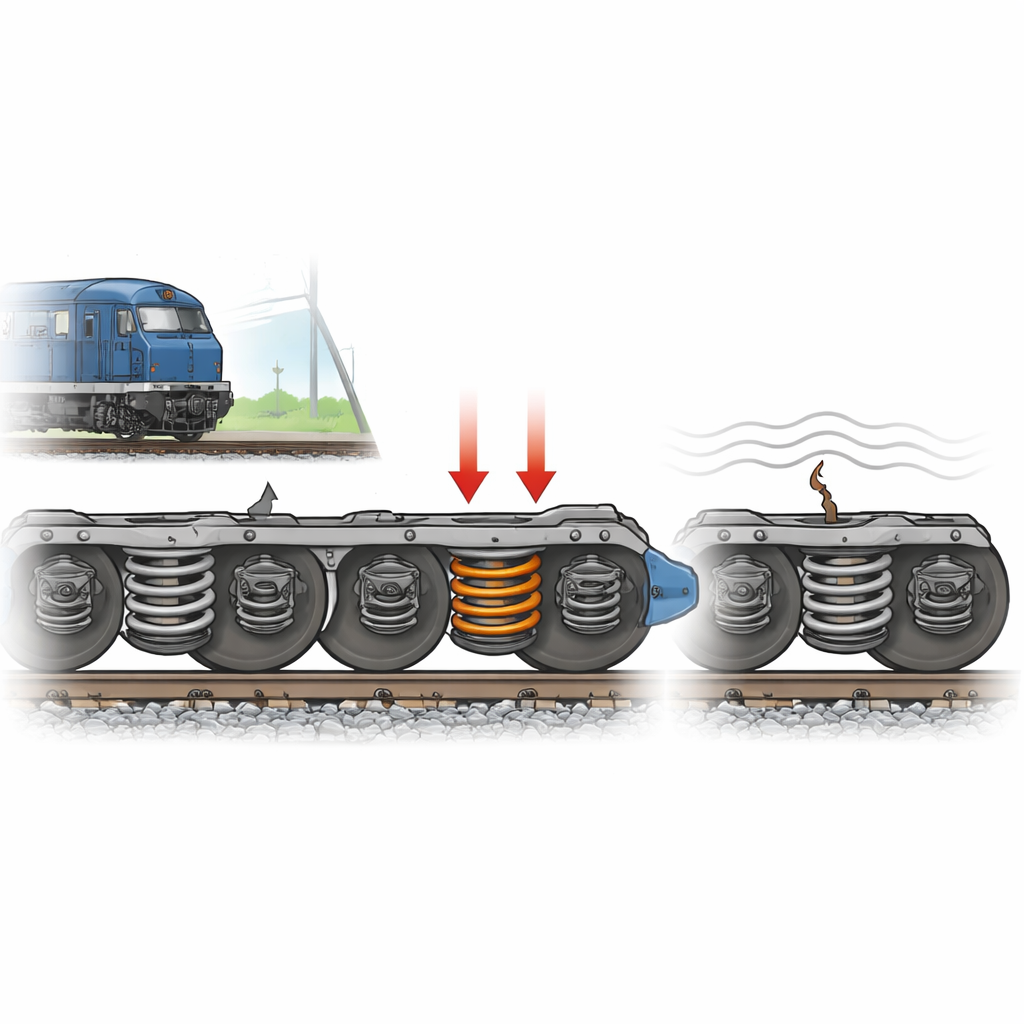
A locomotive bogie—the wheeled frame under the train—uses several coil springs to support the enormous weight of the vehicle and its cargo. On the WAG‑9, each bogie has three axles, and each axle carries inner and outer coil springs that cushion shocks from straight and curved track and from starting and braking forces. The middle axle’s inner spring, in particular, sits in a cramped space and takes a complex mix of vertical and sideways loads as the train passes over uneven rails and rounds bends. When these springs crack or break, the bogie can vibrate more, other parts wear faster, and in extreme cases safety margins shrink.
Checking the Metal Before Blaming the Material
The first step was to ask a simple question: were the springs made of bad steel? The team collected failed springs from locomotives in service and tested their chemical makeup. All were made from a high‑strength spring steel called 50Si2Mn, a common choice in rail and automotive suspensions because it combines elasticity, toughness, and resistance to repeated loading. Spectrometric tests showed that the amounts of carbon, silicon, manganese, and other elements were well within the specified limits. That meant the failures were not caused by the wrong alloy, pointing instead to how the springs were loaded in service and to subtle defects on or just below the surface.
Simulating the Beating Springs Take on the Track
To understand those loads, the researchers built detailed computer models of the suspension using the finite element method. They calculated how much each spring compresses and twists when the locomotive rolls on straight track, rounds a curve, and pulls hard during acceleration. The static—slowly varying—stresses turned out to be safely below the steel’s strength, so simple overloading was not enough to explain breakage. The picture changed when they added dynamic effects: vibrations from track irregularities, the sideways push on curves, and the tug of tractive effort at startup. Under these realistic, constantly changing forces, the middle axle’s inner spring showed very high local stresses at its inner coils and a much shorter predicted fatigue life—on the order of tens of thousands of cycles instead of millions. 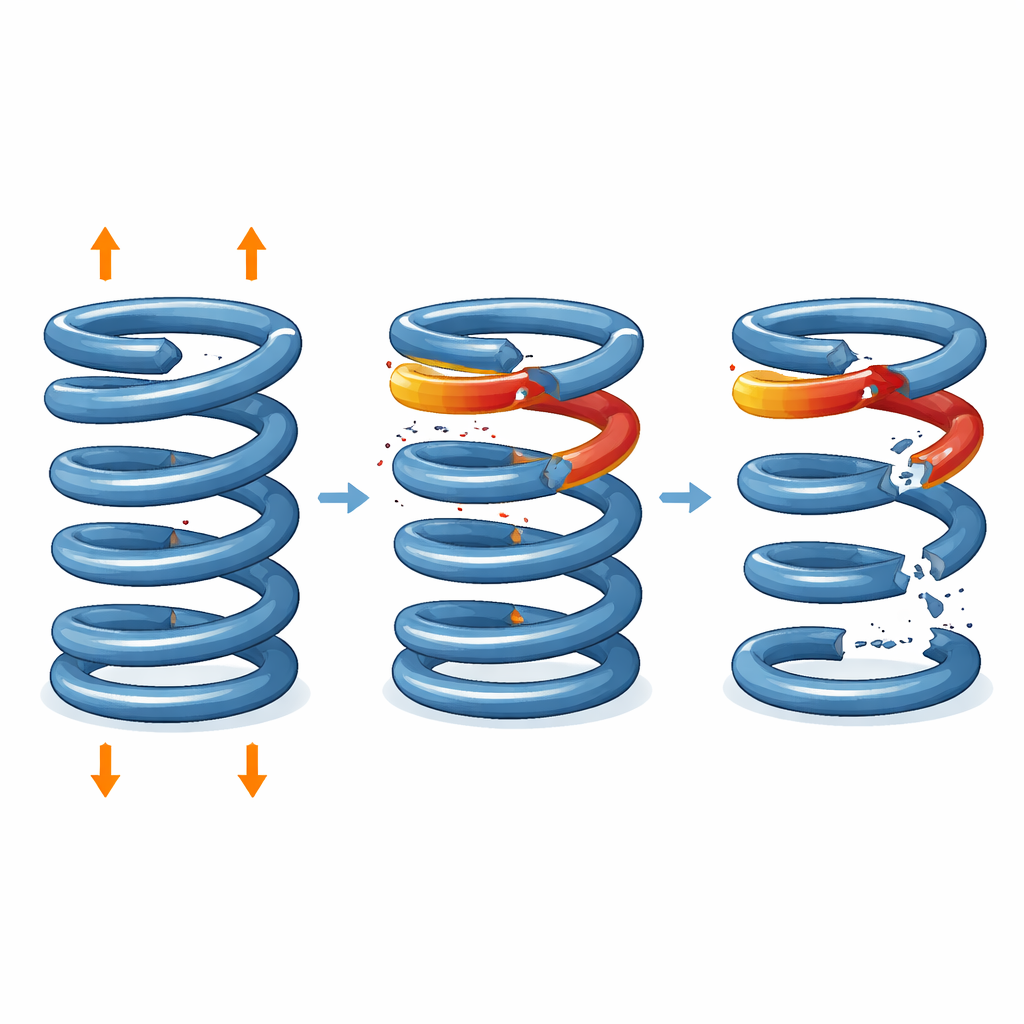
Looking Closely at Cracks and Hidden Flaws
The team then examined broken spring pieces under optical and scanning electron microscopes. The fracture surfaces told a story of slow, repeated damage rather than sudden overload. Cracks typically started at tiny pits and holes on the surface where the protective coating had failed, allowing rust to take hold. These pits acted like miniature notches that concentrated stress each time the spring flexed. The crack faces showed features typical of torsional fatigue—the twisting caused by combined vertical and sideways motion of the coils. In some samples, manufacturing‑related surface imperfections and embedded scale were large enough to serve as ready‑made starting points for cracks, even though the bulk material itself was sound.
From Findings to a Safer, Longer‑Lasting Ride
By matching microscopic evidence, track‑style vibration tests, and computer simulations, the study concludes that early spring failures are driven mainly by dynamic loading and surface flaws, not by weak steel or simple overloading. The middle axle’s inner spring is especially vulnerable because of its geometry and the way it is squeezed and twisted as the locomotive negotiates real‑world track. The authors suggest extending spring life by refining the coil shape, improving surface finish and coatings, tightening quality checks for defects, and tuning the suspension so its natural vibration frequencies do not line up with common track excitations. In everyday terms, their work explains why a part that looks overbuilt on paper can still crack on the rails—and shows how smarter design can give heavy freight trains a smoother, safer, and more reliable ride.
Citation: Shanmugam, T., Chandran, S., Janakiraman, R. et al. Failure assessment and evaluation of locomotive coil spring suspension system. Sci Rep 16, 14071 (2026). https://doi.org/10.1038/s41598-026-42996-w
Keywords: locomotive suspension, coil spring fatigue, railway vibration, bogie dynamics, failure analysis