Clear Sky Science · en
A randomized controlled trial of seated Baduanjin and elastic band training on sleep and psychological needs in older wheelchair users
Why this matters for everyday life
Many people assume that once an older adult relies on a wheelchair, options for feeling better—sleeping well, staying positive, and feeling in control—are very limited. This study challenges that idea. It shows that a simple, chair-based exercise routine combining a traditional mind–body practice with light resistance bands can measurably improve sleep and emotional well-being for seniors in nursing homes who use wheelchairs.
Sleep troubles and hidden emotional needs
Sleep problems such as difficulty falling asleep, staying asleep, or feeling rested in the morning are very common among older adults. For people living in nursing homes and depending on wheelchairs, these issues are often made worse by long hours of sitting, fewer chances to move, and limited social contact. Beyond sleep, many of these residents quietly struggle with feeling capable, feeling in control of their own lives, and feeling close to others. Psychologists call these basic psychological needs: the need to feel competent, autonomous, and connected. When these needs are not met, mood, health, and sleep often deteriorate together.
Turning ancient movement into a seated routine
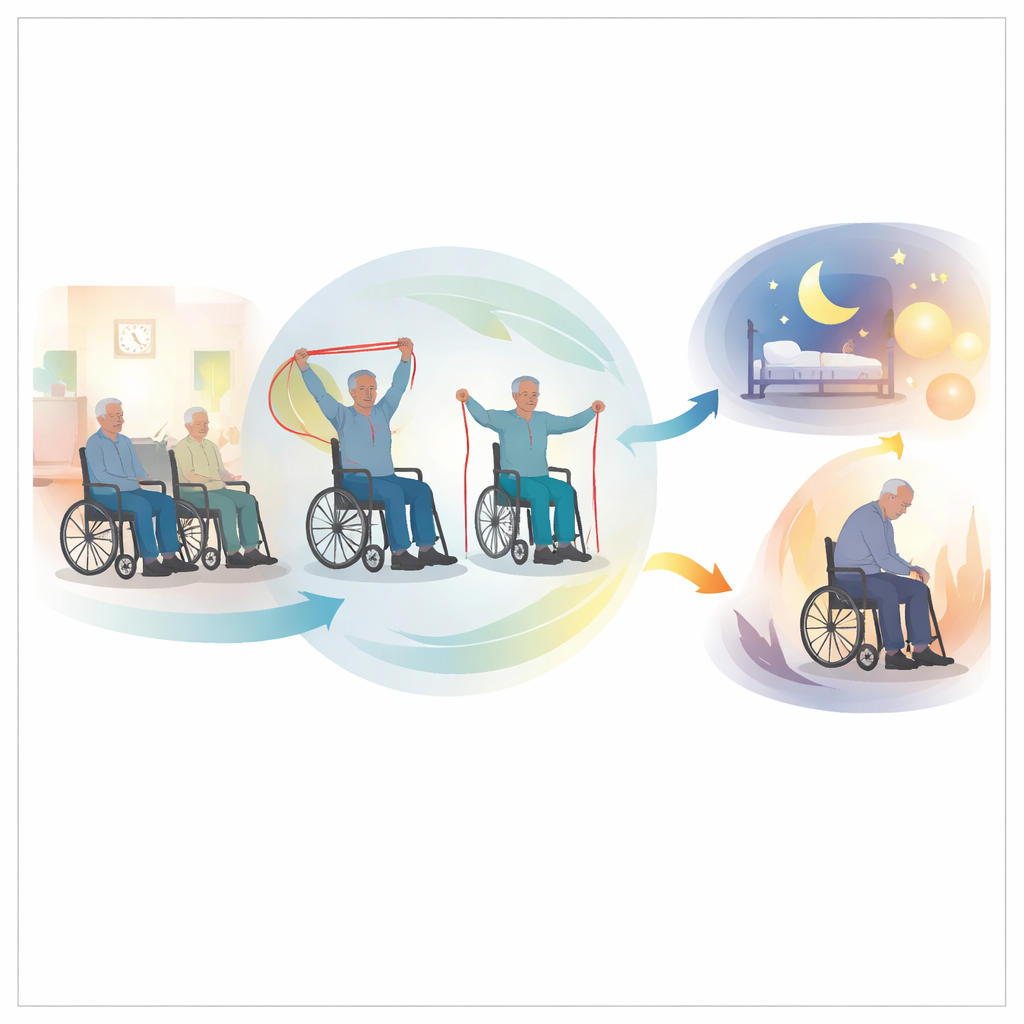
Baduanjin is a gentle traditional Chinese exercise made up of slow, coordinated movements and breathing, usually practiced standing. The researchers redesigned it so that older adults who could not stand safely could do all the movements while seated. They paired this with elastic band training that focuses on arm, shoulder, and core strength. The idea was to create a routine that is safe, simple, and realistic for frail residents, yet still challenging enough to build strength and offer a sense of mastery. The program was delivered three times a week for 12 weeks in 40-minute sessions that included warm-up, seated Baduanjin, resistance band exercises, and cool-down.
How the study was carried out
Forty wheelchair-using residents from two nursing homes in China joined the trial; 34 completed it. They were randomly assigned to either an exercise group or a comparison group. The exercise group took part in the combined seated Baduanjin and elastic band sessions, while the comparison group continued their usual daily routines without added exercise. Before and after the 12 weeks, all participants were interviewed using two standard questionnaires: one measuring sleep quality over the past month, and another measuring how well their basic psychological needs were being met. By comparing changes over time in the two groups, the researchers could see whether the exercise program made a meaningful difference beyond normal day-to-day variation.
What changed for sleep and emotional well-being
After three months, the differences between groups were striking. On average, people in the exercise group reported better sleep, including fewer problems with feeling sleepy and unfocused during the day. Their overall sleep scores improved by about three points, a shift that sleep experts consider clinically meaningful, while scores in the comparison group actually worsened. Even more pronounced were the changes in psychological needs. Those who did the exercises felt more competent, more in control of their own actions, and more connected to others, with relatively large improvements across all three areas. In contrast, residents who did not participate in the program showed gradual declines on the same measures, suggesting that simply continuing life as usual in the nursing home was not enough to preserve emotional well-being.
Why this simple program may work
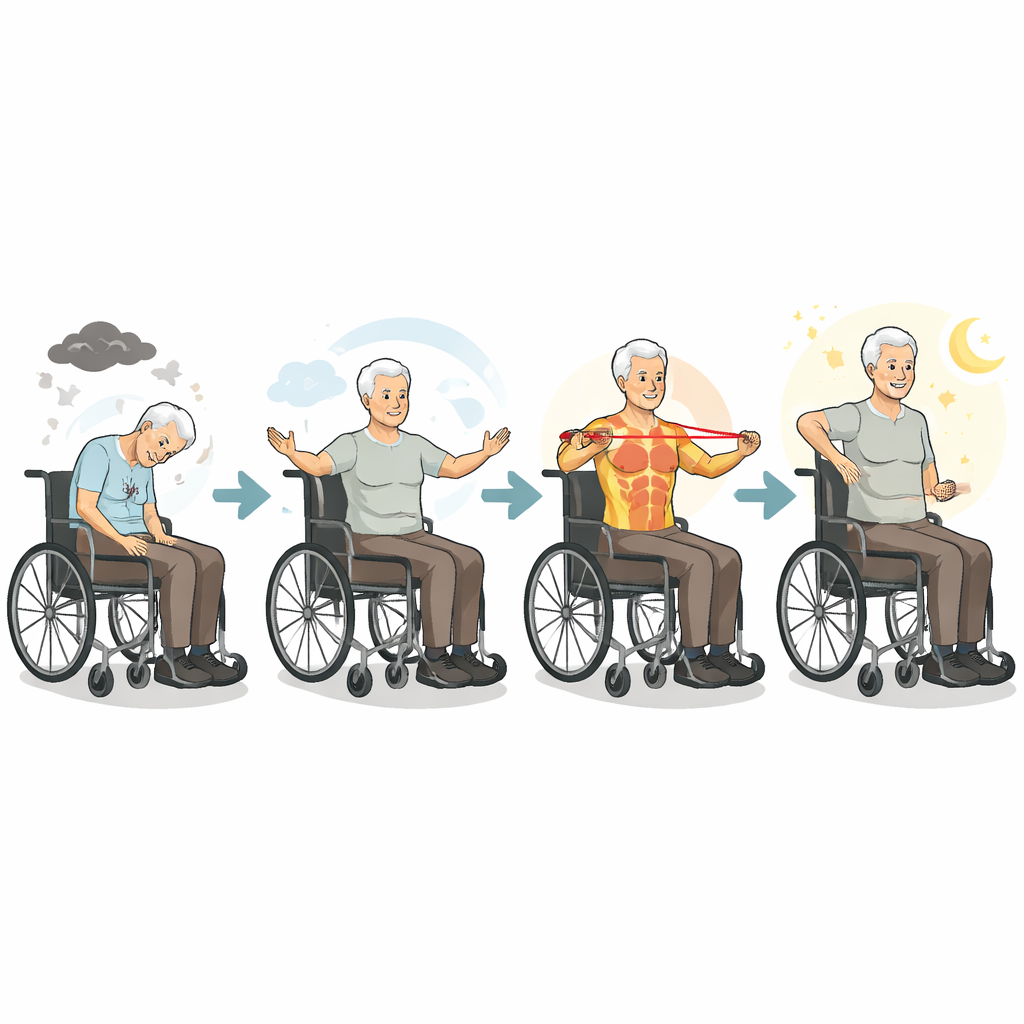
The authors suggest that the program helps through both body and mind. The resistance band work strengthens the upper body and trunk, making everyday tasks like pushing a wheelchair or reaching for objects easier, which can reduce nighttime discomfort and pain. The slow, rhythmic Baduanjin movements and breathing may calm the nervous system and lower stress hormones, making it easier to relax and fall asleep. At the same time, learning and remembering the routine builds confidence, choosing to attend sessions supports a sense of autonomy, and moving together in a small group fosters social bonds. All of these elements feed into basic psychological needs, which are themselves closely tied to sleep quality.
Take-home message and next steps
This trial suggests that a well-designed, chair-based exercise routine can do more than pass the time for older wheelchair users: it can help them sleep better and feel more capable, more in control, and more connected. While the study was relatively small and relied on self-reports, it offers promising early evidence that combining gentle mind–body movements with simple resistance band training is a practical, low-cost way to support both physical rest and emotional needs in a vulnerable population. Larger and longer studies are needed, but for families, caregivers, and facilities searching for accessible activities, this kind of program may be a powerful addition to daily care.
Citation: Pan, Z., Li, H., Sun, X. et al. A randomized controlled trial of seated Baduanjin and elastic band training on sleep and psychological needs in older wheelchair users. Sci Rep 16, 13212 (2026). https://doi.org/10.1038/s41598-026-42965-3
Keywords: wheelchair seniors, seated exercise, sleep quality, emotional well-being, Baduanjin