Clear Sky Science · en
Bond of ribbed and threaded steel reinforcement bars post-installed in concrete considering bonded length and adhesive type
Fixing Tired Concrete Without Tearing It Down
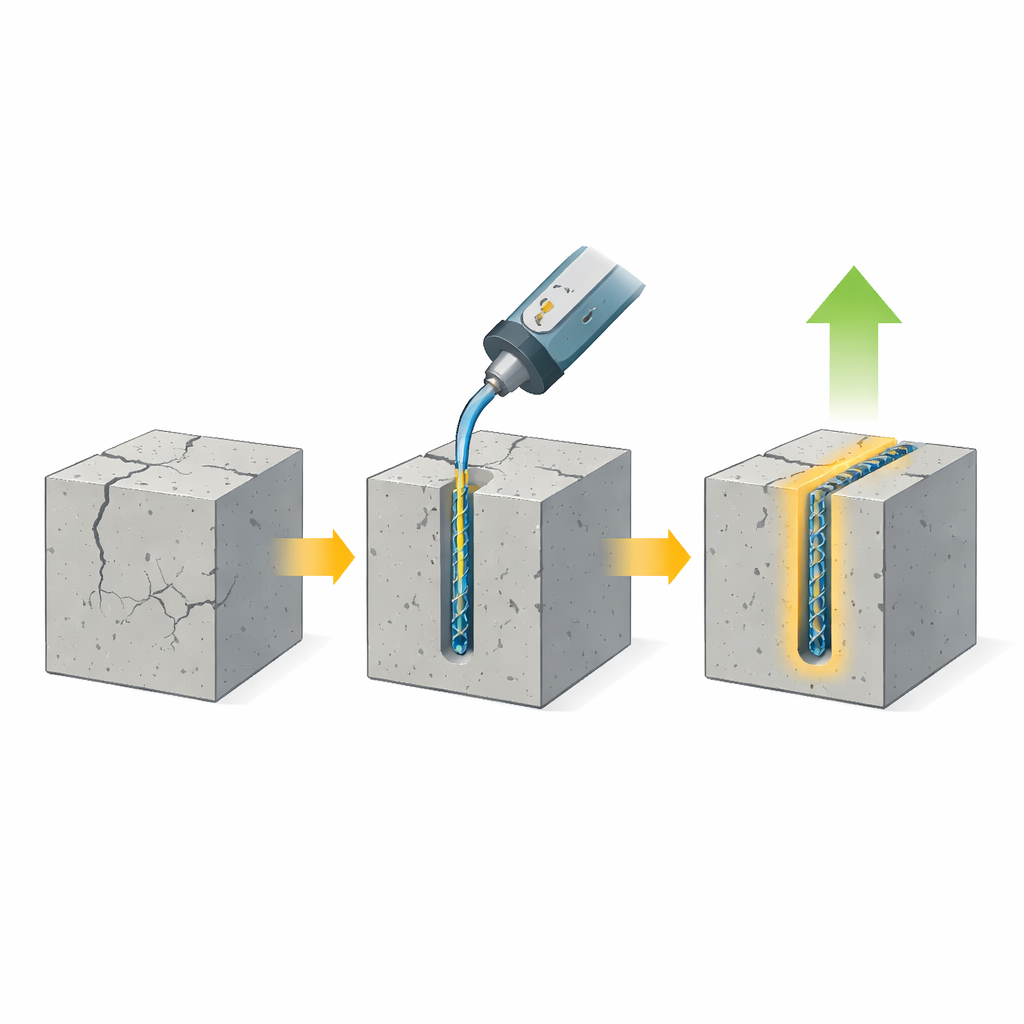
Across the world, many bridges, buildings and parking garages are aging faster than we can replace them. Completely demolishing and rebuilding these structures is expensive and disruptive, so engineers look for ways to strengthen what already exists. This study explores one such repair method: drilling holes into hardened concrete, gluing in new steel bars with powerful epoxy, and using these “post-installed” bars to give old concrete a new lease on life.
How Steel and Glue Team Up Inside Concrete
Reinforced concrete works because steel bars hidden inside the concrete grab onto the surrounding material and share the loads. Traditionally those bars are placed in the formwork and concrete is poured around them. In repair jobs, however, the concrete is already hard, so workers must drill holes, inject a chemical adhesive, and insert new steel bars as anchors. The safety of the upgraded structure depends on how firmly these added bars are “bonded” to the concrete and adhesive, and how much they slip when pulled. The researchers set out to measure that bond in a controlled way and to see how different bar shapes, hole sizes and glues affect performance.
Testing Pull-Out Strength in the Laboratory
To mimic real repair situations, the team cast twenty-one concrete cubes, each about the size of a small paving stone. In three of them, ribbed reinforcing bars were embedded the traditional way during casting to serve as reference samples. In the other eighteen, the bars were added later: vertical holes were drilled, cleaned, filled with one of two commercial epoxy products, and then ribbed or fully threaded bars were inserted to specific depths. The researchers varied three key factors: the length of bar in contact with the adhesive, the diameter of the drilled hole relative to the bar, and whether the bar surface was ribbed (with discontinuous ridges) or threaded (with a continuous spiral). Each specimen was then gripped by a hydraulic jack and the bar was slowly pulled out while instruments recorded force and slip.
What Makes a Strong, Safe Anchor
The tests showed that, in almost all cases, failure happened by the steel bar reaching its yield strength within a classic pull-out scenario, rather than by the concrete splitting apart. That means the glue joint and surrounding concrete were generally stronger than the bar itself, a desirable outcome for design. Bars installed with epoxy in holes moderately larger than the bar (about 60 to 80 percent bigger in diameter) achieved pull-out capacities similar to or slightly higher than the cast-in-place bars. Very tight holes, only about 20 percent larger, reduced strength. Longer bonded lengths allowed the bar to carry more total load but spread that load out, which lowered the average bonding stress along the bar. Comparing bar shapes, conventional ribbed bars consistently developed higher bond strength than threaded bars, mainly because their rougher ribs provided better mechanical grip on the adhesive and concrete.
How Stiffness and Flexibility Work Together
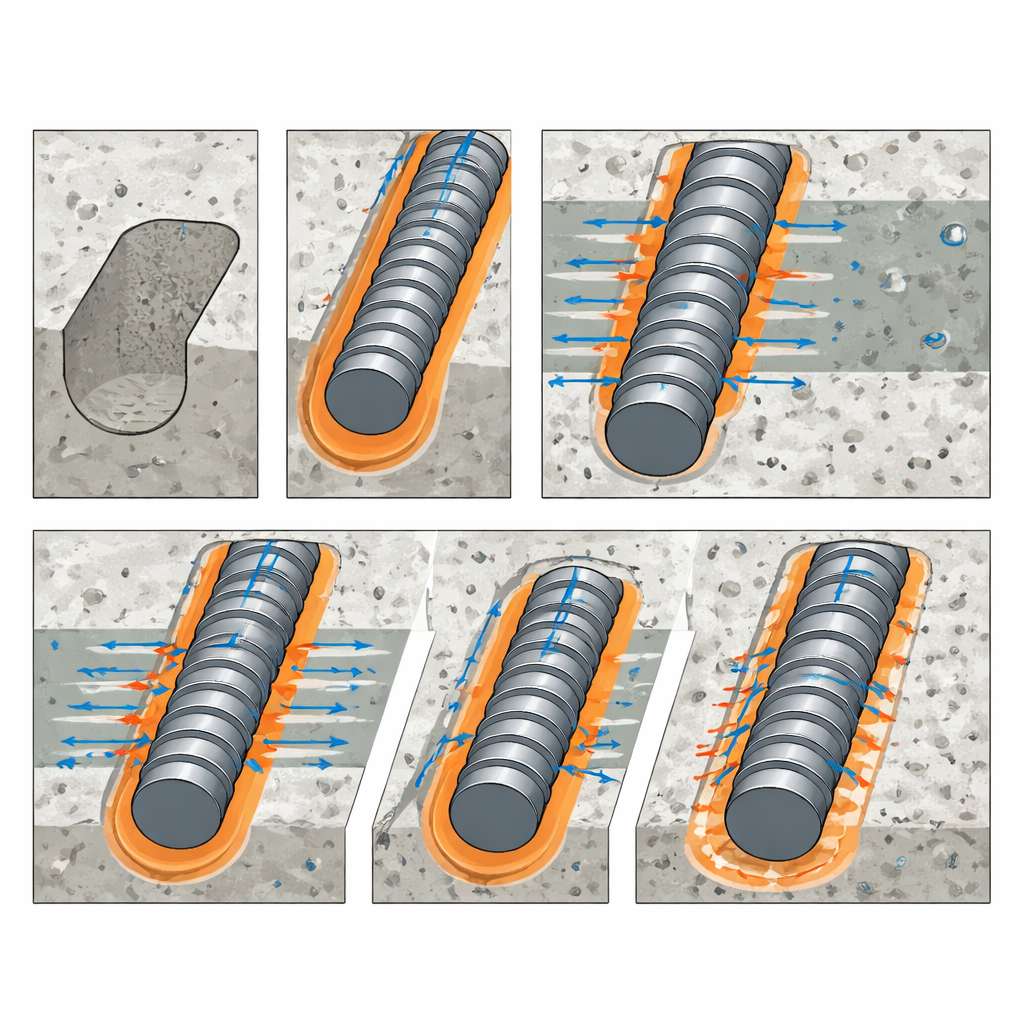
Beyond peak strength, the study also examined how stiff or flexible the connection was as the bar started to move. Epoxy-bonded anchors were generally stiffer than cast-in-place bars at the start of loading, meaning they resisted initial slip more strongly. Yet for many configurations, especially with longer bonded lengths, the post-installed bars showed greater “ductility”: they could slip significantly after yielding without sudden loss of capacity. The two epoxy types behaved similarly in terms of strength, though one tended to produce slightly stiffer, less flexible connections and the other allowed more slip before failure. Threaded bars, while weaker in peak bond, often showed larger slips at high load, indicating a more gradual and forgiving failure process.
Turning Test Data Into Practical Design Rules
Using the full set of measurements, the authors developed a simple equation that predicts the maximum bond stress for post-installed bars based on concrete strength, bar diameter, bonded length, hole size and the geometry of the bar ribs. This formula, checked against all test results, produced safe and reasonably accurate estimates. For engineers, this means that adding steel bars with modern adhesives can be designed with confidence, provided that hole diameters, embedment lengths and bar types are chosen wisely. For the public, the takeaway is that careful laboratory work like this underpins many “invisible” repairs, allowing aging concrete structures to be strengthened and kept in service longer without the cost and disruption of full replacement.
Citation: Fayed, S., Alkharisi, M.K., Bayoumi, ES.A. et al. Bond of ribbed and threaded steel reinforcement bars post-installed in concrete considering bonded length and adhesive type. Sci Rep 16, 10762 (2026). https://doi.org/10.1038/s41598-026-42964-4
Keywords: post-installed anchors, epoxy-bonded rebar, reinforced concrete repair, bond strength, structural retrofitting