Clear Sky Science · en
Impact of over compressing gas diffusion electrodes in alkaline zero-gap CO2 electrolyzers
Why squeezing clean-energy devices matters
Turning carbon dioxide (CO2) into useful fuels and chemicals using electricity could help cut greenhouse gas emissions, especially if that electricity comes from renewable sources. Many of the most promising CO2-to-fuel devices are built like sandwiches, with thin, porous layers that must be clamped tightly together. This study shows that squeezing one of those layers—the gas diffusion electrode in an alkaline CO2 electrolyzer—too hard can backfire, blocking gas pathways, encouraging flooding and salt buildup, and ultimately hurting efficiency and stability. Finding the “just right” level of compression turns out to be a simple but powerful lever for improving performance.
How these devices turn CO2 into fuel
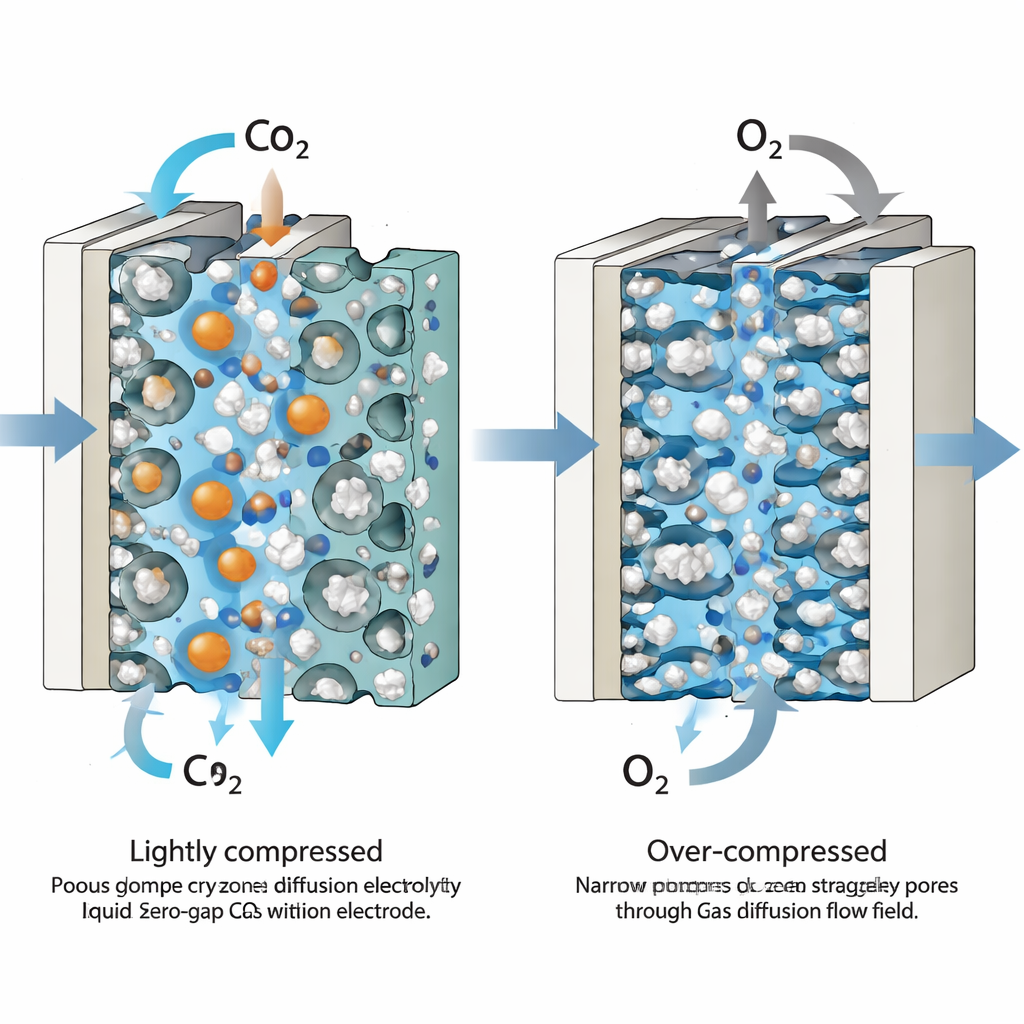
The work focuses on alkaline zero-gap CO2 electrolyzers, a type of device where humidified CO2 gas enters one side (the cathode) and a liquid solution flows on the other side (the anode). Between them sits a thin membrane and two porous gas diffusion electrodes that bring gases, liquids, and electrons together at catalyst sites. At the cathode, CO2 is converted mainly into carbon monoxide (CO), a useful building block for fuels and chemicals, while hydrogen gas (H2) is an unwanted side product. For the device to run efficiently, CO2 gas must reach the catalyst, the liquid must not flood the pores, and salt crystals should not grow inside the electrode. Mechanical compression—how tightly the stack is clamped—directly changes the thickness and porosity of this porous layer, and thus all of these transport processes.
When tight clamping causes hidden blockages
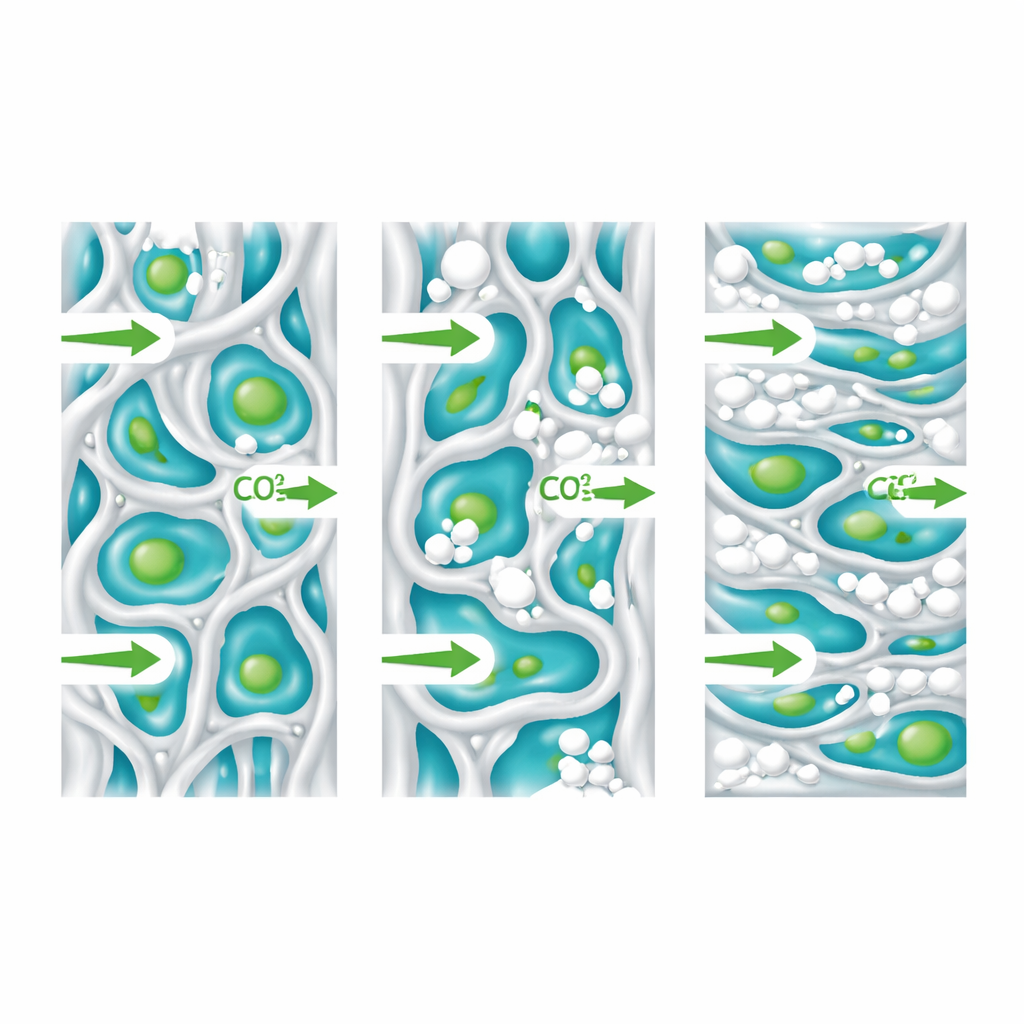
The researchers compared three compression levels of the cathode gas diffusion electrode: 10%, 20%, and 30% reduction in thickness. Using high-speed X-ray imaging at a synchrotron, they watched in real time how liquid from the anode side, condensed water, and solid salt precipitates distributed inside the cathode. At the highest compression, 30%, the pores in the electrode became more tortuous and less open. X-ray absorbance data showed that more liquid and concentrated salt accumulated particularly near the catalyst region and at the interface where gas first enters the porous layer. This created local pockets of trapped liquid and salt that blocked CO2 flow, a kind of microscopic traffic jam that grew worse over time.
Measuring performance losses from the inside out
To connect these internal changes to real-world performance, the team ran the electrolyzer at an industrially relevant current density while tracking cell voltage, resistance components, and product distribution. At 30% compression, the cell voltage fluctuated strongly, consistent with unstable two-phase flow where gas is intermittently choked off by liquid. Electrochemical impedance measurements revealed that mass transport resistance—how hard it is for reactants to reach reaction sites—was more than seven times higher at 30% compression than at 10% by the end of the test. This increase was linked to salt buildup rather than problems at the anode, which showed almost no change in liquid distribution. In contrast, ohmic resistance, related to simple electrical conduction, changed little with compression, indicating that over-squeezing mainly harms gas–liquid transport rather than basic conductivity.
Finding the sweet spot for fuel production
The team also measured how selectively the device produced CO instead of H2 over a 90‑minute run. Initially, highly compressed electrodes showed somewhat higher CO output, likely because shorter diffusion distances briefly favored CO2 access. But as liquid and salt accumulated in the constricted pores, CO production dropped sharply, while H2 production rose and then stabilized, signaling that CO2 was increasingly blocked while water still reached the catalyst. The lightly compressed case (10%) started with a lower CO fraction but maintained it far more steadily, ending with the highest average CO efficiency and smaller performance decay. This indicates that a more open, less tortuous pore structure better balances gas access, liquid presence, and salt management over time.
What this means for cleaner CO2 conversion
In practical terms, this study shows that “more pressure” is not always better when assembling CO2 electrolyzers. A moderate compression level of about 10% was sufficient to maintain good contact between layers while preserving open pathways for CO2 gas and limiting liquid and salt entrapment. Over-compressing the gas diffusion electrode squeezed out the very channels the device relies on to breathe, leading to unstable voltages, higher transport losses, and faster loss of CO-selective performance. By carefully tuning mechanical compression—a low-cost design parameter—engineers can extend device lifetime, stabilize operation at high current, and move CO2 electrolysis closer to viable industrial deployment.
Citation: Farsi, A., Batta, V., Tugirumubano, A. et al. Impact of over compressing gas diffusion electrodes in alkaline zero-gap CO2 electrolyzers. Sci Rep 16, 12443 (2026). https://doi.org/10.1038/s41598-026-42959-1
Keywords: CO2 electrolysis, gas diffusion electrode, mechanical compression, mass transport, electrochemical conversion