Clear Sky Science · en
Investigation of TID-induced capacitance variation in GaAs edge-lift capacitors and its effect on RF impedance matching
Why space radiation matters for tiny radio parts
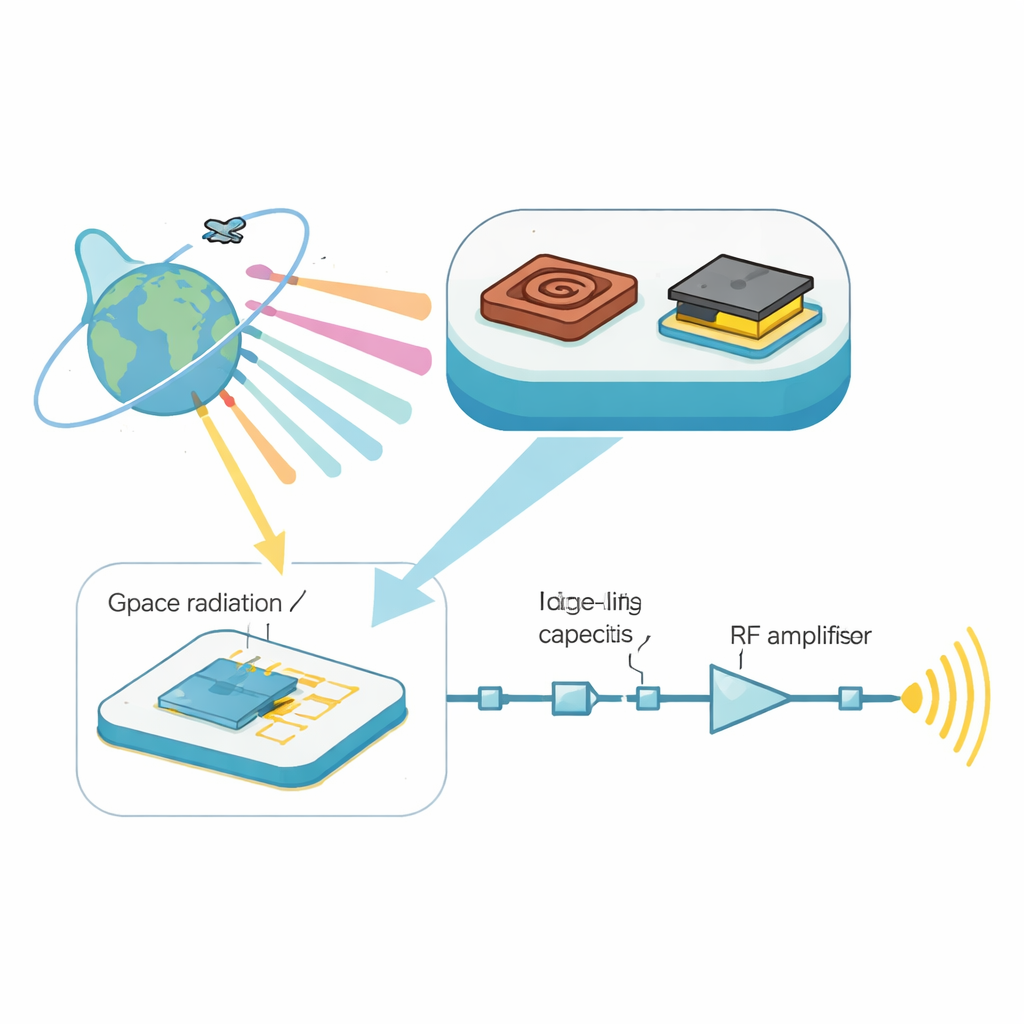
Satellites and space probes rely on exquisitely tuned radio circuits to talk to Earth, often for years at a time. During that long journey, their electronics steadily absorb invisible energy from space radiation. Most attention has focused on how this affects active parts like transistors, but this study shows that some humble passive parts—specifically a special kind of on‑chip capacitor—can quietly drift far from their intended values. That slow drift can knock critical radio circuits out of tune, reducing how clearly spacecraft can send and receive signals.
A closer look at a small but sensitive capacitor
The researchers examined passive components made in a popular technology for high‑frequency chips called GaAs MMICs, widely used in satellite radios. They paid particular attention to a structure known as an edge‑lift capacitor, where the upper metal plate is partly raised above the surface so that much of the electric field “leaks” into the surrounding insulating material instead of staying tightly confined between two flat plates. Because of this geometry, the capacitor’s behavior depends strongly on the properties of the nearby insulating film, mainly a thin layer of silicon nitride. To simulate years of space exposure, the team irradiated these components with gamma rays up to a high total ionizing dose, while keeping an otherwise identical set of spiral inductors as a comparison.
What radiation does to the capacitor’s value
Using precision radio‑frequency measurements up to 20 GHz, the team extracted the effective capacitance of the edge‑lift capacitors before and after irradiation. They found that at 10 GHz the capacitance jumped from about 7.65 picofarads without radiation to nearly 23 picofarads at the highest dose—a roughly threefold increase. This change was much larger than the scatter from device to device, leaving little doubt that radiation was the driving factor. In contrast, the small series resistance of the capacitor changed only slightly, and the companion spiral inductors hardly changed at all in either inductance or quality factor. That contrast points to the electric‑field geometry: the inductor’s fields stay mostly within the metal conductors, while the capacitor’s stray fields run through the very dielectric region that radiation alters.
Turning radiation effects into a usable model
To understand the mechanism in a practical way for designers, the authors built three‑dimensional electromagnetic simulations of the capacitor and gradually adjusted the insulating layer’s ability to store electric charge, a property known as permittivity. By increasing this value from its normal setting to a higher one, they could reproduce the measured growth in capacitance under different radiation doses. In other words, the complicated microscopic damage caused by radiation could be captured, for circuit‑design purposes, as if the insulating film had simply become “more polarizable.” The match between measured and simulated capacitance across frequency showed that this radiation‑equivalent dielectric model is a reliable shortcut for predicting behavior without having to measure every new circuit in a radiation facility.
How a drifting capacitor detunes a radio circuit
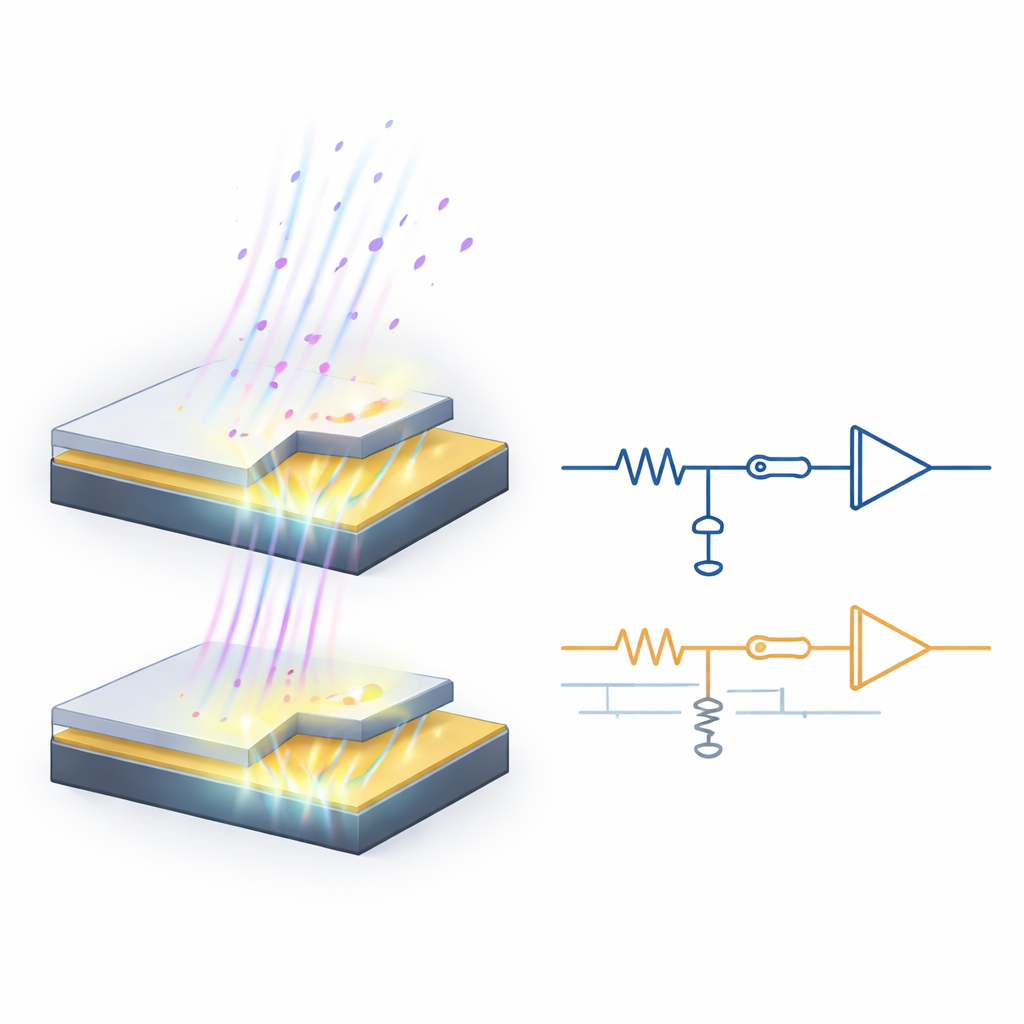
The team then asked what this capacitor drift means for a realistic radio‑frequency front end. They placed the radiation‑equivalent capacitor into a simulated input matching network feeding a low‑noise amplifier around 10 GHz. Under normal conditions, the network shapes the input impedance so that it sits near a sweet spot where gain and noise performance are both good. When they swapped in the radiation‑modified capacitor, the input impedance shifted to a more capacitive region, pulling the operating frequency downward. This detuning caused the amplifier’s gain to drop by more than a decibel and pushed the noise performance away from its optimum, even though the active transistor itself was assumed unchanged. The result is a quieter, slightly mistuned receiver—exactly the kind of subtle degradation that can jeopardize long‑mission communications.
What this means for future space electronics
For non‑specialists, the key message is that the “background” parts of a circuit can be as vulnerable to radiation as the headline devices. In fringe‑field‑dominated capacitors, radiation changes the insulating material enough to significantly increase capacitance, and those shifts ripple through to the system level by detuning impedance‑matching networks. The authors show that by treating radiation as an effective change in the dielectric properties within standard electromagnetic simulations, designers can predict and compensate for these shifts in advance. This approach should help make future satellite and spaceborne radio systems more robust, ensuring their tiny on‑chip parts stay in tune even after years of exposure to harsh space environments.
Citation: Kim, MS., Hwang, H.J., Kang, C.G. et al. Investigation of TID-induced capacitance variation in GaAs edge-lift capacitors and its effect on RF impedance matching. Sci Rep 16, 12177 (2026). https://doi.org/10.1038/s41598-026-42919-9
Keywords: space radiation, GaAs MMIC, edge-lift capacitor, RF impedance matching, total ionizing dose