Clear Sky Science · en
Nanoflower-like 2D WSe2-wrapped 2D Ti3C2Tx MXene heterostructure for supercapacitor applications
Why Faster Energy Storage Matters
From quick‑charging electric cars to stabilizing solar and wind power, our daily lives increasingly depend on devices that can store and release energy very quickly and reliably. Supercapacitors are one of the most promising tools for this job, but they still struggle to store as much energy as conventional batteries. This study explores a new way to build the heart of a supercapacitor—the electrode—by combining two ultra‑thin materials into a flower‑on‑sheet structure that can charge fast, last long, and hold more energy than many existing designs.
Building a Better Energy Sponge
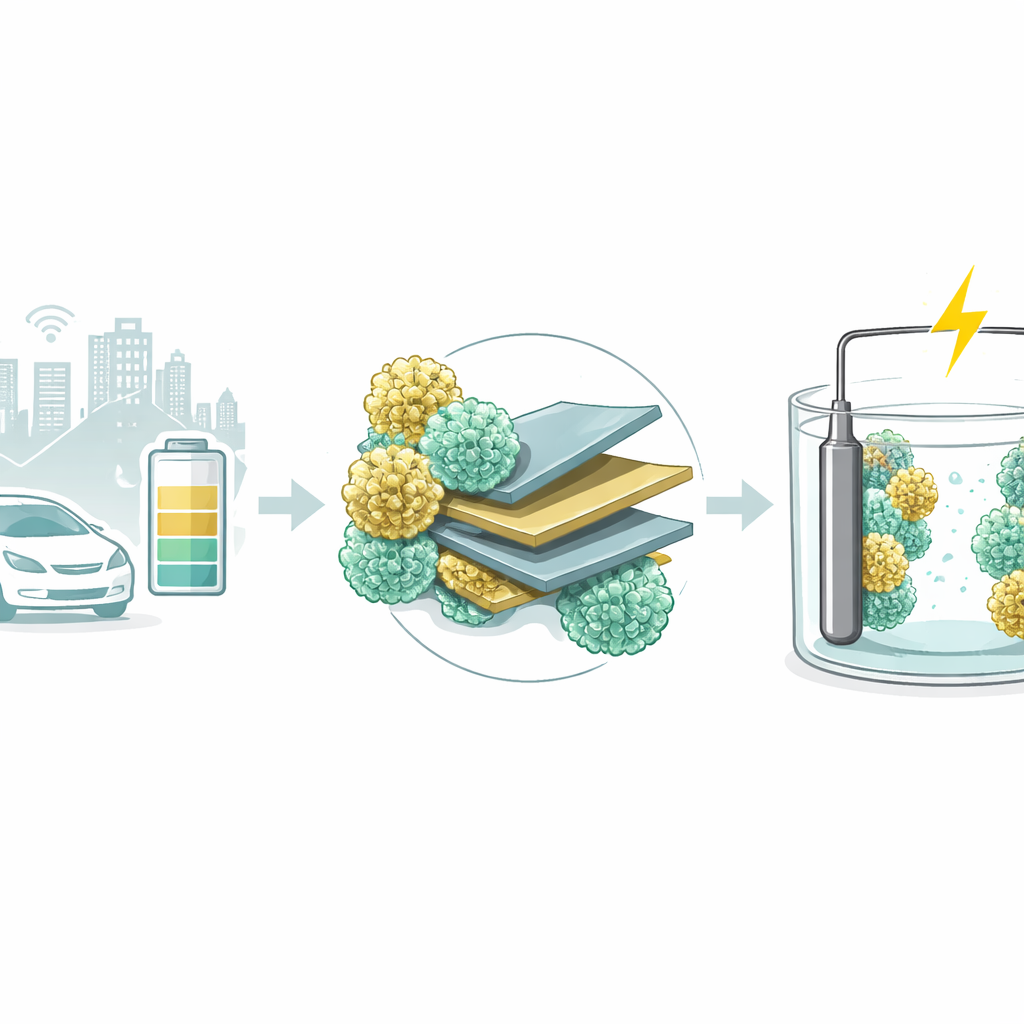
The researchers focused on supercapacitors, which store energy differently from batteries. Instead of relying mainly on slow chemical reactions, supercapacitors store charge on surfaces, allowing very rapid charging and discharging and long lifetimes. To push their performance further, scientists look for electrode materials with huge surface area and excellent electrical conductivity. In this work, the team combined two two‑dimensional materials: a metal‑like compound called tungsten selenide that grows into tiny “nanoflowers,” and a highly conductive layered material known as a MXene, made from titanium carbide sheets. The idea was to let the nanoflowers wrap around the flat sheets, creating a highly textured surface that behaves like a powerful energy sponge.
Flower‑on‑Sheet Nanoarchitecture
To create this hybrid structure, the team used water‑based, high‑temperature treatments in sealed steel containers, a method known as hydrothermal synthesis. First, they grew the flower‑shaped tungsten selenide particles, then they etched and peeled the titanium carbide to make thin MXene sheets. Finally, they grew the nanoflowers directly in the presence of these sheets so that the flowers coated and wrapped around them. Advanced microscopes revealed that the resulting material looks like delicate clusters of petals decorating smooth layers, with the flowers firmly attached to the sheets. Other techniques showed that the crystal structures of both components were preserved and that the spacing between MXene layers expanded slightly, opening extra channels for ions to move in and out.
How the New Electrode Stores Charge
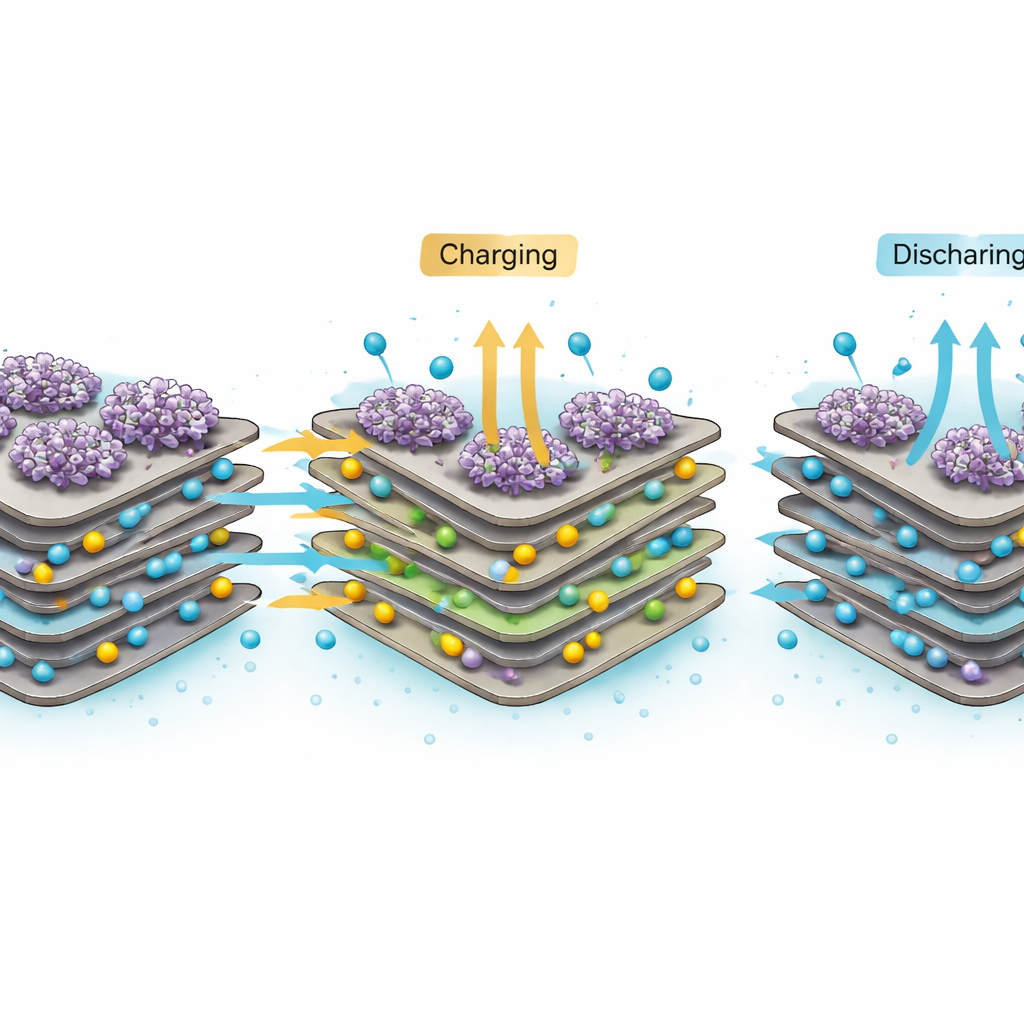
In a supercapacitor, ions from the liquid electrolyte move to and from the electrode surface during charging and discharging. The nanoflower‑decorated MXene offers several advantages for this process. The MXene sheets act as fast “highways” for electrons, thanks to their metallic conductivity. The tungsten selenide flowers provide a huge number of edges and nooks where ions can land and participate in quick, reversible reactions. The expanded spacing between layers gives ions more room to move, reducing bottlenecks. Together, these features mean more charge can be stored at once, and it can be moved in and out quickly with less resistance. Measurements confirmed that ions can diffuse rapidly through the open channels and that the contact between flowers and sheets helps electrons and ions work together efficiently.
Performance in Realistic Tests
To see how well the new material works in practice, the researchers coated it onto nickel foam to make working electrodes and tested them in a standard water‑based potassium hydroxide solution. They compared three cases: only tungsten selenide flowers, only MXene sheets, and the combined flower‑on‑sheet structure. The hybrid electrode outperformed both ingredients by a wide margin, storing roughly twice as much charge per gram as either component alone at the same test current. It also kept its performance over time: after 10,000 rapid charge‑discharge cycles, the hybrid electrode retained nearly all of its original capacity and showed very low electrical resistance. Detailed impedance tests indicated that the new structure eased the flow of both ions in the liquid and electrons in the solid, confirming the benefits of the tightly connected two‑material design.
What This Means for Future Devices
In simple terms, this work shows that carefully arranging ultra‑thin materials into a flower‑on‑sheet pattern can make supercapacitors that charge very fast, last for thousands of cycles, and store significantly more energy than many current designs. By wrapping conductive sheets with high‑surface‑area nanoflowers, the researchers created a sturdy, highly accessible playground for ions and electrons. While more development is needed before such electrodes appear in commercial products, this approach points toward lighter, more reliable energy‑storage devices that could help power next‑generation electric vehicles, wearable electronics, and renewable‑energy systems.
Citation: Manimekalai, A., Mohandoss, S., Venkatesan, R. et al. Nanoflower-like 2D WSe2-wrapped 2D Ti3C2Tx MXene heterostructure for supercapacitor applications. Sci Rep 16, 14590 (2026). https://doi.org/10.1038/s41598-026-42893-2
Keywords: supercapacitors, MXene, tungsten selenide, energy storage, nanostructured electrodes