Clear Sky Science · en
Comparative optimization of electric robo-taxi (eRT) and electric unmanned aerial vehicle (eUAV) systems
New Ways to Move Around the City
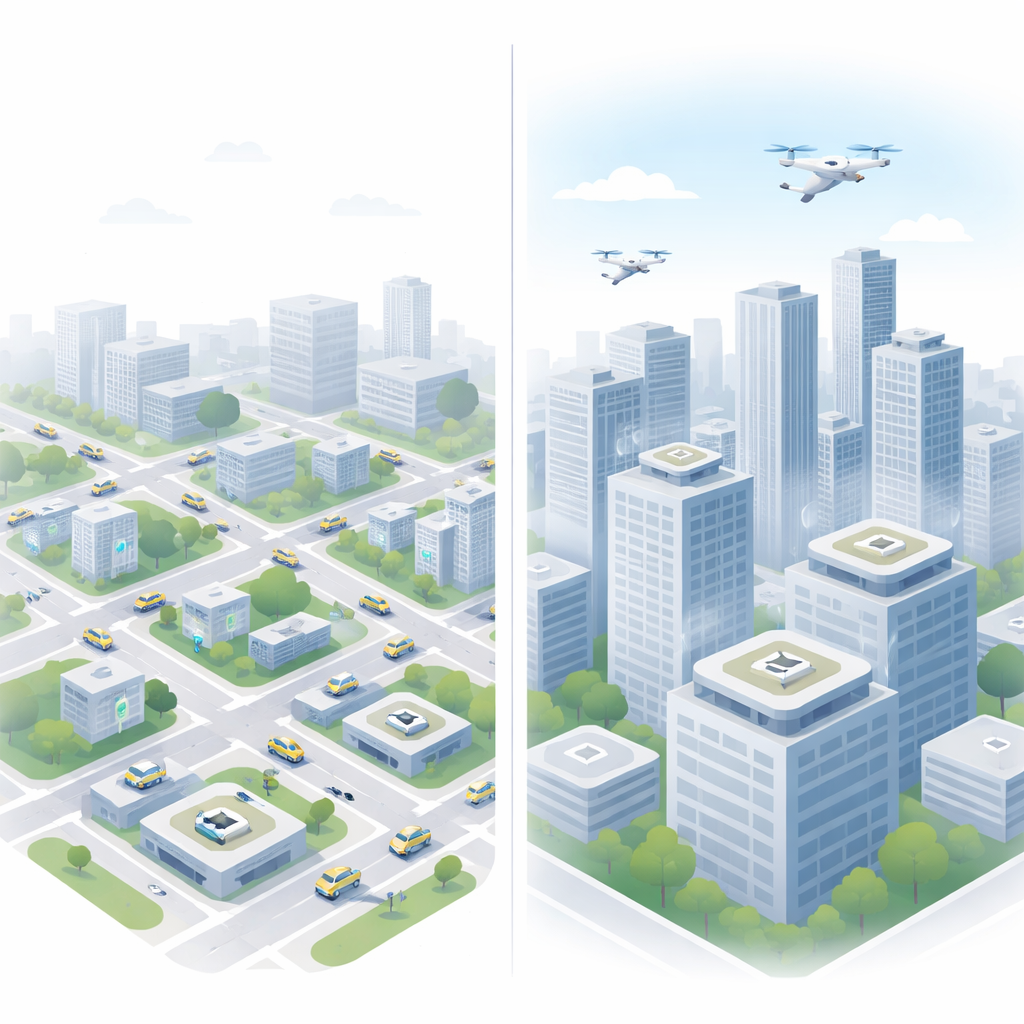
Imagine hailing a ride in a dense city and having two options: a driverless electric car that glides through traffic, or a small electric aircraft that lifts you over the streets and lands on a nearby rooftop. This study asks a simple but pressing question: under the same rules and constraints, which system makes more sense for cities—ground-based electric robo‑taxis or electric unmanned aerial vehicles used like air taxis—and what trade-offs do they pose between travel time and total cost?
Two Futuristic Ride Options, One Common Test City
The researchers built a shared framework to evaluate both systems fairly, using Sejong City in South Korea as a testbed. They fed in realistic road networks, real-time traffic speeds, and statistically generated passenger requests. For each system, the framework decides how many vehicles are needed, how many fast chargers to install and where, and how big the batteries should be. Then it simulates a year of operation for 100 daily passengers and adds up everything that matters: the total cost of vehicles, charging infrastructure, electricity, and the travel time passengers experience from request to arrival.
How Robo-Taxis and Air Taxis Actually Operate
On the ground, electric robo‑taxis are assumed to be fully autonomous. A central control system constantly tracks their locations, battery levels, and passenger requests. Each car cycles through three basic states: cruising while idle, carrying a passenger, or heading to a charging station. When its battery runs low, it is routed to the nearest available charger; when requests come in via a smartphone app, the system assigns the car that can reach the passenger quickly and still have enough charge to get to a charger afterward. Charging-station locations, numbers of chargers, and charging power are treated as design choices that strongly shape cost and wait times.
What Changes When You Take to the Air
The aerial system uses electric multicopter-style vehicles that shuttle a single passenger at a time between preselected tall buildings. Here, the idle state happens at vertiport charging stations on rooftops rather than along roads. Vehicles climb to a fixed cruising altitude to avoid obstacles, fly almost straight-line paths, then descend to another rooftop. Because landing and takeoff pads take space and must be carefully sited, each vertiport is more expensive than a ground charger, and each aircraft needs a dedicated charging position. The flying range depends sensitively on weight, aerodynamics, and battery capacity, so the model includes how heavier batteries both extend energy supply and increase energy consumption per kilometer.
Balancing Time Savings Against Total Cost
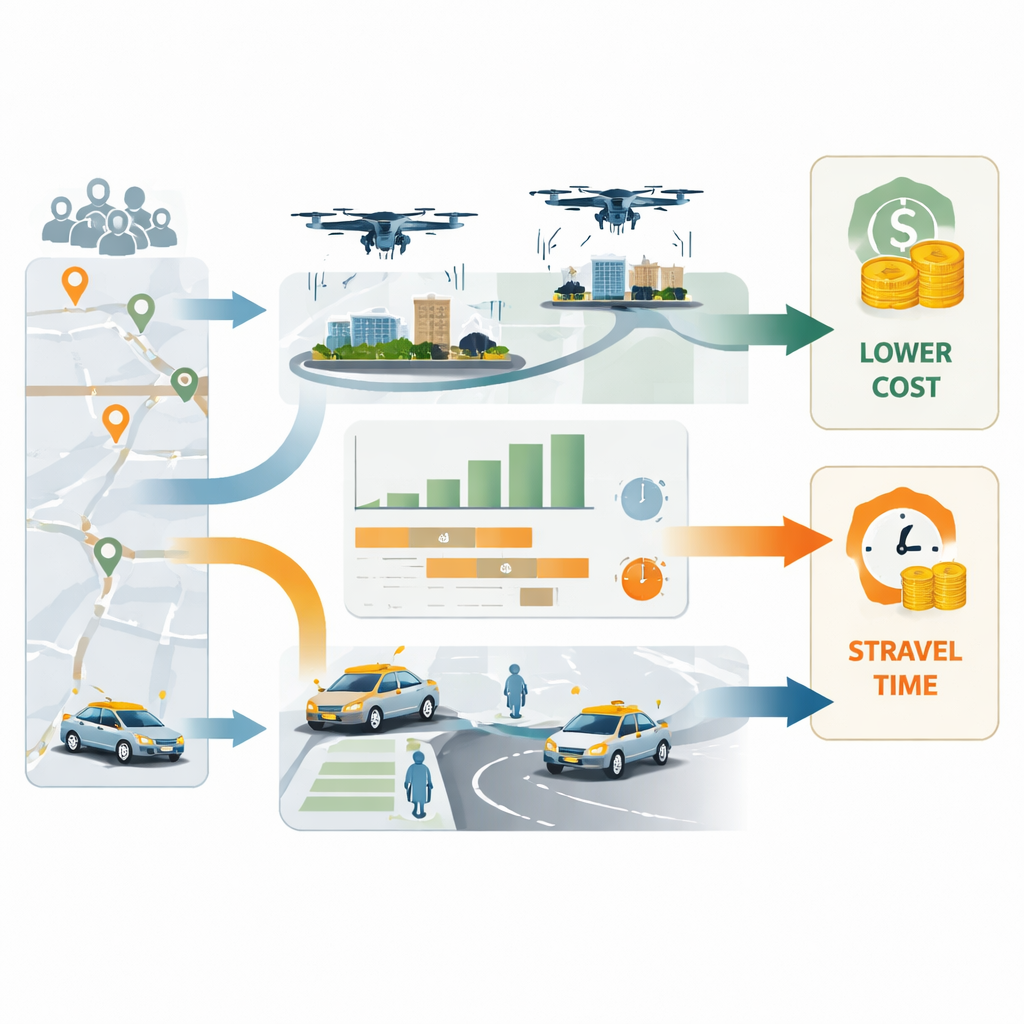
With this setup, the team used a genetic algorithm—a search method inspired by evolution—to find the cheapest designs that still meet chosen target travel times. For relatively relaxed targets (around 27–30 minutes door-to-door), optimized robo‑taxi systems are far cheaper overall than aerial systems, mainly because ground chargers and vehicles are less costly and can be shared flexibly. But as cities demand faster trips—for example, around 21 minutes—the cost of the ground system rises sharply: more cars, more chargers, and more energy are needed to fight congestion and shorten waits, and below about 21 minutes, no feasible robo‑taxi design is found. In contrast, the air system’s cost grows only modestly as travel-time targets tighten, since flying over traffic naturally shortens distance and avoids jams. The study also finds that although air taxis offer much shorter median travel times, their trip times are more variable, with a higher chance of long delays, whereas robo‑taxis are slower on average but more consistent.
What This Means for Future City Travel
For everyday conditions where people can tolerate longer trips, electric robo‑taxis appear to be the economical workhorse: they use existing streets, need fewer and cheaper stations, and consume less energy per kilometer. When cities or specific routes demand very rapid travel, however, well-designed electric air-taxi systems can deliver speed that cars simply cannot match, at competitive or even lower total cost—so long as cities are willing to invest in dense rooftop infrastructure. Overall, the study suggests that tomorrow’s urban mobility is unlikely to be a winner‑take‑all race between wheels and wings. Instead, ground robo‑taxis may handle most routine trips cheaply and reliably, while electric air taxis emerge as a premium, high-speed layer of the network, especially where time is at a premium and airspace and safety rules allow.
Citation: Seo, H., Kim, S., Shin, B. et al. Comparative optimization of electric robo-taxi (eRT) and electric unmanned aerial vehicle (eUAV) systems. Sci Rep 16, 12617 (2026). https://doi.org/10.1038/s41598-026-42843-y
Keywords: electric robo-taxis, urban air mobility, autonomous transport, charging infrastructure, mobility optimization