Clear Sky Science · en
Hidden Markov models reveal ontogenetic plasticity in green and loggerhead sea turtles
Why turtle travel habits matter
For animals that can live for many decades and cross whole oceans, knowing exactly how they use different places as they grow is vital for protecting them. This study focuses on green and loggerhead sea turtles along Florida’s Atlantic coast and asks a deceptively simple question: do turtles of the same size always use the same habitats in the same way? By digging into nearly half a century of turtle capture records with modern analytical tools, the authors uncover hidden patterns in how turtles explore, settle, and pass through coastal areas—patterns that traditional size-based categories have largely missed.
Following turtles over a lifetime
Conservation biologists have long divided sea turtles into neat life stages—tiny hatchlings drifting offshore, growing juveniles in the open ocean, then larger youngsters and adults feeding in shallow coastal waters. These stages are usually defined by body size, and many management plans assume that a turtle of a given size can be linked to a specific habitat and behavior. The authors challenge this assumption using 47 years of capture–recapture data from a unique site at the St. Lucie Nuclear Power Plant in southeast Florida, where turtles entering seawater intake pipes are gently collected, measured, tagged, and released. With almost 20,000 capture events for green and loggerhead turtles, the dataset offers an unusually long and detailed window into how individual turtles appear, disappear, and sometimes return to the same spot.
Three hidden ways of using a place
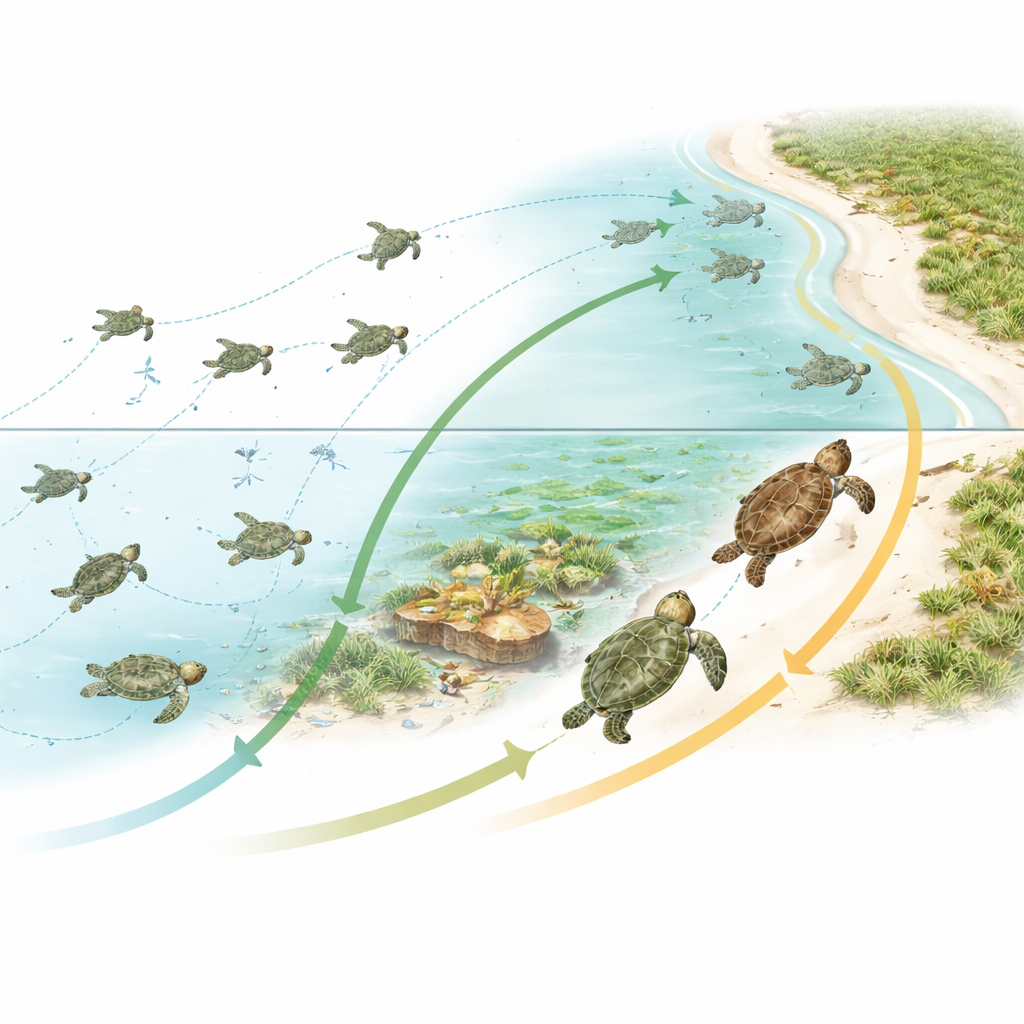
Instead of starting with fixed life stages, the researchers let the data speak first. They used a statistical tool called a Hidden Markov Model, which can tease out unobserved “states” from repeated measurements through time. Here, the model looked at each turtle’s shell length and the time of year it was captured, and then estimated the chance that the turtle was in one of three latent states. Only after the model was fit did the authors interpret these states as Nomadic (rarely detected, likely roaming), Resident (frequently detected, staying put), and Transient (seen seasonally, likely passing through). Crucially, these are not rigid categories forced by the researchers; they are patterns that emerge from the data and are then given biological meaning.
Different species, different flexibility
For green turtles, the three states lined up fairly well with expectations of gradual shifts from oceanic juveniles to coastal residents to larger, more mobile individuals. Smaller greens were most often classified as Nomadic, appearing sporadically and likely representing young turtles exploring coastal areas after leaving the open ocean. Medium-sized turtles were largely Resident, showing strong site fidelity and frequent recapture, consistent with long-term use of productive reefs and seagrass beds. The largest greens were more often Transient, showing up seasonally in connection with migration or breeding. Still, the size ranges of these states overlapped, revealing that even greens do not follow a perfectly tidy size-based script.
Loggerheads break the size rules
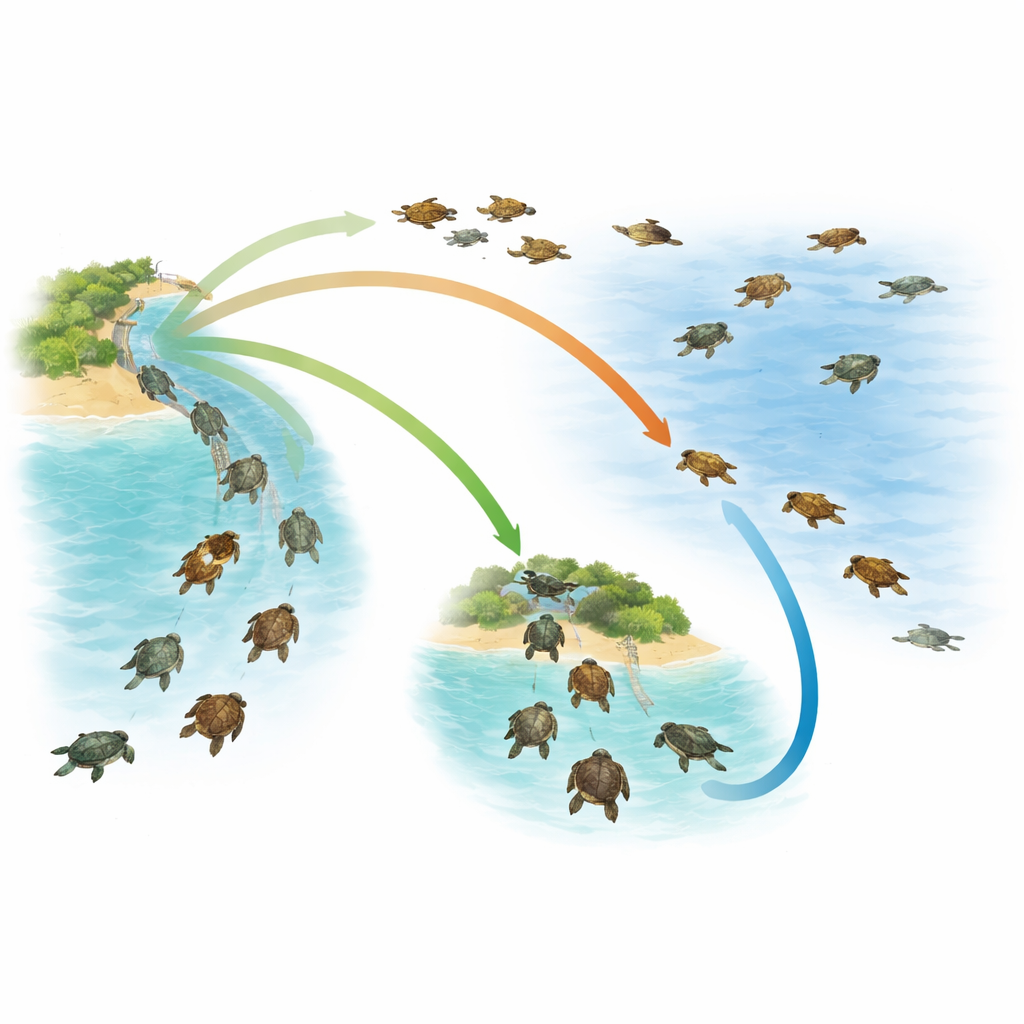
Loggerhead turtles told a more complicated story. While the same three behavioral states appeared, their size ranges overlapped much more, and body size was a weaker predictor of how an individual used the site. Turtles of similar size could be nomadic roamers, local residents, or seasonal visitors. The three-state model also fit loggerhead data better than simpler, size-based alternatives and captured patterns that could not be explained by size alone, such as seasonal rises in particular states. This supports earlier tracking studies showing that loggerheads can switch between staying in place and wide-ranging movements depending on conditions, rather than following a single, size-driven path.
Why behavior-first thinking helps conservation
To test whether these hidden states reflected real ecological differences, the authors compared them with independent clues. Turtles that the model classified as Resident were much more likely to be recaptured over the years, matching the idea of animals that repeatedly use the same area. In contrast, Nomadic and Transient turtles were mostly seen once or only occasionally, consistent with low or intermittent local availability. By combining size, season, and capture history, the behavior-based approach paints a richer and more flexible picture of habitat use than traditional stage labels tied to fixed size thresholds. For conservation, this means managers can better estimate when turtles are truly present and relying on a given habitat, when they are just passing through, and how those patterns may shift over decades as oceans and coastlines change.
Citation: Welsh, R.C., Mansfield, K.L. Hidden Markov models reveal ontogenetic plasticity in green and loggerhead sea turtles. Sci Rep 16, 13696 (2026). https://doi.org/10.1038/s41598-026-42842-z
Keywords: sea turtles, habitat use, behavioral states, migration, conservation