Clear Sky Science · en
An interpretable IGWO-MKRVM model for predicting excavation damaged zone thickness of drift
Why safer tunnels matter
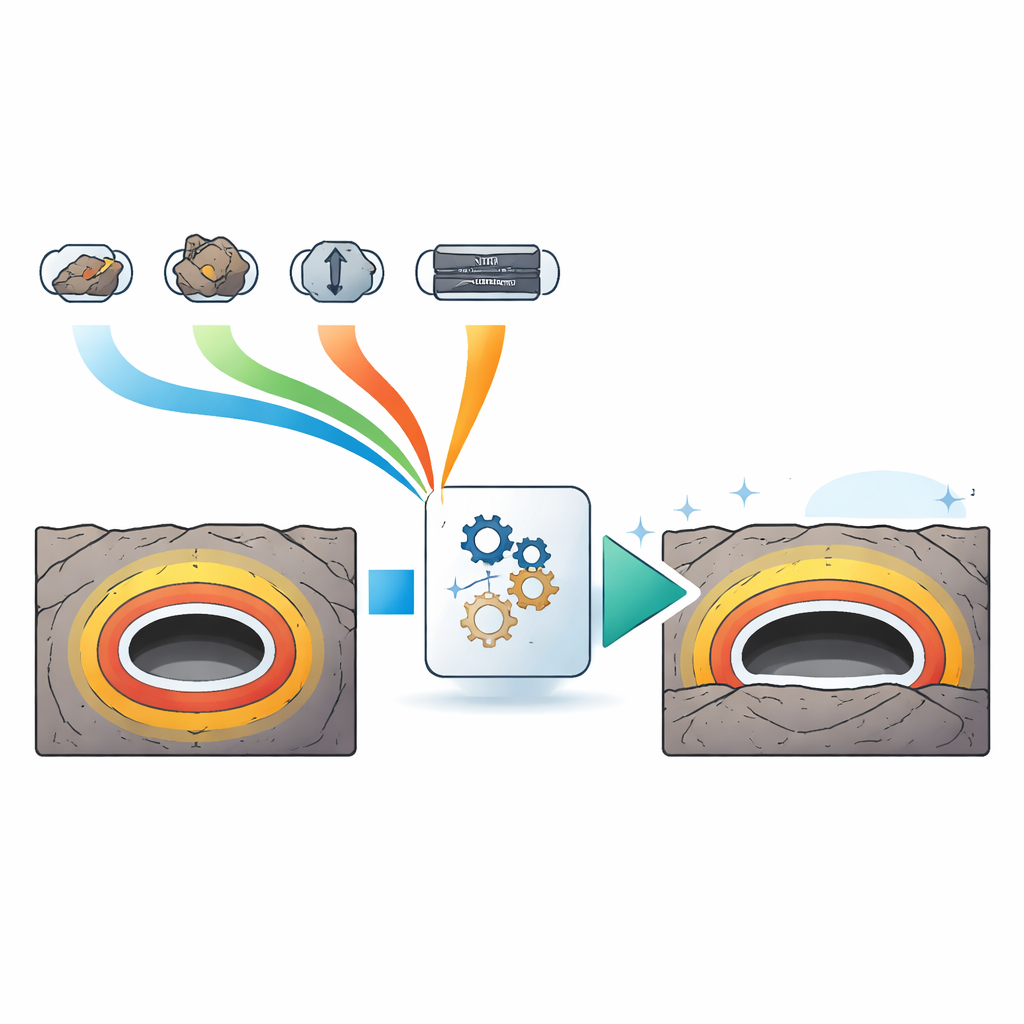
Whenever engineers carve a tunnel through rock, the excavation disturbs the surrounding ground. A ring of cracked and weakened rock forms around the opening, known as the excavation damaged zone. If this damaged ring grows too thick, the tunnel walls can deform or even collapse, threatening miners, infrastructure, and nearby communities. The paper summarized here presents a new way to predict how thick that damaged zone will be in different geological conditions, using a blend of modern machine learning and careful interpretability so that engineers can understand not just the answers, but the reasons behind them.
The hidden ring of weakened rock
Underground drifts and tunnels are surrounded by rock that has been squeezed and fractured by excavation. This affected layer, the excavation damaged zone thickness, directly controls how much support is needed to keep the tunnel safe. But the thickness depends on several interacting factors: how strong the rock is, how broken it is by joints and cracks, how deep it lies beneath the surface, and how wide the tunnel spans. These influences are strongly nonlinear and vary from site to site, so simple formulas or even advanced simulations often fail to give accurate, widely applicable predictions. Traditional field tests such as ground-penetrating radar and acoustic surveys can measure the damaged zone, but they are expensive and difficult to perform routinely.
Using smart algorithms to read the rock
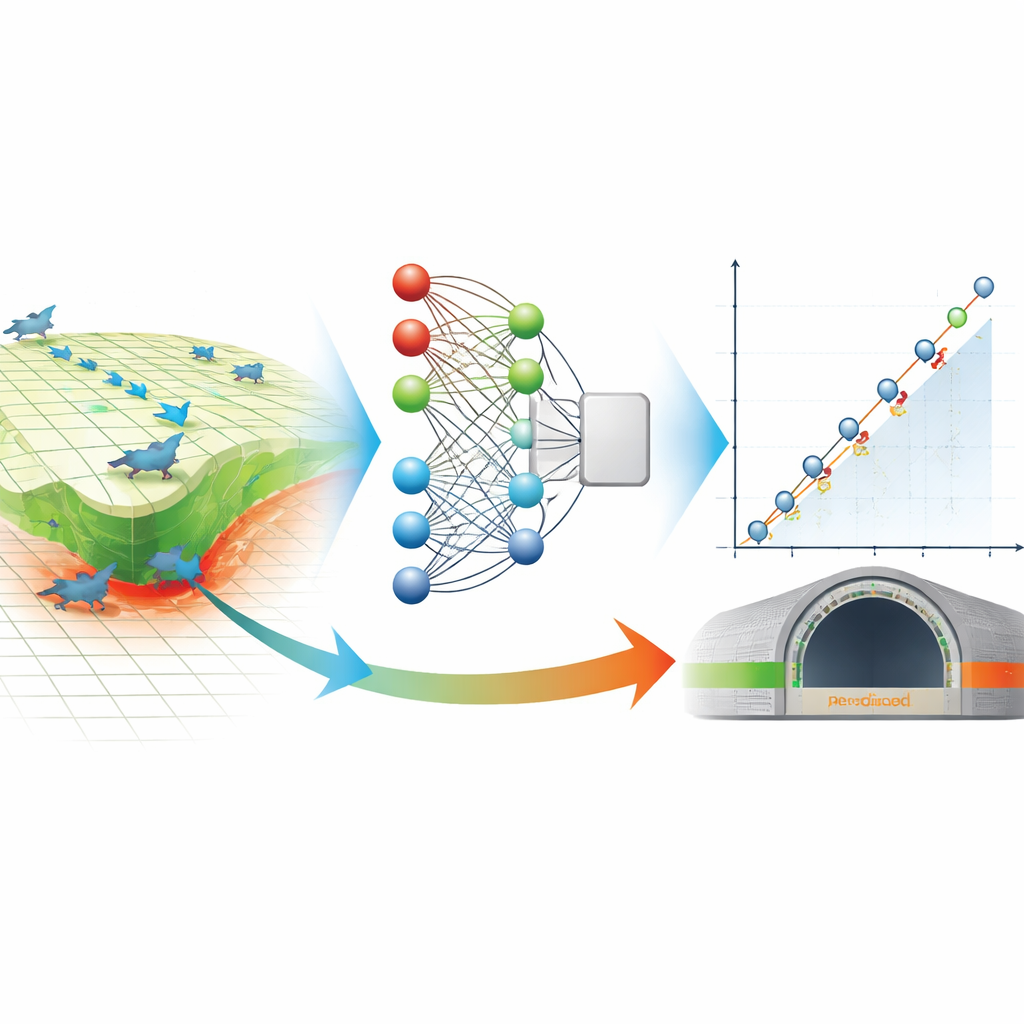
To tackle this challenge, the authors collected 209 real-world measurements of damaged-zone thickness from different types of mines, including coal, gold, phosphate, and lead operations. For each case they recorded four key inputs: rock mass strength, a joint index describing how fractured the rock blocks are, the depth of the tunnel, and the tunnel span. They then built a prediction model that combines a powerful pattern-recognition engine, called a multi-kernel relevance vector machine, with an improved optimization method inspired by the hunting behavior of grey wolves. The optimization step tunes the model’s internal settings so it can best fit the complex relationships in the data while remaining efficient for small engineering datasets.
How the hybrid model improves predictions
The heart of the approach lies in using several simple mathematical “lenses,” or kernels, at once to capture both broad trends and fine local variations in how rock responds. The model blends linear, radial, and Laplacian kernels so it can handle smooth changes, sudden shifts, and noisy measurements all together. The improved grey wolf optimizer enhances this by exploring the space of possible parameter settings more thoroughly. It uses carefully designed random starting points, a nonlinear way of shifting from broad search to fine-tuning, and a strategy that proposes opposite candidate solutions to avoid getting stuck in poor local choices. Tests on standard benchmark problems show that this enhanced optimizer converges faster and more reliably than several other modern swarm and evolutionary algorithms.
Beating existing prediction tools
When applied to the tunnel dataset, the integrated IGWO–MKRVM model delivered very accurate predictions. On unseen test cases, it achieved a coefficient of determination above 0.95 and very low error measures, meaning that its predicted damaged-zone thickness closely matched field measurements. The authors compared it with a range of established tools, including classic neural networks, Gaussian process regression, support vector-based hybrids, and a tuned random forest. In every case, the new model produced smaller errors and more stable performance, demonstrating both strong fitting ability and robust generalization to new geological conditions.
Opening the black box of machine learning
Because engineers must justify safety decisions, the authors also focused on making the model interpretable. They used a modern explanation framework called SHAP, which treats each input as a “player” in a cooperative game and calculates how much it contributes to each prediction. This analysis revealed that the joint index and the tunnel’s depth are the dominant drivers of damaged-zone thickness: heavily jointed rock and deeper tunnels tend to produce much thicker damaged rings. Tunnel span and rock strength also matter, but to a lesser extent—larger spans increase damage, while stronger rock tends to keep it in check. The method further uncovers how these factors interact, for instance showing that deep tunnels in weak, highly jointed rock are especially vulnerable.
What this means for underground safety
In everyday terms, the study offers engineers a smarter calculator for predicting how far damage will extend into the rock around a tunnel, and a clear explanation of which conditions make that damage worse. By combining a carefully tuned learning engine with transparent feature-importance analysis, the method not only outperforms existing models but also builds trust in its recommendations. This can help designers choose safer tunnel shapes, support systems, and excavation strategies tailored to local geology, ultimately reducing the risk of rock falls and collapses in underground works.
Citation: Yang, R., Zhang, G., Ye, Y. et al. An interpretable IGWO-MKRVM model for predicting excavation damaged zone thickness of drift. Sci Rep 16, 13548 (2026). https://doi.org/10.1038/s41598-026-42835-y
Keywords: tunnel stability, rock mechanics, machine learning, underground mining, geotechnical safety