Clear Sky Science · en
Reducing noise levels in eddy current measurements using self-differential probes of the substrate conductivity under a layer of conductive coating in moved objects
Seeing Inside Metals Without Cutting Them Open
Modern factories need to know what is happening inside metal parts without sawing them apart. One important clue is how well a material conducts electricity, which reveals changes in strength, heat treatment, or hidden damage. This article describes a way to make these electrical checks more reliable even when metal parts are moving fast on production lines and are covered by conductive coatings.
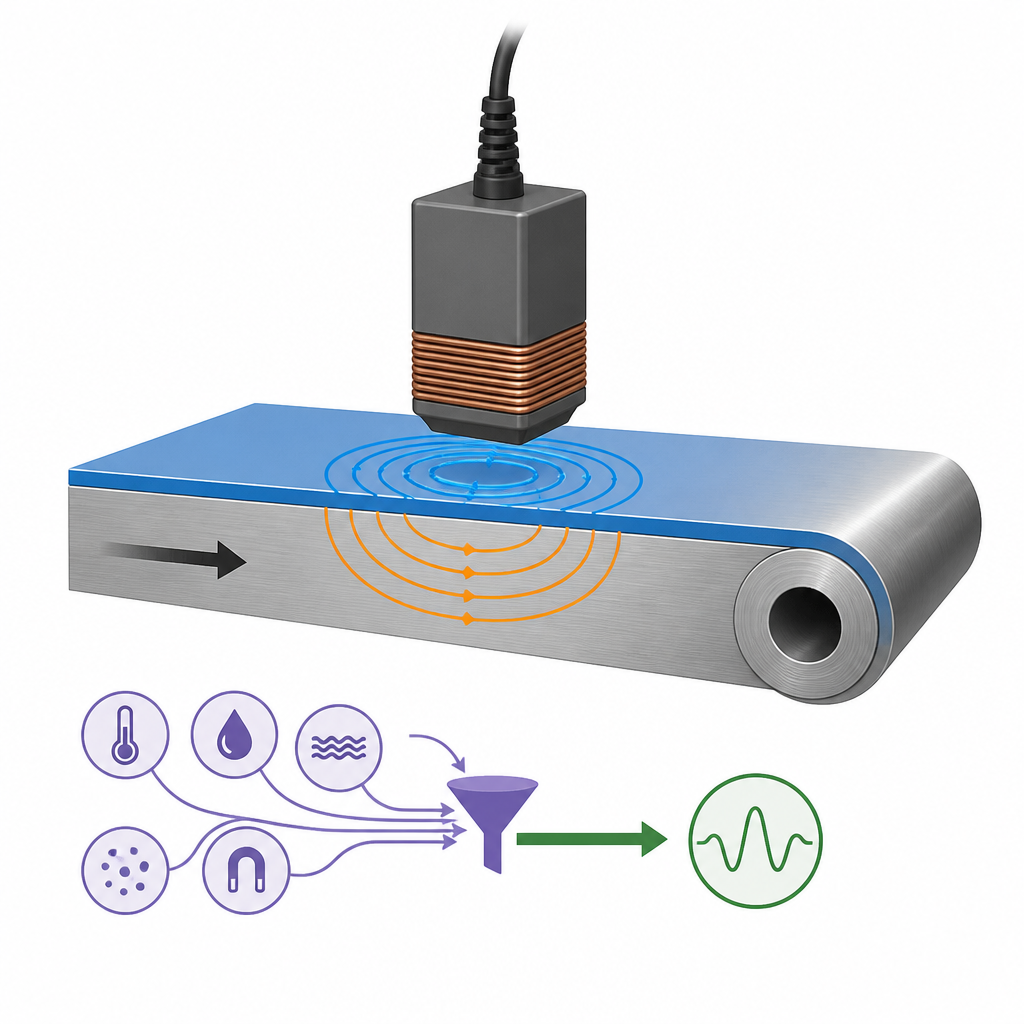
Why Measuring Through Coatings Is So Tricky
Many real-world parts are not bare metal. They may carry anodized layers, anti-corrosion films, or other metal coatings. Engineers often care about the deeper base material, not the thin outer layer. Eddy current methods use magnetic fields from small coils to induce swirling electrical currents in the metal, then read back the response. In practice, this response is distorted by many unwanted influences. Small changes in the gap between probe and surface, uneven coating thickness, tiny variations in material properties, and even extra currents caused by the motion of the part all behave like noise. Instead of a clean signal that reflects only the hidden substrate, the probe delivers a mixture of useful information and interference.
From Patchwork Fixes to Built-In Noise Resistance
Industry has many tools for cleaning such signals. Designers tweak probe shapes, add magnetic cores, or run at carefully chosen frequencies. Electronics and digital processing then work hard to filter out noise after the fact, and newer machine learning methods attempt to recognize and remove disturbances from recorded data. All of these steps help, but each typically attacks only a subset of noise sources and often requires complex processing after measurement. The authors take a different path: they try to make the probe itself inherently insensitive to these disturbances, so that the signal is already much cleaner the instant it is created.
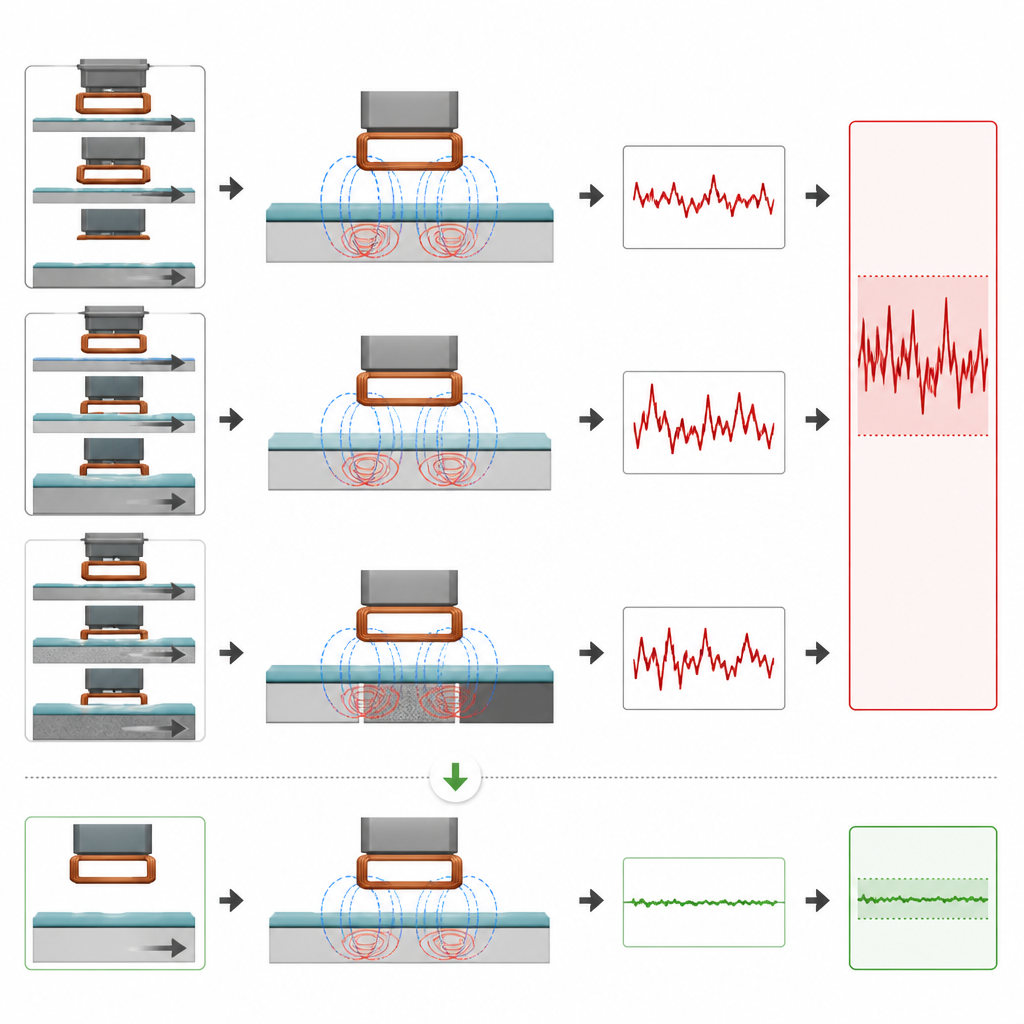
Designing a Quieter Probe by Smart Experiment Planning
The study focuses on special “self-differential” probes. These devices use paired coil segments arranged so that, in ideal conditions, their signals cancel each other, leaving zero output. When the metal strip moves or its conductivity changes, the symmetry breaks and a useful signal appears. The researchers considered two main probe layouts, one with rectangular coils and one with a tangential arrangement using a circular coil. They built mathematical models describing how each design behaves over coated metals, both non-magnetic and weakly magnetic, while the object moves. Using Taguchi’s method, a structured strategy for planning experiments, they systematically varied probe dimensions, spacing, operating frequency, and motion speed, alongside realistic noise factors such as coating thickness variations, lift-off changes, and material property fluctuations.
Choosing the Best Geometry and What Matters Most
For each virtual experiment, the team calculated how strongly the probe responded to the substrate and how much the response varied under noise. These results were combined into a single measure called the signal-to-noise ratio, favoring designs that give strong, stable signals. By scanning many combinations efficiently with Taguchi’s orthogonal arrays, they identified “optimal” sets of dimensions and settings for both probe types. Statistical analysis showed that one design with rectangular coils clearly offered the highest signal-to-noise ratio for both non-magnetic and weakly magnetic substrates. Further variance analysis revealed which design choices matter most: the distance between excitation and pick-up coils had by far the largest influence, while some other dimensions and even the strip’s speed played only minor roles within the tested ranges.
Testing Robustness with Randomized Noise
To mimic the messy reality of a factory, the authors then used Monte Carlo simulations. They repeatedly generated random combinations of lift-off, coating thickness, coating conductivity, and, for weakly magnetic substrates, magnetic permeability. For each random case, they computed the probe’s output and compared it to an ideal noise-free reference. Across dozens of such trials, the optimized rectangular-coil probe consistently showed smaller fluctuations than non-optimized versions. In some scenarios, the spread of the signal was several percent lower for the optimized design, and even under combined disturbances the relative deviations remained noticeably reduced. This means that the new probe design turns a tangle of uncontrolled influences into a more stable, easier-to-interpret signal.
What This Means for Real-World Inspections
In simple terms, the paper shows how to fine-tune eddy current probes so that they “ignore” many common disturbances at the moment the measurement is made. By carefully shaping coil geometry and choosing operating conditions through a planned search, the authors achieve cleaner readings of the hidden metal beneath conductive coatings, even when parts are moving and material properties vary. For inspectors and process engineers, this can translate into more reliable monitoring of material quality and heat treatment, with less dependence on heavy digital post-processing. The work demonstrates that thoughtful design guided by statistical methods can make inspection tools both more accurate and more robust to the noisy realities of industrial environments.
Citation: Halchenko, V.Y., Trembovetska, R. & Tychkov, V. Reducing noise levels in eddy current measurements using self-differential probes of the substrate conductivity under a layer of conductive coating in moved objects. Sci Rep 16, 14769 (2026). https://doi.org/10.1038/s41598-026-42808-1
Keywords: eddy current testing, conductive coatings, signal to noise, non destructive evaluation, probe design