Clear Sky Science · en
Design and development of a graphene-based MIMO antenna for smart multi-band sub-6 GHz 5G wearable communication applications
Smart Clothing That Talks
Imagine a T‑shirt that can quietly connect you to high‑speed 5G networks, monitor your health, or link your gadgets together—all without hard metal parts digging into your skin. This study describes a new type of tiny radio built directly onto denim fabric using graphene, a form of carbon that is both highly conductive and extremely flexible. The work shows how such a fabric‑based antenna can handle several important wireless bands at once while remaining safe and comfortable to wear.
From Stiff Metals to Soft Carbon
Conventional antennas in phones and wearables are usually made from copper. While copper carries electricity well, it is relatively stiff, can crack when bent repeatedly, and raises concerns about cost and environmental impact. For clothing and body‑worn gadgets, these rigid metal parts can feel uncomfortable and may not perform well when the fabric folds and stretches. Graphene, made from atom‑thin carbon sheets, promises a different approach: it is light, flexible, and can be printed like ink onto textiles, turning ordinary cloth into a smart surface that can send and receive wireless signals.
Turning Jeans into a 5G Gateway
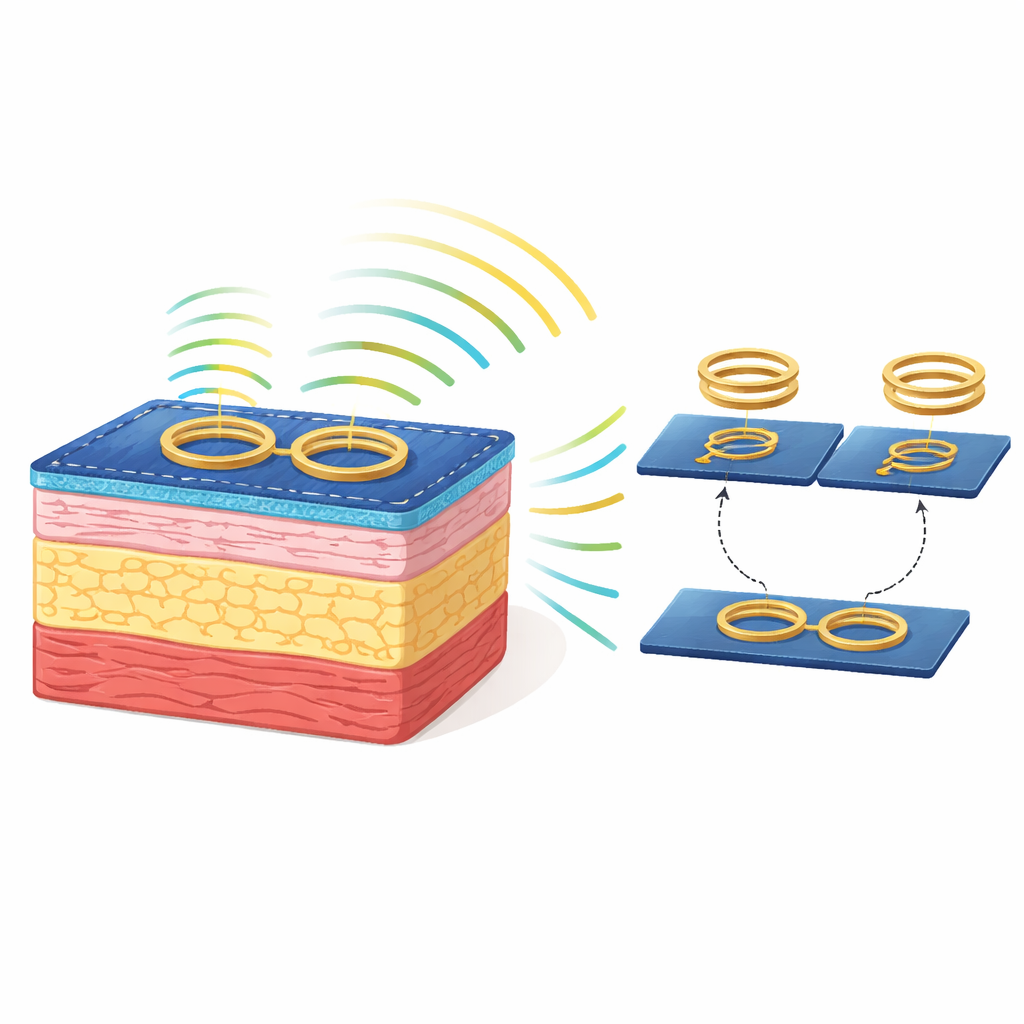
In this work, the researchers printed a pair of small antennas onto a piece of jeans material, creating a two‑port "MIMO" module—essentially two cooperating antennas that improve data speed and reliability. The denim acts as the support layer, chosen because it is sturdy, comfortable, and has low impact on radio waves. By carefully shaping the graphene into ring‑like patches and adding a special figure‑of‑eight slot in the conductive backing, the team tuned the design to work in several distinct frequency bands. These include the key sub‑6 GHz ranges used by many 5G networks, as well as higher bands in the so‑called X‑band that could support future short‑range links and sensing functions. The entire device is about the size of a postage stamp and only half a millimeter thick.

How the Design Delivers Many Channels
Rather than relying on one broad, unfocused band, the antenna is sculpted so that electric currents naturally form different patterns at different frequencies. Starting from a simple circular patch, the designers shifted to a ring shape, then duplicated it to create a two‑element system, and finally carved the figure‑of‑eight slot into the ground plane. Each change reshaped how currents flow, producing several well‑separated operating bands instead of one wide blur. Measurements showed strong performance at four main resonances around 3.5, 5.6, 8.4, and 12.9 GHz, with low interference between the two antenna elements. This low mutual influence, together with evenly shared signal power, is crucial for dependable MIMO operation in crowded wireless environments.
Printing, Wearing, and Testing on the Body
To build the device, the team used a screen‑printing process similar to how graphics are placed on T‑shirts, but with graphene ink instead of colored dyes. After curing the ink with heat and attaching tiny connectors, they measured the antenna both in open air and directly on a person’s chest. The response changed only slightly when worn, and the antenna still covered the intended 5G and higher bands. Radiation pattern tests in an anechoic chamber showed near‑uniform coverage at lower frequencies, ideal for links that must work even as the wearer moves, with more complex patterns at higher frequencies that are still usable for specialized applications.
Checking Safety Inside the Body
Because these antennas sit directly on clothing against the skin, the researchers carefully examined how much of the radio energy is absorbed by the body. Using computer models of layered tissues—skin, fat, and muscle—they computed the specific absorption rate (SAR), a standard measure of how much power per kilogram of tissue is converted to heat. At all operating bands, including the main 5G ranges, the peak SAR values stayed well below international safety limits even at relatively high transmit power. At lower frequencies, energy spread more deeply but remained modest; at higher frequencies it stayed closer to the surface, further limiting internal exposure.
What This Means for Everyday Wearables
Put simply, the study shows that a thin patch of jeans printed with graphene can act as a multi‑channel, 5G‑ready antenna system that bends and moves with the body while staying within strict safety guidelines. By combining flexible fabric, carbon‑based conductors, and a carefully sculpted layout, the design points toward future clothing that seamlessly handles communications for phones, sensors, and medical devices. Rather than strapping on hard gadgets, people could one day wear their connectivity woven directly into their everyday outfits.
Citation: Al-Gburi, A.J.A., Mohammed, N.J., Saeidi, T. et al. Design and development of a graphene-based MIMO antenna for smart multi-band sub-6 GHz 5G wearable communication applications. Sci Rep 16, 12873 (2026). https://doi.org/10.1038/s41598-026-42793-5
Keywords: wearable antennas, graphene electronics, 5G communication, smart textiles, body-centric wireless