Clear Sky Science · en
Assessing the structural performance of additively manufactured carbon fibre reinforced PLA-based adherends bonded with graphene-enhanced adhesive using experimental and ANN analysis
Stronger 3D printed parts for real-world use
Many people now rely on 3D printing to make gadgets, tools, and even medical devices, but printed plastic parts can be too weak where they are joined together. This study explores how to make the glued connections between 3D printed pieces much stronger and more reliable, so that lightweight printed structures can safely handle real loads in cars, planes, and other everyday technologies.
Why glued joints matter in 3D printing
Most desktop 3D printers can only make objects as big as their build area, so larger structures are assembled from smaller pieces. These pieces are often joined with bolts or rivets, which add weight and can damage the plastic, or with glue, which spreads loads more gently but can fail if the bond is weak. The authors focused on a common biodegradable plastic called PLA, reinforced with short carbon fibers, and asked how to design a glued overlap joint that can carry much higher forces without breaking.
Mixing graphene into the glue
To boost the strength of the glue layer, the team mixed tiny platelets of graphene into a standard epoxy adhesive and used it to bond carbon fiber reinforced PLA strips in a simple single overlap joint. They prepared several versions of the adhesive with different amounts of graphene and carefully dispersed the particles using ultrasonic mixing. Before building joints, they first printed test pieces in different print directions and found that aligning the print lines with the pulling force gave the highest basic strength, so they used this setting for all later samples. 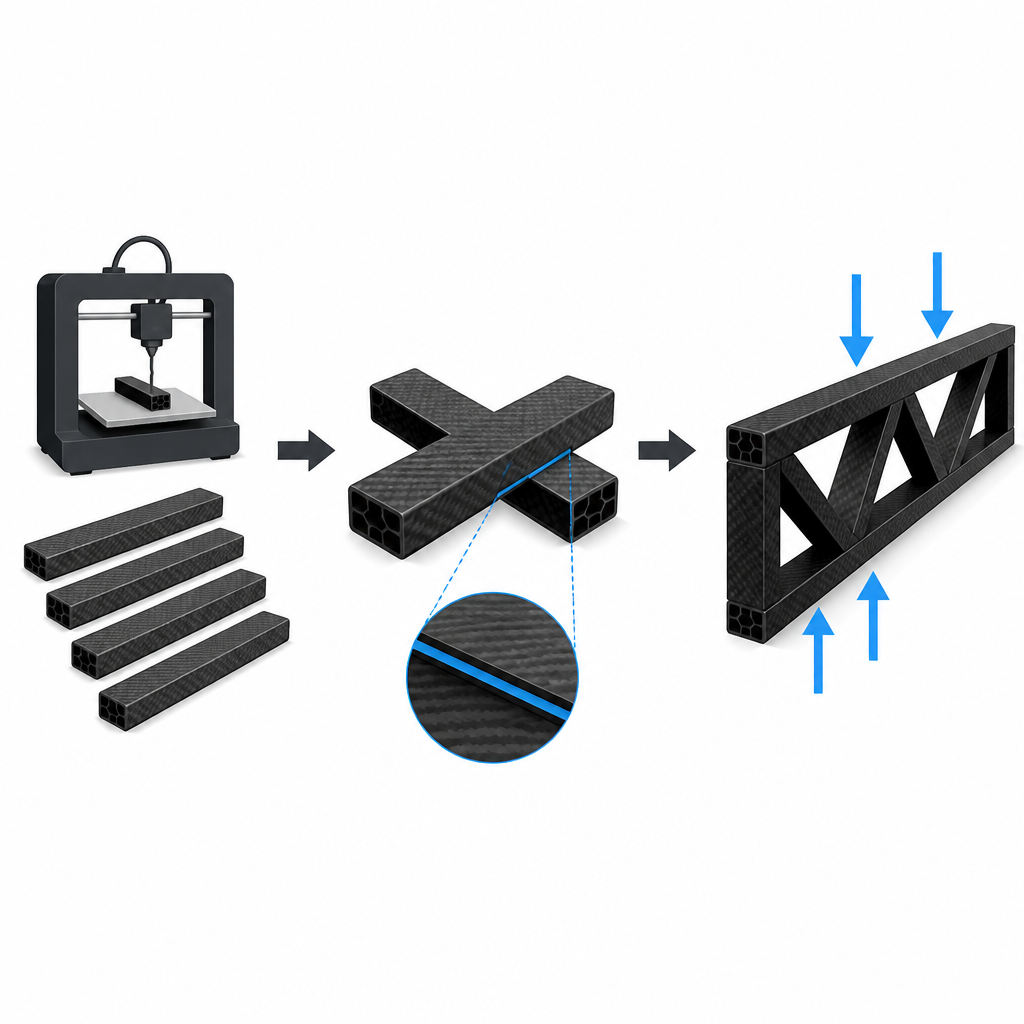
How the new joints behaved under bending and shear
The researchers then pulled and bent the bonded strips while measuring how much force they could carry and how far they stretched. Adding a small amount of graphene quickly increased the joint strength, and at about one and a half percent by weight the improvement was dramatic, more than doubling the shear strength and raising the bending strength by about two thirds compared with plain adhesive. At this level, the joints absorbed more energy before breaking and the way they failed changed from the glue peeling away from the plastic to the glue itself tearing, a sign of much better bonding between glue and printed part.
Looking closer at cracks and vibrations
To see why the graphene made such a difference, the team examined broken joint surfaces under a powerful electron microscope. In plain glue the fracture surface was smooth, showing that cracks cut straight through with little resistance. With the right graphene content, the surface became rough and full of tiny features where particles forced cracks to twist, branch, and bridge around them, delaying final failure. When too much graphene was added, the particles clumped together, creating weak zones where cracks could start more easily, which explains why strength dropped again at higher loadings. The team also tapped the joined strips to study how they vibrated, and found that the joints with the optimal graphene level had higher natural frequencies and lower damping, meaning they were stiffer and wasted less energy as they shook. 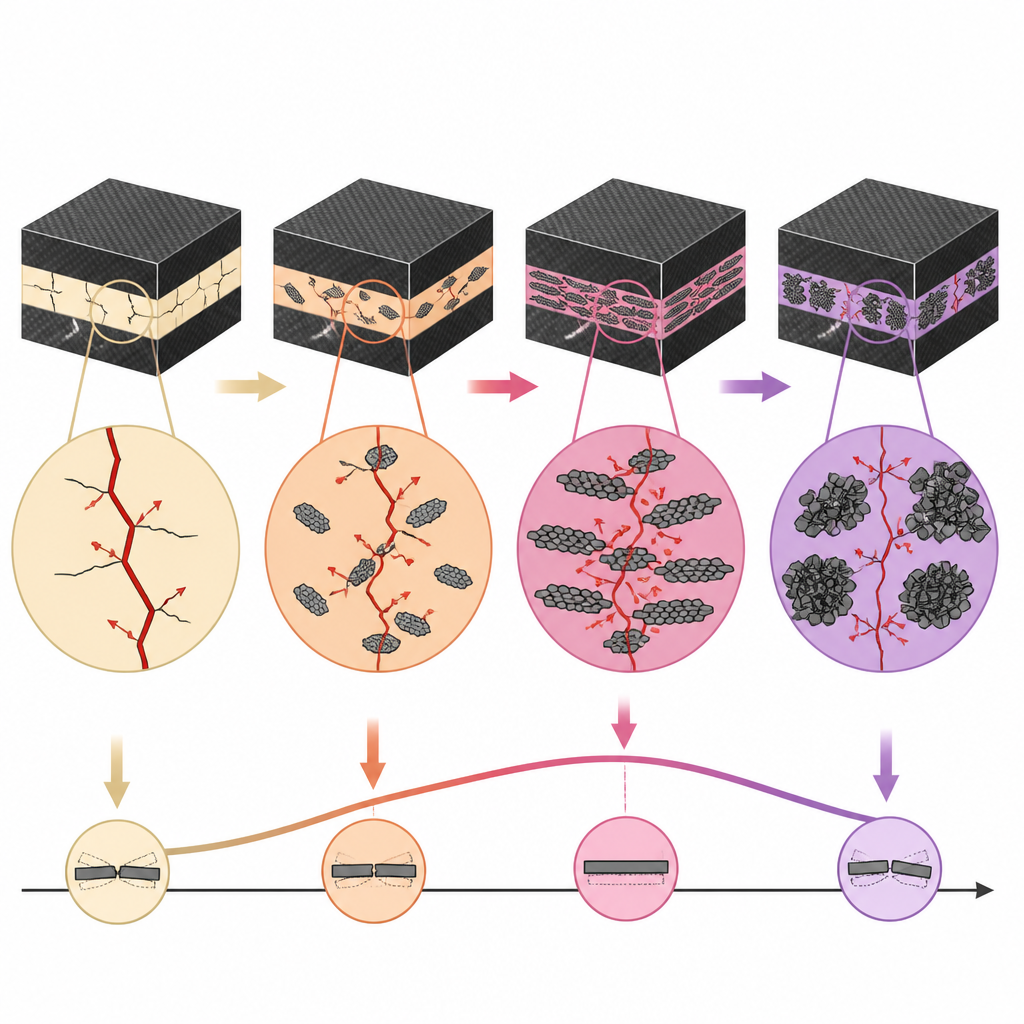
Teaching a computer to predict joint performance
Beyond the lab tests, the authors trained an artificial neural network, a type of computer model inspired by the brain, to predict how the joints would behave. They fed it information about the joint loads, the amount of graphene, and the observed responses in shear, bending, and vibration. After training, the model could closely match the measured results, with only a few percent error. This suggests that engineers could use similar models to quickly estimate how a new joint design will perform without having to build and test as many physical samples.
What this means for future 3D printed structures
In everyday terms, this work shows that carefully mixing a small amount of graphene into the glue used between 3D printed carbon fiber reinforced PLA parts can make their joints far stronger and stiffer, up to a clear optimum level. Combined with computer models that reliably predict performance, this approach could help designers create lighter, tougher 3D printed assemblies for vehicles, buildings, and devices that must stand up to real-world forces rather than just sitting on a desk.
Citation: Dhilipkumar, T., Karthikeyan, N., Murali, A.P. et al. Assessing the structural performance of additively manufactured carbon fibre reinforced PLA-based adherends bonded with graphene-enhanced adhesive using experimental and ANN analysis. Sci Rep 16, 15609 (2026). https://doi.org/10.1038/s41598-026-42780-w
Keywords: 3D printed joints, graphene adhesive, carbon fibre PLA, structural strength, neural network prediction