Clear Sky Science · en
An AI-generated art evaluation model that integrates computational aesthetics and cognitive psychology
Why judging AI made art matters
As AI systems flood our screens with paintings, photos, and designs, we still do not fully understand how humans decide whether this machine made art is beautiful, or how computers could meaningfully share that task. This study builds a bridge between how psychologists think the mind responds to art and how AI models score images, with the goal of making automated art ratings more aligned with human experience and easier to understand.
Connecting human feelings and machine scores
Most existing image scoring systems treat beauty as a black box number. In contrast, this work starts from well known ideas in psychology: people like images that are easy to process, that have clear structure, and that balance familiarity with novelty. The author turns these ideas into a step by step AI model that mimics how viewers move from raw sight to an overall feeling about a picture. The design combines basic visual organization, a measure of how hard an image is to interpret, and two different routes for making a judgment quickly or slowly. 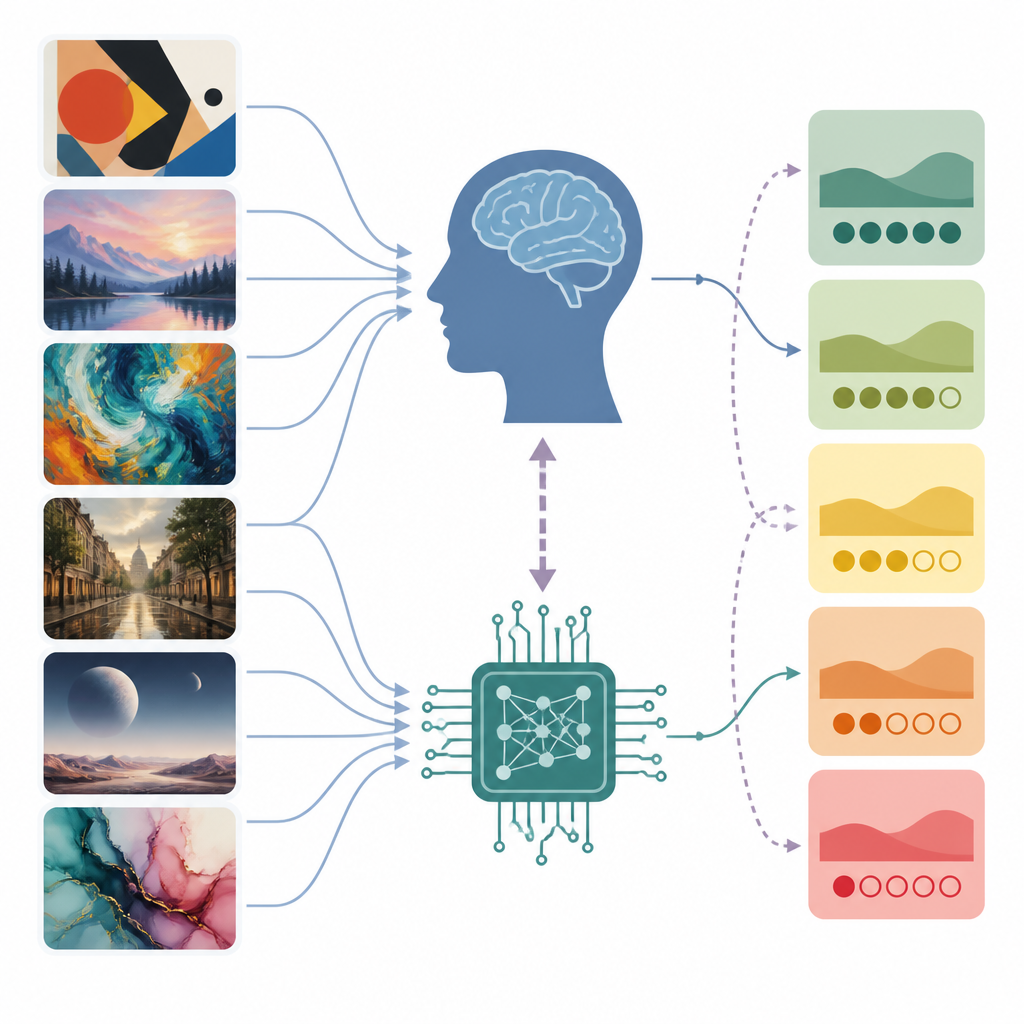
How the new evaluation model works inside
The model first organizes each image into meaningful regions, echoing the way our eyes separate figure from background and notice similarities, groupings, and complete shapes. It then estimates how easy the image is to process by combining visual clutter, familiarity with typical pleasing patterns, and the level of novelty, tuned so that moderate surprise is favored over boredom or confusion. On top of this, the model runs two pathways at once: a fast route that captures the overall look and mood in a fraction of a second, and a slower route that inspects local details, textures, and content more carefully before everything is fused into a final aesthetic score.
Putting the model to the test with people
To see whether these computations really match human experience, the study recruited 120 volunteers with different levels of art expertise. They viewed both human created and AI generated artworks that ranged from simple to visually dense, rated how much they liked them, and completed workload surveys that describe how mentally demanding each viewing felt. An eye tracker recorded where and for how long they looked at different parts of each image, and additional verbal reports captured how they reasoned about their choices. This rich mix of reaction times, gaze patterns, and self reports allowed direct comparison between the model’s inner workings and people’s actual viewing behavior. 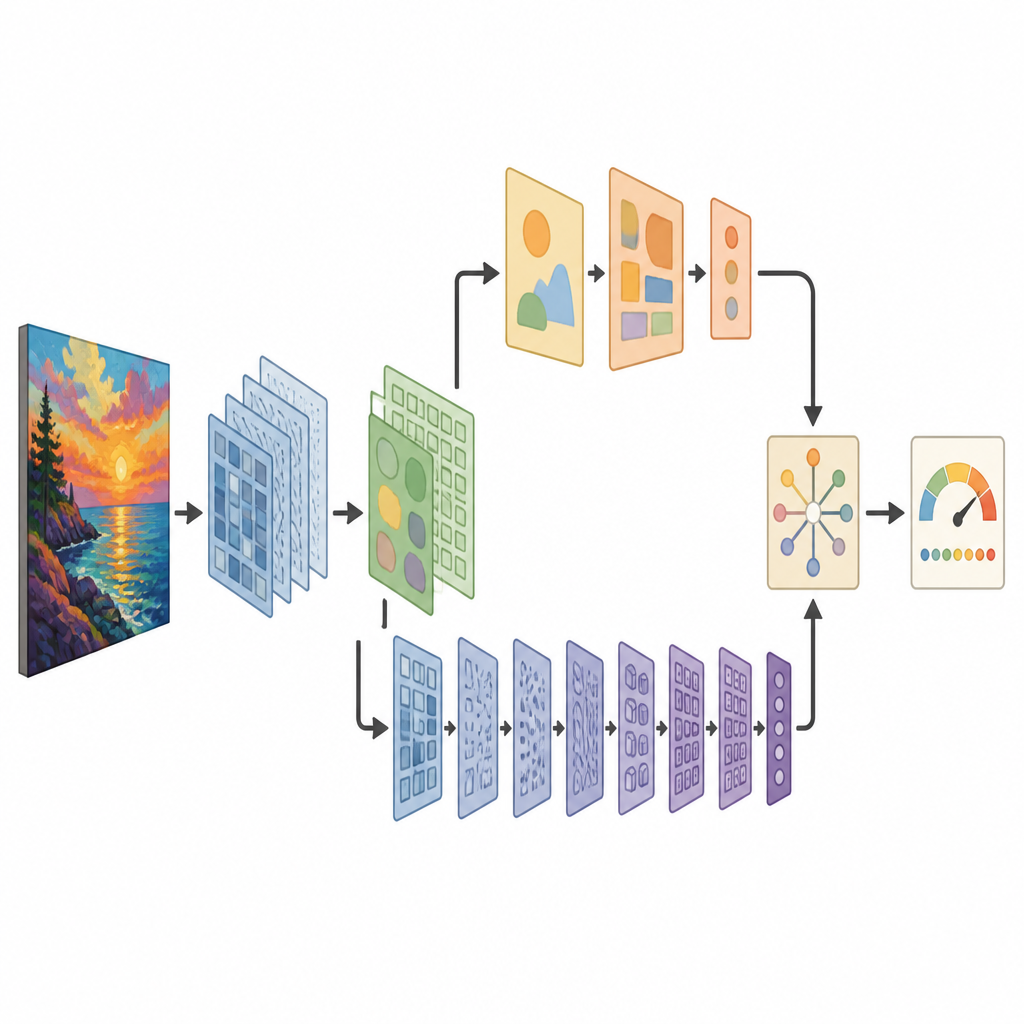
What the comparisons revealed
The AI’s ratings showed a strong match with human judgments, close to the agreement typically seen between different people. Its predictions lined up especially well for images with clear structure, where basic visual grouping rules are most obvious. The model also successfully tracked mental effort, correctly predicting which images would feel more demanding to process, particularly on measures such as mental demand and physical strain. Eye movement patterns from the model’s attention maps resembled human scanpaths: both focused more on visually and aesthetically important regions, and the timing of fast and slow viewing phases echoed the two pathway design. Yet the study also found that cultural background, personal associations, and art training explained many of the remaining mismatches, reminding us that beauty is never entirely universal.
What this means for our encounters with AI art
For a general reader, the key message is that it is possible to build AI systems that judge images in ways we can actually interpret, not just trust blindly. By rooting every part of the model in psychological ideas about attention, effort, preference, and emotion, the research shows that AI can help explain how we experience art, even as our reactions are shaped by culture and personal history. In practical terms, the framework can guide recommendation engines, digital learning tools, and gallery displays so they respect human limits and tastes. At the same time, the work underlines that AI should complement, not replace, human aesthetic judgment, serving as a lens on our minds rather than a final authority on what counts as beautiful.
Citation: Jin, C. An AI-generated art evaluation model that integrates computational aesthetics and cognitive psychology. Sci Rep 16, 15309 (2026). https://doi.org/10.1038/s41598-026-42766-8
Keywords: AI art, aesthetic judgment, cognitive psychology, eye tracking, image evaluation