Clear Sky Science · en
Hybrid dimension reduction and logit models for glare-induced crash severity
Why Bright Light Can Be Dangerous
Anyone who has driven straight into a rising sun or faced blinding headlights at night knows how suddenly the road can seem to disappear. This paper digs into when and where that kind of glare is most likely to turn a routine trip into a serious crash. Using eight years of detailed crash reports from Texas, the authors show that glare-related collisions are not random: they follow distinct patterns that depend on the type of road, speed, lighting, vehicles, and people involved. Understanding these patterns can help transportation agencies design smarter roads, lighting, and rules that keep drivers safer in difficult visual conditions.
How the Study Looked at Crashes
Rather than lumping all glare-related crashes together, the researchers first filtered more than 11,000 police-reported crashes in which officers noted that a driver’s vision was blocked by sun or headlights. They then used a two-step process: a clustering technique to sort crashes into groups with similar features, followed by statistical models to estimate how different factors change the odds of minor, moderate, or severe injury. This hybrid approach allowed them to uncover “hidden” patterns that simpler models can miss, such as how the same speed limit or vehicle type can have different safety implications depending on the road setting and lighting.
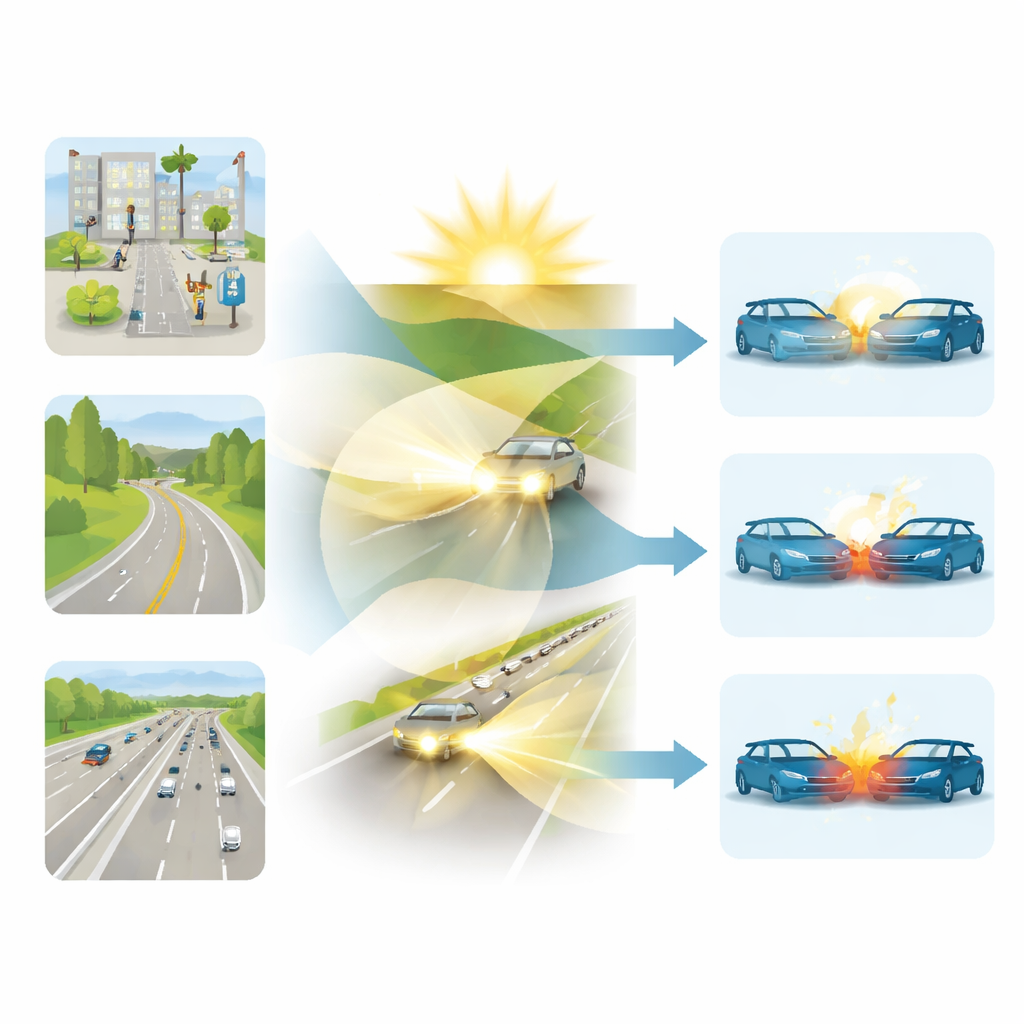
Three Main Situations Where Glare Matters
The analysis revealed three clear types of glare-related crashes. The first and most common involved low- to moderate-speed angle collisions in cities and towns, often at intersections where one vehicle is turning and another is going straight. In these settings, a brief burst of sun or headlight glare can make it hard to judge gaps or see oncoming traffic, but speeds are usually low enough that severe, life-threatening injuries are less common. The second type centered on high-speed rear-end crashes, typically on rural, multi-lane highways. Here, glare makes it harder to notice brake lights or slowing traffic ahead, and even a fraction of a second of delayed braking at 65–70 mph can turn a minor mistake into a major collision. The third type involved nighttime crashes on unlit two-lane rural roads, where oncoming high beams can effectively blind drivers, leaving little time or space to avoid a serious crash.
Who and What Is Most at Risk
The models showed that people, vehicles, and the environment all shape how dangerous a glare-related crash becomes. Crashes involving female passengers and Hispanic drivers tended to result in more moderate (but not necessarily fatal) injuries, suggesting differences in exposure, vehicles, or seating patterns that safety programs should consider. Younger drivers appeared somewhat less likely to suffer the most severe injuries under glare, possibly because their eyes adapt more quickly to sudden brightness changes than those of middle-aged adults. Larger vehicles such as sport-utility vehicles and pickup trucks often shifted outcomes from fatal to moderate injuries for their occupants, reflecting the protective effect of heavier, taller vehicles—but at the same time increasing the forces involved for others on the road.
Why Road, Speed, and Light Level Matter
Speed limits and lighting conditions strongly influenced injury severity across all three crash types. Lower speed limits and daytime conditions consistently reduced the odds of fatal or incapacitating injury. In contrast, higher speeds, straight-line travel, poor or absent roadway lighting, and strong headlight glare at night were all linked to greater harm. Two-lane, two-way roads in some urban and suburban settings tended to be more forgiving, while unlit rural roads were associated with more serious outcomes. These findings reinforce that the same glare can be relatively harmless at 25 mph on a city street but deadly at highway speeds on a dark country road.
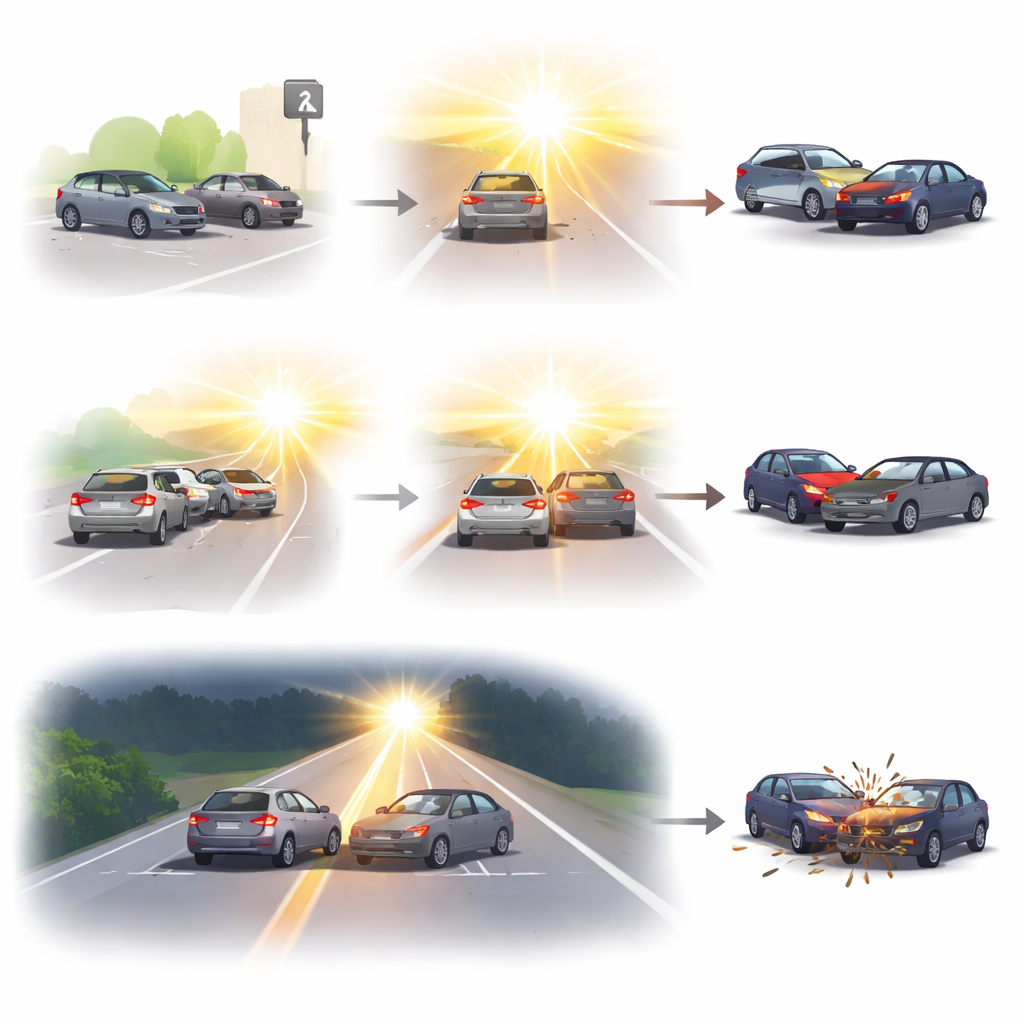
Turning Insights into Safer Roads
To a lay driver, the main takeaway is that bright light itself is not the only problem—what matters is how glare interacts with speed, road type, and lighting. The authors argue that safety solutions should be targeted to each crash type. For cities, that could mean lower dynamic speed limits and better intersection design during sunrise and sunset. For highways, it points to stricter speed control, brighter pavement markings, and more visible brake cues. For rural nighttime driving, adaptive headlamps and better rules for high-beam use could significantly cut the risk of deadly crashes. By combining advanced data analysis with real-world crash records, this study shows that glare-related danger is predictable and, with the right mix of engineering, technology, and education, can be greatly reduced.
Citation: Tusti, A.G., Starewich, M., Barua, S. et al. Hybrid dimension reduction and logit models for glare-induced crash severity. Sci Rep 16, 13691 (2026). https://doi.org/10.1038/s41598-026-42745-z
Keywords: sun glare, headlight glare, traffic safety, crash severity, roadway lighting