Clear Sky Science · en
Wavelength-dependent photofragmentation of pyrazine
Cosmic Light Breaking Apart Life’s Building Blocks
Ultraviolet light from stars does far more than give planets a sunburn. In the thin gas between the stars, these energetic rays can break large molecules into smaller fragments, shaping the chemistry that ultimately leads to planets and, potentially, life. This study explores how one such molecule, pyrazine—a simple ring containing carbon and nitrogen atoms—breaks apart under different colors of ultraviolet light, revealing hidden reaction pathways that matter for both biology and astrochemistry. 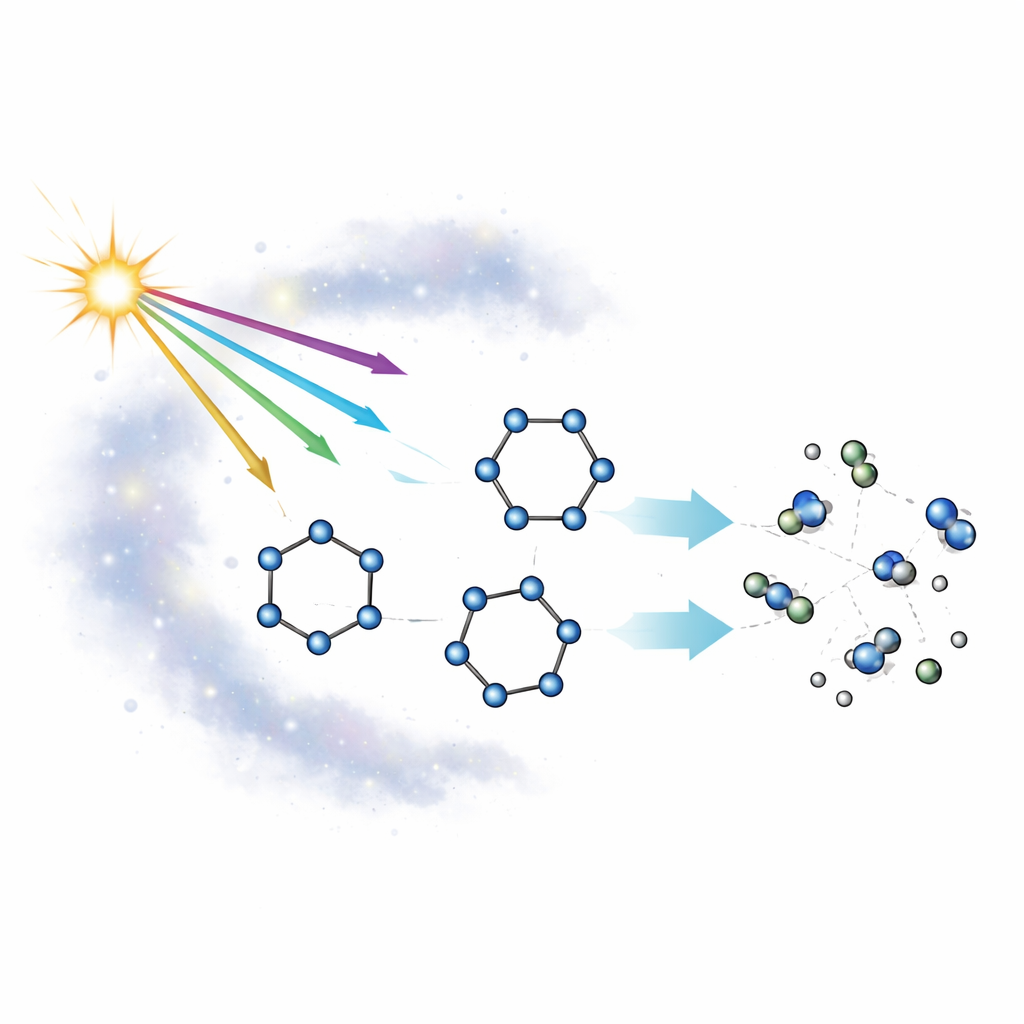
A Simple Ring with an Outsize Role
Pyrazine belongs to a family of nitrogen-rich ring molecules that resemble the cores of DNA and RNA bases and are common in pharmaceuticals and agricultural chemicals. In space, related rings are thought to seed the formation of larger carbon structures known as polycyclic aromatic hydrocarbons and their nitrogen-bearing cousins. These big molecules are abundant in regions bathed in strong starlight, where they are slowly chipped down into smaller bits. Understanding how a basic ring like pyrazine falls apart under ultraviolet light helps scientists trace how complex organic matter is recycled into simpler pieces throughout interstellar clouds and planetary atmospheres.
Two Colors of Ultraviolet, Two Different Breakup Stories
The researchers fired short, intense laser pulses at a jet of gaseous pyrazine using two specific ultraviolet colors: a deeper violet (266 nanometers) and a near-violet (355 nanometers). In both cases, the molecule absorbed more than one photon in quick succession, was kicked into a charged state, and then shattered into fragments that were weighed in a time-of-flight mass spectrometer. The deeper violet light tended to smash pyrazine into very small pieces, especially single carbon ions and tiny carbon–hydrogen fragments, while still leaving a faint signal from the intact charged ring. The near-violet light, by contrast, produced a richer variety of fragments and only a weak trace of the original ion, signaling more extensive and diverse breakup routes.
Hidden Rearrangements Before the Break
Some of the fragments formed under near-violet light could not be explained by simply snapping one or two bonds in the pyrazine ring. Notably, ions containing one carbon and two nitrogen atoms in a compact group appeared, suggesting that the atoms had shuffled around inside the ring before it broke. The authors propose that pyrazine first twists into a closely related ring shape, pyrimidine, which is slightly more stable and places the nitrogen atoms in different positions. This quiet reshaping, triggered by the absorbed light, opens new doors for how the molecule can then crack apart, making fragments that would otherwise be inaccessible. The team also observed additional rare fragments that point to extensive hydrogen movement within the molecule before bonds rupture. 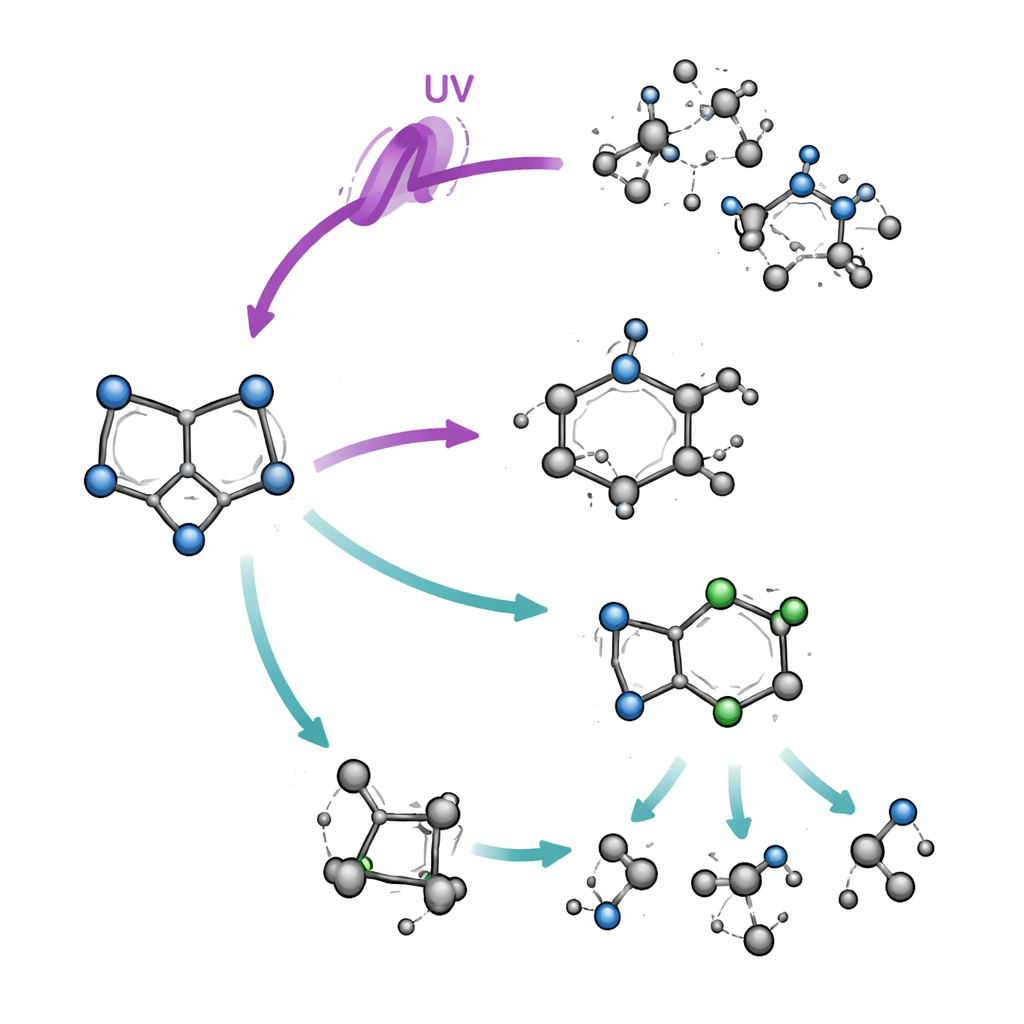
Measuring How Light Intensity Tips the Balance
By varying the brightness of the ultraviolet pulses, the researchers could infer how many photons typically drive each breakup route and how likely it is for the molecule to pass through the rearranged state. Some fragments grew steadily with increasing intensity, consistent with direct, rapid breakup pathways. Others behaved in a counterintuitive way: their signals actually declined as the light became stronger. This pattern suggests a competition between slower rearrangement-driven routes and faster direct shattering. At higher intensities, the molecule is more often blasted apart before it has time to reorganize, muting those more intricate pathways. These trends strengthen the case that photoinduced reshaping of the ring is a real and important step, not just a theoretical curiosity.
Why Starlight-Driven Breakups Matter
In space, ultraviolet light controls which molecules survive in bright regions near young stars and which are torn down into reactive fragments. The fragments identified here—small carbon and nitrogen ions and simple molecules such as HCN-related pieces—are known to power networks of reactions that build and destroy organic compounds in interstellar clouds and in atmospheres like that of Saturn’s moon Titan. Even though the experiments use intense laser pulses and multiple-photon events, they access the same excited states that single high-energy photons reach in space. By mapping out how pyrazine fragments under different ultraviolet conditions, this work gives astrochemists much-needed input for models of how complex nitrogen-bearing aromatics are processed in photodissociation regions and planetary skies, helping explain how starlight sculpts the raw materials for chemistry—and possibly biology—throughout the cosmos.
Citation: Payra, S.S., Thakkar, P., Lenka, Y. et al. Wavelength-dependent photofragmentation of pyrazine. Sci Rep 16, 12113 (2026). https://doi.org/10.1038/s41598-026-42710-w
Keywords: pyrazine, ultraviolet photodissociation, astrochemistry, nitrogen heterocycles, interstellar molecules