Clear Sky Science · en
Computational screening of AI-derived cyclotides as putative VEGFR2 binders for wound-site angiogenesis
Why stubborn wounds need new ideas
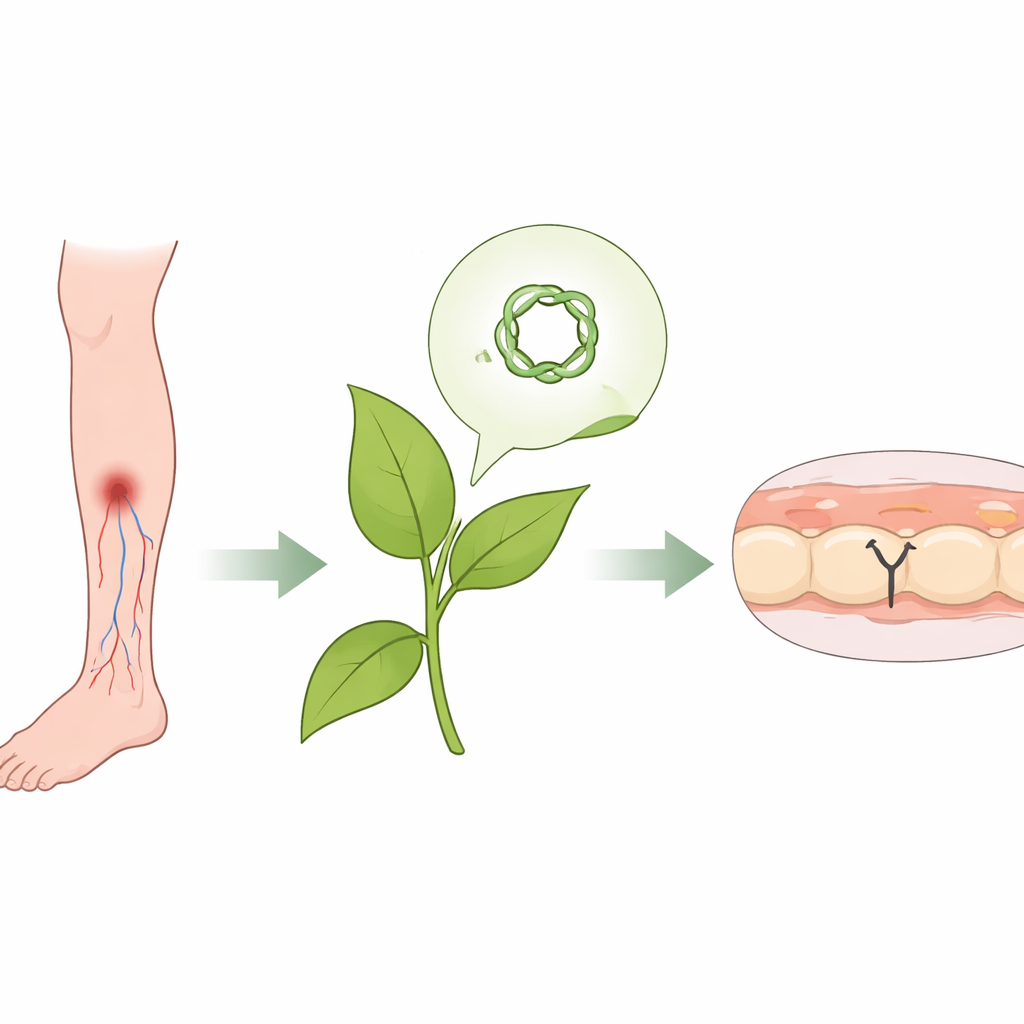
Some skin wounds, especially in people with diabetes, simply refuse to heal. A big reason is poor growth of new blood vessels, which starves the injured tissue of oxygen and nutrients. This study explores an unusual source of help: tiny, ultra‑stable ring‑shaped molecules from a common garden plant that might latch onto a key blood‑vessel switch on our cells and, one day, help jump‑start healing.
A plant molecule with staying power
The researchers focus on cycloviolacin O13, a member of the cyclotide family of mini‑proteins found in Viola odorata (sweet violet). Cyclotides form a closed ring tied together by three internal molecular “bridges,” making them extraordinarily tough against heat and digestive enzymes. That toughness is attractive for chronic wounds, where normal growth factors are quickly chewed up by proteases. Earlier work showed related cyclotides can kill bacteria and cancer cells, suggesting they readily interact with cell surfaces. Here, instead of using them to destroy cells, the authors ask whether one such cyclotide could be reshaped into a safe helper that supports blood vessel growth.
Targeting the body’s main vessel‑growth switch
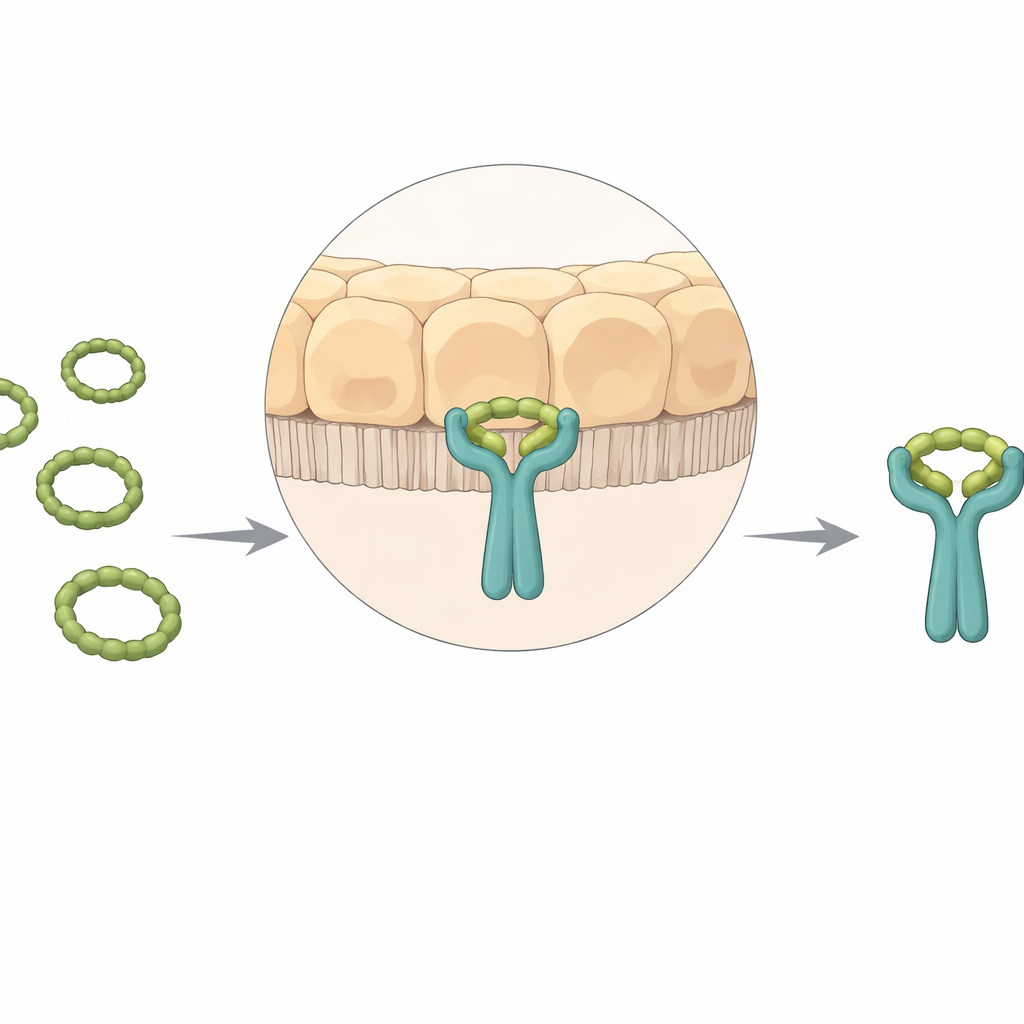
New capillaries in healing tissue are largely controlled by a receptor called VEGFR2 that sits on the surface of blood vessel lining cells. When its natural partner, VEGF, binds, VEGFR2 switches on signals that make cells divide, move, and organize into fresh vessels. In hard‑to‑heal wounds, this signaling is often too weak. The team set out to see whether any of 22 related cyclotides might bind stably to a suitable region on VEGFR2, potentially nudging this pathway in a useful direction. Rather than mixing real proteins in a lab, they built and tested these interactions entirely inside a computer, using modern structure‑prediction tools and physics‑based simulations.
Screening candidates in silico
First, they obtained a detailed three‑dimensional structure of the outer part of human VEGFR2 and rigorously checked its quality. They then used an AI‑driven tool (AlphaFold) to model each cyclotide’s shape and a separate program (PrankWeb) to predict the most likely surface pockets on VEGFR2 where a peptide could nestle. With this map in hand, they performed docking calculations, positioning every cyclotide into the best‑scoring pocket and estimating how tightly and consistently it would fit. Cycloviolacin O13 rose to the top, showing the strongest and most coherent binding pose among all candidates across multiple docking platforms.
Watching the complex move over time
Docking offers only a snapshot, so the authors next ran long molecular dynamics simulations—virtual movies following atoms over half a microsecond. They simulated three systems: VEGFR2 alone, the cycloviolacin O13–VEGFR2 pair, and the peptide by itself in water. The receptor‑peptide pair remained compact and stable throughout, with the bound peptide barely shifting in its pocket and a dense, persistent network of hydrogen bonds holding the interface together. In contrast, VEGFR2 alone wobbled more and adopted a looser shape. The peptide on its own behaved as a rigid, highly resilient ring, confirming that it can present a consistent surface to the receptor. Additional motion analyses suggested that when O13 is bound, local movements around the pocket become more coordinated without freezing the receptor entirely.
Early safety signals from the immune system
Because any new wound treatment must not provoke harmful immune reactions, the team used several online tools to estimate whether cycloviolacin O13 would look like an allergen, a toxin, or a strong immune trigger. Across these tests, the peptide scored as non‑allergenic, non‑toxic, and below standard thresholds for being seen as a foreign antigen. A simulated immune response showed only mild, transient antibody and cell‑based activity, without the hallmarks of a vaccine‑like reaction. The authors stress that these are only predictions, but they support the idea that O13 could be a relatively quiet guest in the wound environment if properly dosed and formulated.
What this means for future wound care
Taken together, the computations portray cycloviolacin O13 as a remarkably stable, plant‑derived ring peptide that can form a long‑lived, mechanically robust complex on a predicted binding pocket of VEGFR2, without obvious red flags for immune safety. However, the study cannot tell whether this binding will turn the receptor on, block it, or simply sit there harmlessly. It also cannot exclude unwanted effects, such as damage to delicate vessel cells at higher doses, which related cyclotides can cause. The real test will come from experiments in living cells and wound models, measuring VEGFR2 activation, downstream signaling, blood‑vessel formation, and safety. If those hurdles are passed, cycloviolacin O13—or an engineered cousin based on the same rugged scaffold—could form the basis of a new class of plant‑inspired dressings that help stubborn wounds finally close.
Citation: Karaca Ocak, Ö., Ali, N. Computational screening of AI-derived cyclotides as putative VEGFR2 binders for wound-site angiogenesis. Sci Rep 16, 13462 (2026). https://doi.org/10.1038/s41598-026-42662-1
Keywords: chronic wound healing, angiogenesis, VEGFR2, cyclotides, computational drug design