Clear Sky Science · en
Impact of exercise-induced fatigue on the risk of stress fractures in the tibia during smash landing in female badminton players
Why tired legs can spell trouble
Badminton looks light and fast, but every leaping smash slams the player back to the ground with several times their body weight. For elite female players, these repeated landings can quietly damage the shin bone (tibia) over time, sometimes ending seasons with painful stress fractures. This study asked a simple question with big implications for training: when players are truly tired, do their smash landings put their shins under more dangerous mechanical strain?
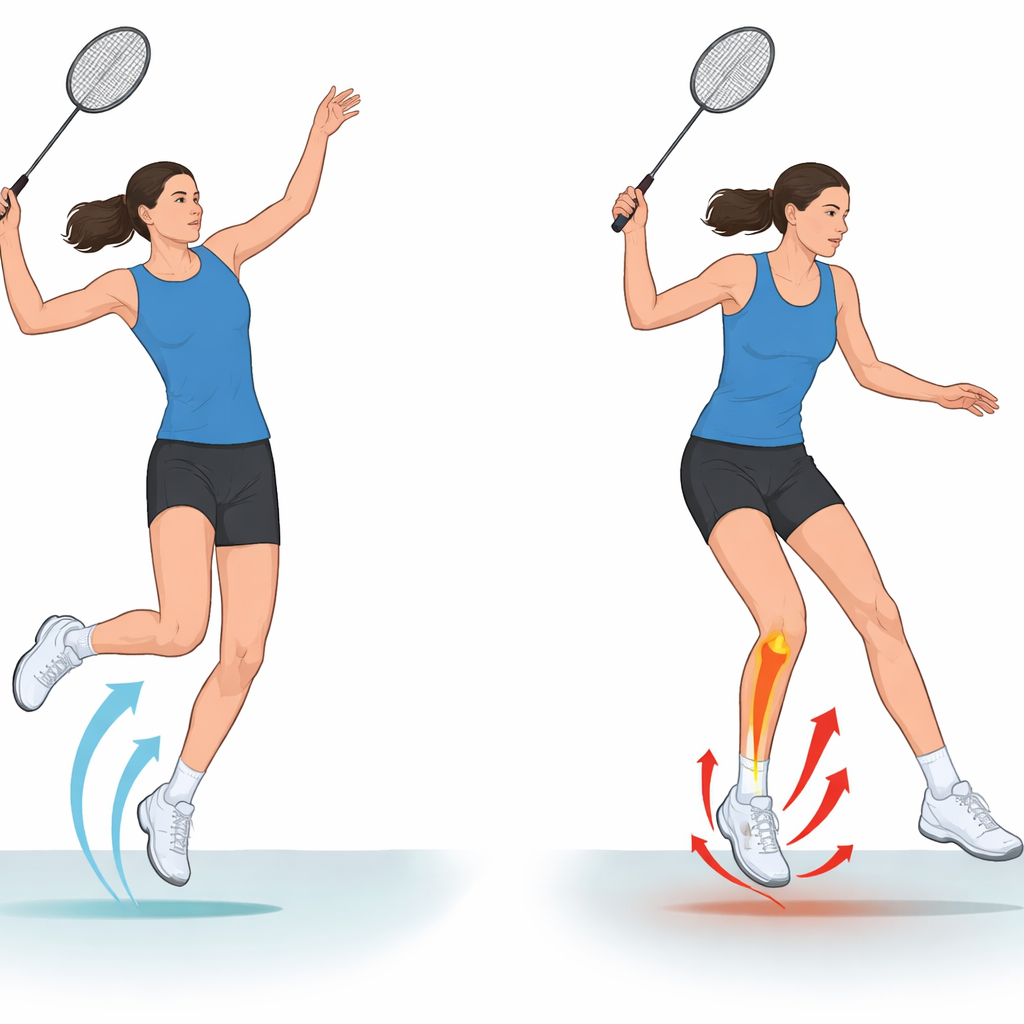
Hidden cracks in a hard-working bone
Stress fractures are tiny cracks that build up in bone when repeated loads outpace the body’s ability to repair itself. They do not come from one dramatic fall, but from thousands of everyday impacts that are just a bit too high, too fast, or too frequent. The tibia is one of the most vulnerable bones, and female athletes are at particular risk. While most research on tibial stress fractures comes from runners and soldiers, badminton is different: jump-smash landings involve sudden stops, sideways motion, and landing on one leg, all of which create complex forces along the shin.
Putting elite players to the test
The researchers studied 13 elite female badminton players performing two common backhand smash landings: a rearcourt jump forward onto one leg and a lateral jump smash that finishes on the non-dominant leg. Players first completed these moves when fresh. On another day, they went through a demanding, badminton-specific speed drill until their jump height fell, heart rate soared, and they reported near-maximal exertion. Before and after fatigue, high-speed cameras and force plates captured how their bodies moved and how hard they hit the ground. A computer-based body model estimated the pull of key calf and shin muscles, and a detailed three-dimensional model of the tibia translated all of these forces into stress and strain inside the bone.
What fatigue changes in a landing
Surprisingly, the players did not land with larger peak vertical forces when tired; the maximum force pushing up from the ground stayed about the same. Their hip, knee, and ankle did not bend much more or less either. The critical changes were subtler but more worrisome. After fatigue, the tibia experienced higher impact accelerations and the vertical load rose faster during landing. In other words, the force ramped up more sharply, giving muscles and soft tissues less time to cushion the blow. At the same time, the simulated force from the tibialis anterior—the muscle along the front of the shin that helps control the foot on landing—dropped noticeably, indicating that tired players were relying less on this protective muscle.
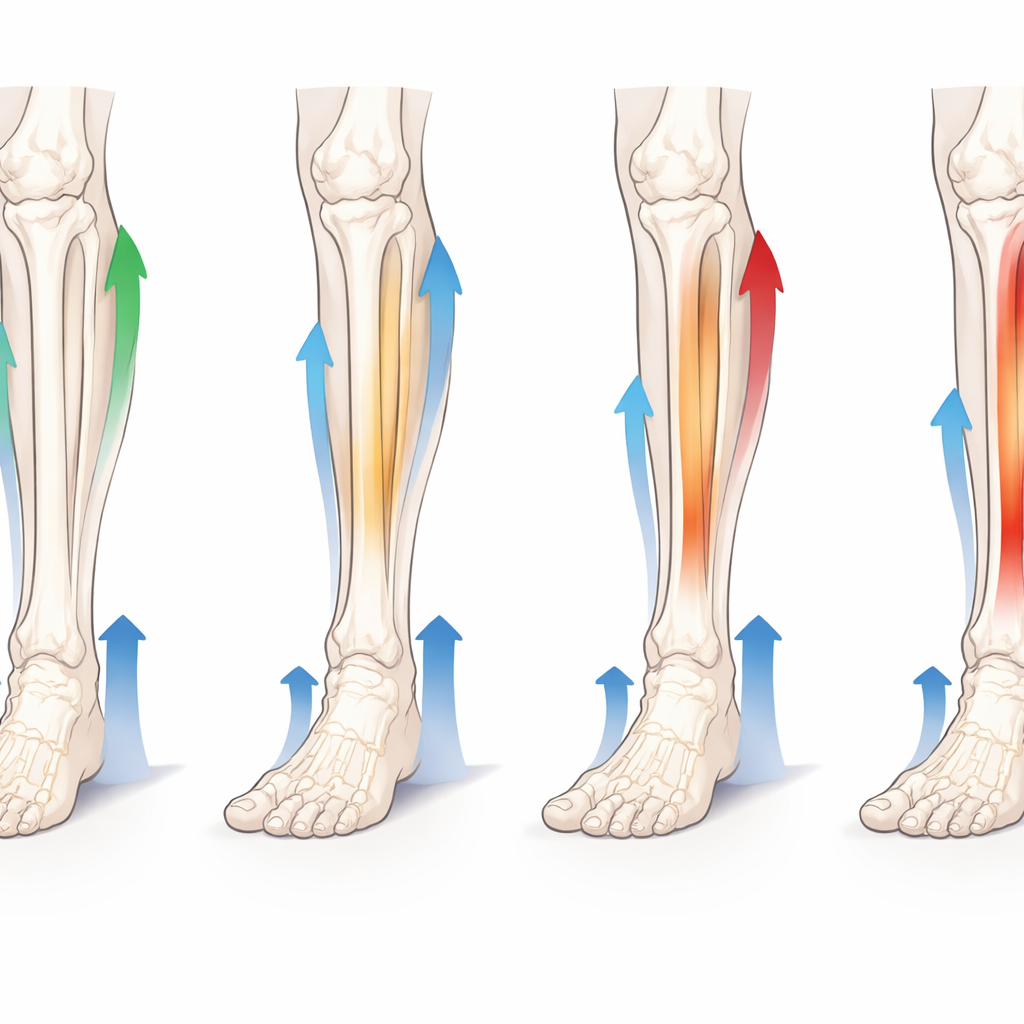
Stress hot spots inside the shin
When all of these external and internal forces were fed into the virtual tibia, a clear pattern emerged. In the fatigued state, stress and strain inside the bone rose dramatically—more than doubling, and in some landing types increasing several-fold—compared with fresh landings. The highest values clustered along the front-inner and back surfaces of the mid-to-lower shin, regions already known to be prone to stress injuries. Some landings under fatigue produced strain levels near or beyond thresholds that laboratory studies associate with accelerated micro-crack formation in bone. The lateral jump smash, which combines sideways movement with a one-legged landing, produced the largest increases, especially at the back of the tibia.
What this means for players and coaches
Although the study focused on a small group of elite women and used a single detailed bone model to avoid unnecessary medical imaging, the message is clear and practical. When these athletes become very tired, their landings change in ways that quietly raise mechanical risk to the tibia: the ground load rises more abruptly, the shin absorbs stronger jolts, and key stabilizing muscles contribute less. Together, these shifts create a harsher environment inside the bone that could speed the buildup of micro-damage if hard training or competition continues unchecked. For players and coaches, this highlights the value of managing fatigue, practicing soft, well-controlled landings even when tired, and strengthening shin and ankle muscles to help keep that crucial lower-leg bone safely within its limits.
Citation: Ma, J., Ye, B., Zhang, B. et al. Impact of exercise-induced fatigue on the risk of stress fractures in the tibia during smash landing in female badminton players. Sci Rep 16, 12419 (2026). https://doi.org/10.1038/s41598-026-42661-2
Keywords: badminton landing, tibial stress fracture, exercise-induced fatigue, female athletes, sports biomechanics