Clear Sky Science · en
RBF-assisted surrogate modeling and machine learning for mechanical property prediction in friction stir additive manufacturing: Application to dissimilar AA6061/AA7075 aluminum alloys.
Why this matters for future metal parts
Modern cars and aircraft need metal parts that are strong, light, and fast to produce. A promising technique called friction stir additive manufacturing (FSAM) can stack layers of aluminum without melting them, avoiding many defects of conventional 3D printing. But running large numbers of trial-and-error experiments to dial in the right process settings is expensive and slow. This study shows how a small set of real tests, combined with mathematical interpolation and machine learning, can help engineers explore which FSAM settings are likely to give better strength and hardness in mixed aluminum parts—while clearly spelling out what is prediction and what still needs to be proven in the lab.
Building parts by stirring, not melting
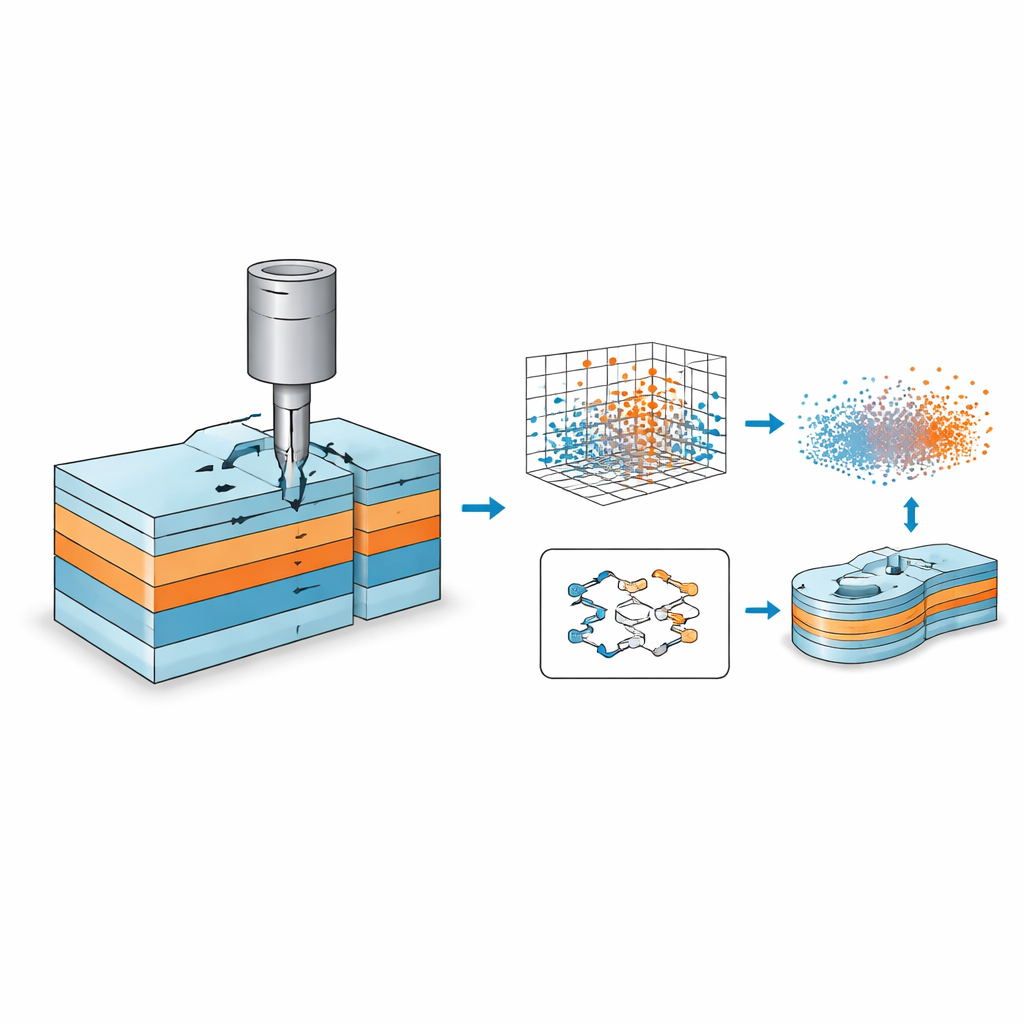
FSAM is a solid-state process: a rotating tool presses into stacked metal plates and moves along them, generating frictional heat that softens—but does not melt—the material. As the tool advances, it stirs and bonds fresh material into the structure, layer by layer. Because the metal never fully melts, FSAM avoids porosity and cracking that can plague fusion-based 3D printing and can produce fine, uniform grains similar to forged metals. The authors focus on alternating layers of two widely used aluminum alloys, AA6061 and AA7075, arranged in two stacking orders (6061-over-7075 and 7075-over-6061), to study how process settings affect ultimate tensile strength and Vickers hardness.
Doing more with just nine experiments
A key challenge is data scarcity: full-scale FSAM experiments are costly, time-consuming, and limited by machine availability and safety constraints. Here, only nine carefully chosen experiments (a Taguchi L9 design) were performed, varying three knobs: tool rotation speed, traverse speed, and tilt angle. To fill in the gaps between these nine points, the team used a mathematical technique called radial basis function (RBF) interpolation. RBF takes the measured data and builds a smooth surface across the three-parameter space. From this surrogate surface, they generated 882 synthetic data points, effectively creating a dense “virtual” map of how strength and hardness might vary within the tested window of speeds and angles.
Teaching models to learn the surrogate, not the world
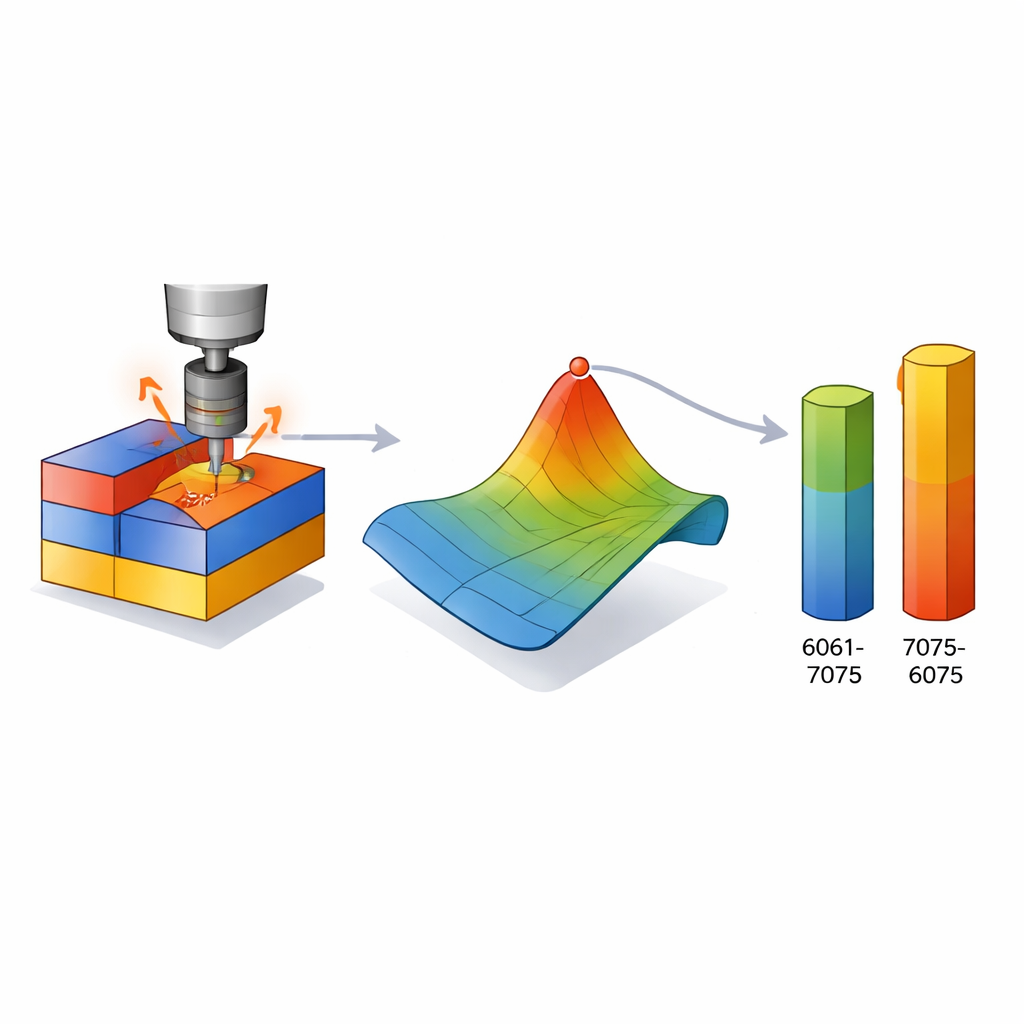
On this enriched dataset of 891 points (9 real + 882 synthetic), the authors trained three different regression models: Gaussian Process Regression (GPR), Support Vector Regression (SVR), and Bayesian Ridge Regression. These models were asked to predict tensile strength and hardness for both stacking sequences, given the three process parameters. GPR stood out, reproducing the RBF-based values with errors often below 1% and high R² scores (typically above 0.85 across the synthetic set). SVR showed modest, mostly systematic underestimation, and Bayesian Ridge—a linear method—struggled with the strongly nonlinear behavior, especially for hardness. Crucially, the authors emphasize that this near-perfect performance means the models have learned the RBF surrogate very well; it does not yet prove that they capture all the messy variability of real FSAM experiments.
Which knobs matter most under these conditions?
To make the models interpretable, the study uses SHAP (SHapley Additive exPlanations), a tool that assigns an importance score to each input parameter for each prediction. Within the synthetic design space, tool rotation speed emerges as the dominant driver for tensile strength in both stacking orders, with traverse speed next and tilt angle generally a distant third. For hardness, the picture is more balanced: rotation and traverse speeds trade places in importance depending on whether 6061 is on top of 7075 or vice versa. The analysis also highlights that the stacking sequence itself matters—the 7075-over-6061 configuration tends to reach higher strength and hardness under similar processing conditions, aligning with the higher baseline strength of AA7075.
What this framework can and cannot claim
To check realism, the authors perform leave-one-out tests on the original nine experiments. Errors there are several percent—much larger than on the synthetic points—showing that real measurements are noisier and that the surrogate cannot yet be treated as ground truth. The authors are explicit about this limitation: their framework is a way to explore trends and identify promising regions of parameter space when only a handful of experiments are available. Any “optimal” setting picked from the synthetic maps is, at this stage, a hypothesis that still needs independent experimental confirmation. Even so, the approach offers a reusable blueprint for other data-scarce manufacturing problems, combining sparse experiments, smooth interpolation, probabilistic machine learning, and explainable analysis to guide smarter follow-up testing rather than blind trial and error.
Citation: Venkatachalam, K., Selvaraj, S.K., Mannayee, G. et al. RBF-assisted surrogate modeling and machine learning for mechanical property prediction in friction stir additive manufacturing: Application to dissimilar AA6061/AA7075 aluminum alloys.. Sci Rep 16, 14168 (2026). https://doi.org/10.1038/s41598-026-42608-7
Keywords: friction stir additive manufacturing, aluminum alloys, surrogate modeling, Gaussian process regression, synthetic data