Clear Sky Science · en
Multi-criteria inventory classification considering demand stability
Why keeping the right spare parts matters
Imagine running a workshop where giant tunnel-boring machines carve subway lines under a city. If a key spare part is missing when a machine breaks, a whole construction site can grind to a halt. If you stock too much of the wrong part, money sits idle on the shelf and some items may never be used. This paper looks at a smarter way to decide which spare parts deserve the most attention, focusing not just on how much is used, but on how steady or jumpy that demand really is.
The usual way companies sort their stock
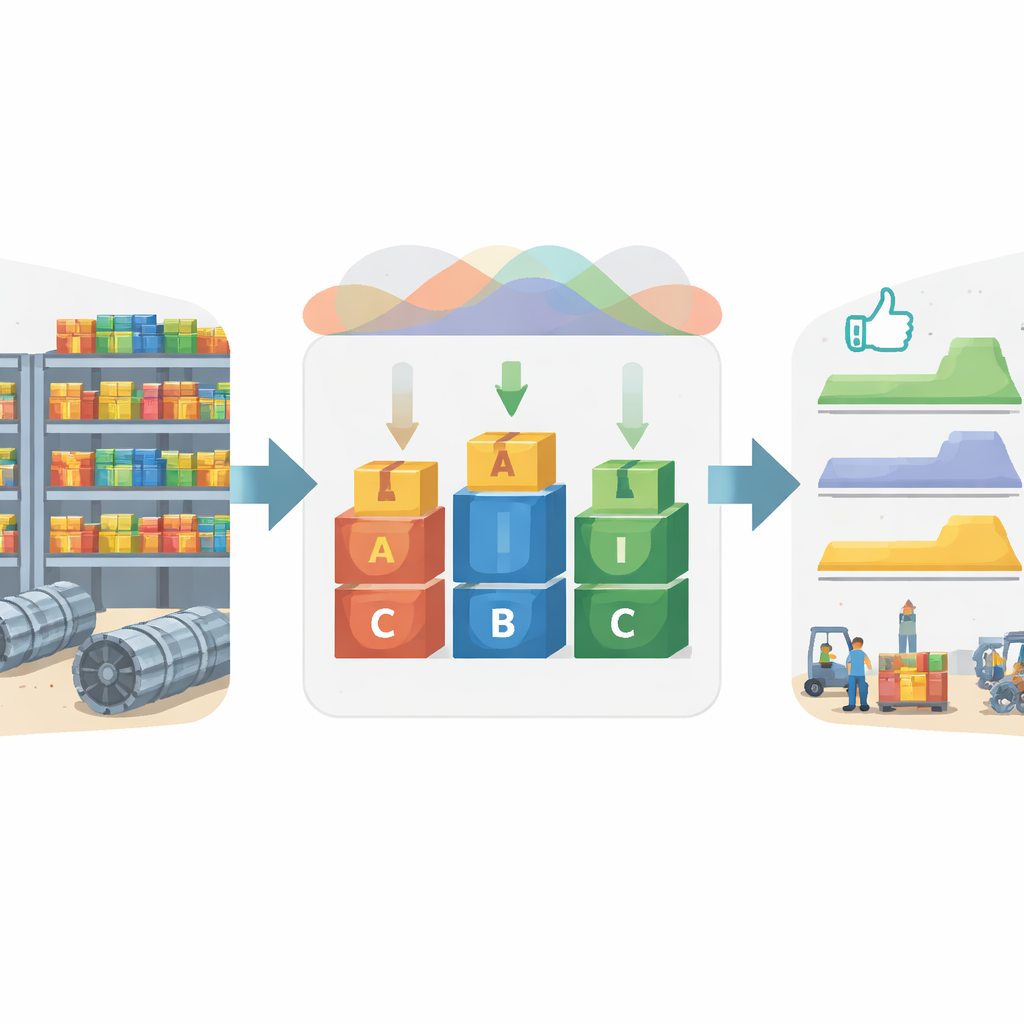
Most factories face thousands of different spare parts, known as stock-keeping units, or SKUs. To cope, they often use ABC classification: a small group of “A” items gets the tightest control, a middle group “B” gets moderate attention, and a large group “C” gets simpler, cheaper rules. Traditionally, this sorting relies on measures such as yearly usage in money terms or average demand. Many advanced methods have been proposed to combine several such criteria, including expert judgment, optimization models, and artificial intelligence. Yet nearly all of them treat demand as a single number and largely ignore how much that demand jumps up and down over time.
A new focus on how demand wiggles
The authors argue that the stability of demand is just as important as its size. A part that sells in steady amounts each month is fairly easy to manage, even if volumes are high. By contrast, a part whose demand swings wildly — sudden spikes followed by dry spells — is much harder to plan. If planners underestimate these swings, they risk painful shortages and emergency purchases. If they overreact, they may buy far too much, leading to obsolete stock. To capture this behavior, the study uses three simple statistics from past monthly demand: the average level, how widely it varies, and the gap between the highest and lowest month. All three are treated as signs that an item deserves closer attention when they grow larger.
How the two-step method ranks spare parts
The heart of the paper is a two-phase ranking method called the Double Ng-model, or D-Ng-model. It builds on an earlier, spreadsheet-friendly mathematical tool that can combine several criteria into a single score without asking managers to guess weights. In the first phase, the method looks only at the three demand-related measures and turns them into a “demand stability” score for each SKU. In the second phase, this score is combined with other practical factors, such as how expensive the part is and how long it takes to restock, to create a final priority score. Parts are then sorted from most to least critical and placed into A, B, or C groups according to the usual ABC proportions.

Testing the idea on tunnel-boring machine parts
To see whether the new approach really helps, the authors applied it to 52 spare parts used to service tunnel-boring machines at a Chinese manufacturer. Demand for these parts is notoriously hard to forecast, because projects depend on government policies, local ground conditions, and varied maintenance practices. The researchers compared the new D-Ng-model with the traditional Ng-model that does not explicitly measure demand stability. They found that several parts moved between classes when instability was taken into account: some items with modest average demand but very erratic usage were promoted to higher-importance groups, while others with steadier demand were demoted. Using standard formulas for stock levels and fill rates, they then simulated how each classification would perform in practice.
What better sorting means in real life
The analysis showed that, across a range of service-level targets, the new demand-aware method achieved slightly higher rates of orders filled on time while also lowering the cost of holding safety stock. The improvements were modest in percentage terms but meaningful in money, as even small savings add up when dealing with many items over long periods. Sensitivity tests on order quantities also revealed that simply buying more does raise service levels but with rapidly diminishing returns and rising risk of obsolete stock. For managers, the message is clear: paying attention to how bumpy demand is — not just how big it is — helps them focus effort and money on the parts most likely to cause trouble, leading to more reliable service at lower overall cost.
Citation: Wang, C., Ning, G. Multi-criteria inventory classification considering demand stability. Sci Rep 16, 10664 (2026). https://doi.org/10.1038/s41598-026-42590-0
Keywords: inventory classification, demand variability, spare parts management, ABC analysis, manufacturing logistics