Clear Sky Science · en
Introducing the inverted pendulum as a negative stiffness mechanism and a novel structural system to improve seismic performance using a quasi-zero stiffness approach
Why safer buildings matter
For people living in earthquake-prone regions, building safety is not an abstract concern—it determines whether homes, hospitals, and critical infrastructure remain usable after a major shock. This study presents a new way to protect buildings from earthquakes by rethinking how they are connected to the ground. Instead of simply making structures stronger or more rigid, the authors design a clever support system that allows the building to move in a controlled, gentle way so that dangerous shaking is filtered out before it reaches the occupied floors. 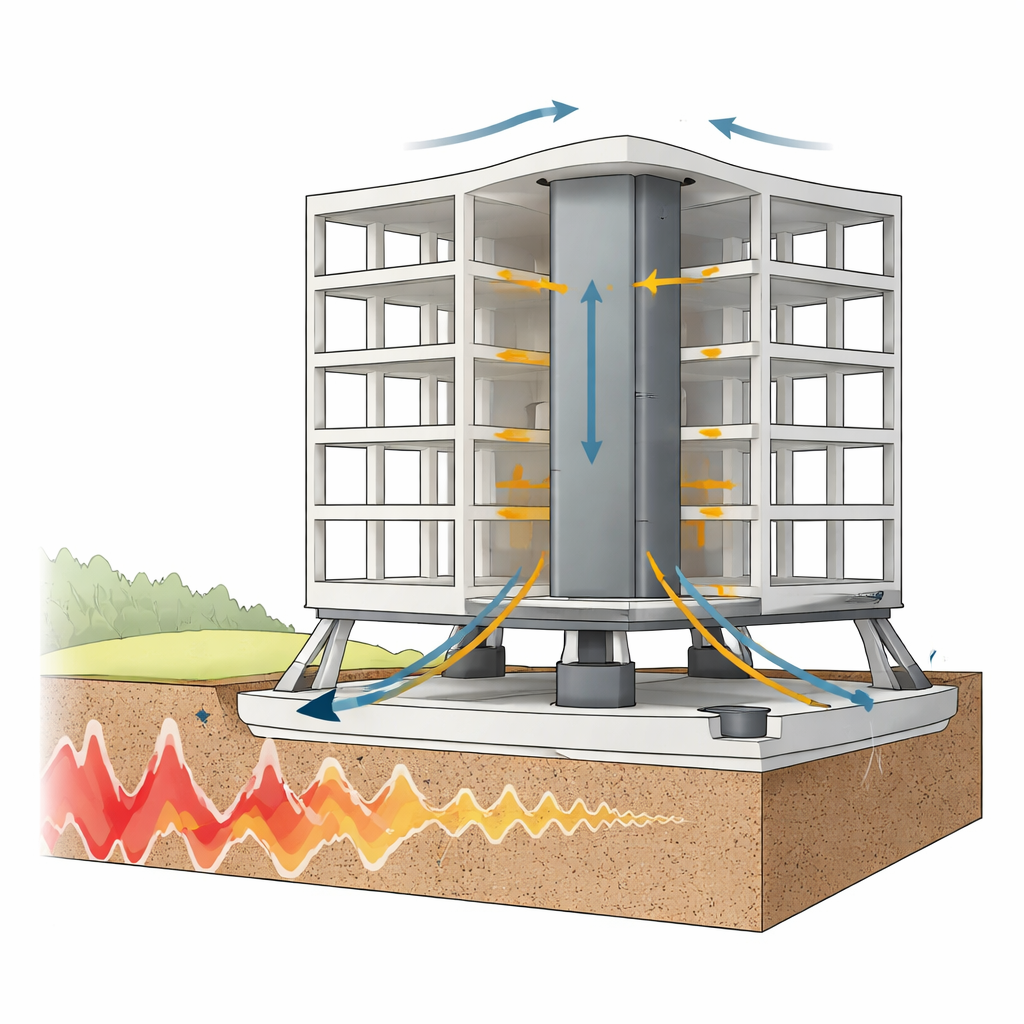
How buildings usually fight earthquakes
Traditional buildings are designed mainly to carry vertical weight from floors, walls, and roofs. Over time, engineers added braces, shear walls, and rigid frames to better handle sideways pushes from earthquakes. These measures increase a building’s lateral stiffness, which helps it stand up to strong forces but can also cause large internal forces and damage when the ground moves quickly. To reduce this problem, modern seismic isolation systems place flexible elements—such as rubber bearings or sliding pendulums—between the building and its foundation. These systems lengthen the building’s natural “swaying” period so that it moves out of sync with the most damaging earthquake frequencies, cutting down the shaking that reaches the structure.
A new twist: using “negative stiffness”
The innovation in this paper is to deliberately combine two opposite behaviors in one hybrid system: positive stiffness, which tends to pull a displaced object back toward its starting point, and negative stiffness, which tends to push it farther away. The positive part is provided by a pendulum-based isolator—similar in spirit to existing pendulum bearings—while the negative part comes from an inverted pendulum formed by a heavy central core supported on pin-ended columns. When arranged together, the outer structural shell rests on pendulum isolators that want to recentre it, while the heavier inner core behaves like a slightly unstable column that “softens” the overall sideways resistance. The result is a quasi-zero stiffness state: over a useful range of motion, the building feels extremely flexible, so it sways slowly and gently instead of jerking with the ground.
How the hybrid system works in practice
To understand the mechanism, the authors first write down the equations of motion for a pair of connected pendulums—one normal and one inverted—using energy methods. These equations show that introducing negative stiffness effectively increases the system’s vibration period, as if a short pendulum suddenly behaved like a much longer one. In numerical tests, a one-meter pendulum equipped with negative stiffness responded as though it were five meters long. The team then simulates the system’s response under three well-known earthquake records from the United States and Japan. They compare several cases: a fixed-base structure, a structure with only positive-stiffness isolation, and the new hybrid system with various levels of damping. 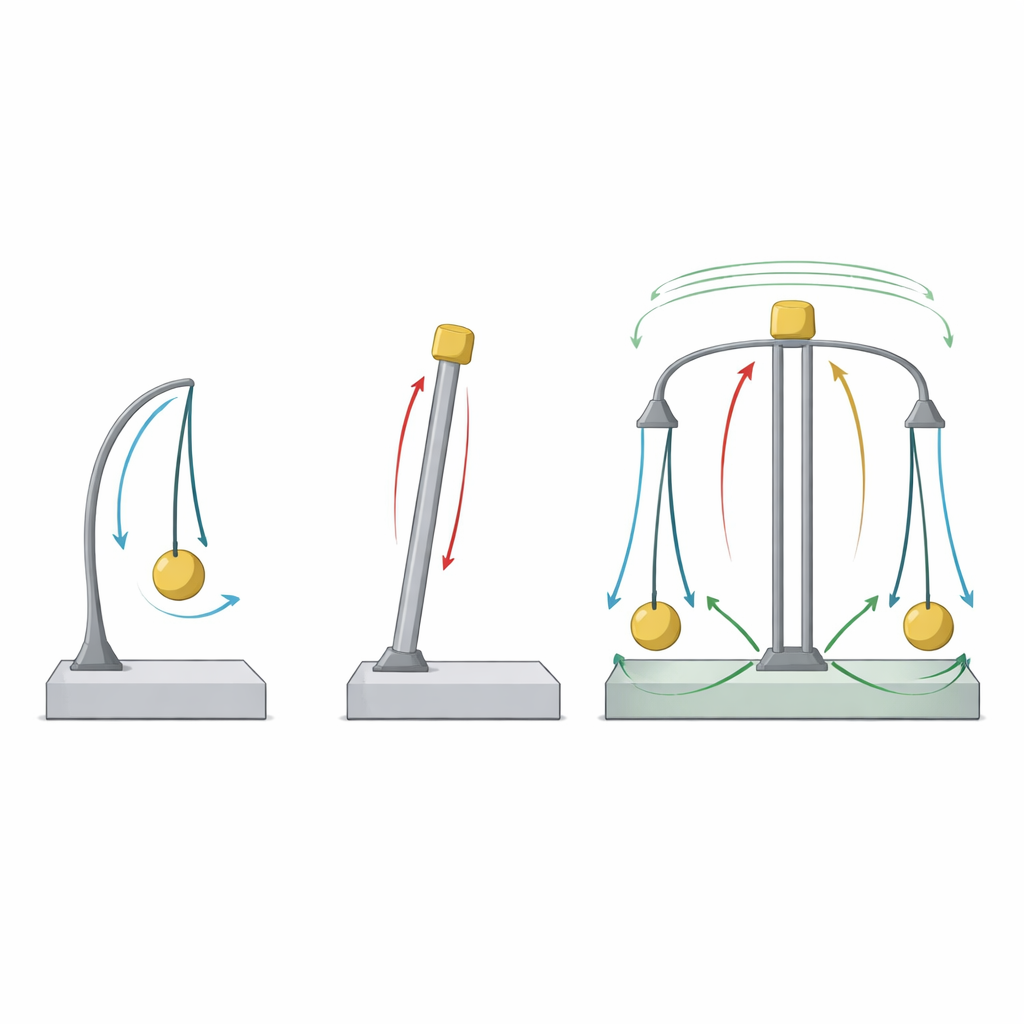
What the simulations reveal
The earthquake analyses show that adding negative stiffness dramatically reduces acceleration transmitted to the structure, making the motion smoother and less violent for occupants and contents. Importantly, unlike many conventional isolators that achieve lower accelerations at the cost of larger displacements, the proposed system can actually reduce displacements as well. Energy-based measures confirm that the hybrid isolator lets less seismic energy enter the structure compared with both a fixed frame and a standard isolated system with the same basic period. Fast Fourier Transform analysis, which breaks the motion into its frequency components, further demonstrates that the hybrid system filters out much of the damaging frequency content, while added damping keeps resonance under control.
Testing the idea on a realistic building
To move beyond abstract models, the authors design a four-story steel frame made of two interacting parts. The outer frames sit on pendulum isolators and supply positive stiffness, while the heavier central block is supported on pin-ended columns that act as the inverted pendulum. Numerical simulations using commercial structural software show that this configuration can achieve an extremely long effective period—comparable to that of a building supported on a pendulum tens of meters tall, even though the actual pendulum length is only about one meter. Under strong earthquakes, the building’s floor accelerations drop to near-zero levels and displacements remain modest. Additional studies examine how sensitive the system’s period is to the mass ratio between the two parts, how it remains stable against overturning, and how simple mechanical or electronic locks could keep it still under wind or everyday use, releasing it only during earthquakes.
What this means for future buildings
In plain terms, this research shows that by carefully balancing a stable pendulum system against an intentionally unstable inverted pendulum, engineers can create building supports that are extraordinarily soft to earthquake shaking without needing tall, awkward pendulum spaces. The building’s own heavy core becomes part of the protective mechanism, turning negative stiffness from a problem into a tool. The study’s models and simulations suggest that such a hybrid isolator can sharply reduce both the shaking and movement of structures during earthquakes, while remaining stable and practical to build. If further developed and tested experimentally, this approach could lead to a new generation of earthquake-resistant buildings that feel almost calm even when the ground is violently in motion.
Citation: Azizi, A., Barghian, M. Introducing the inverted pendulum as a negative stiffness mechanism and a novel structural system to improve seismic performance using a quasi-zero stiffness approach. Sci Rep 16, 14343 (2026). https://doi.org/10.1038/s41598-026-42589-7
Keywords: seismic isolation, negative stiffness, pendulum systems, earthquake engineering, vibration control