Clear Sky Science · en
Drought pattern under climate change in Harris County, Texas, USA based on CMIP6 projections
Why future droughts in Houston matter
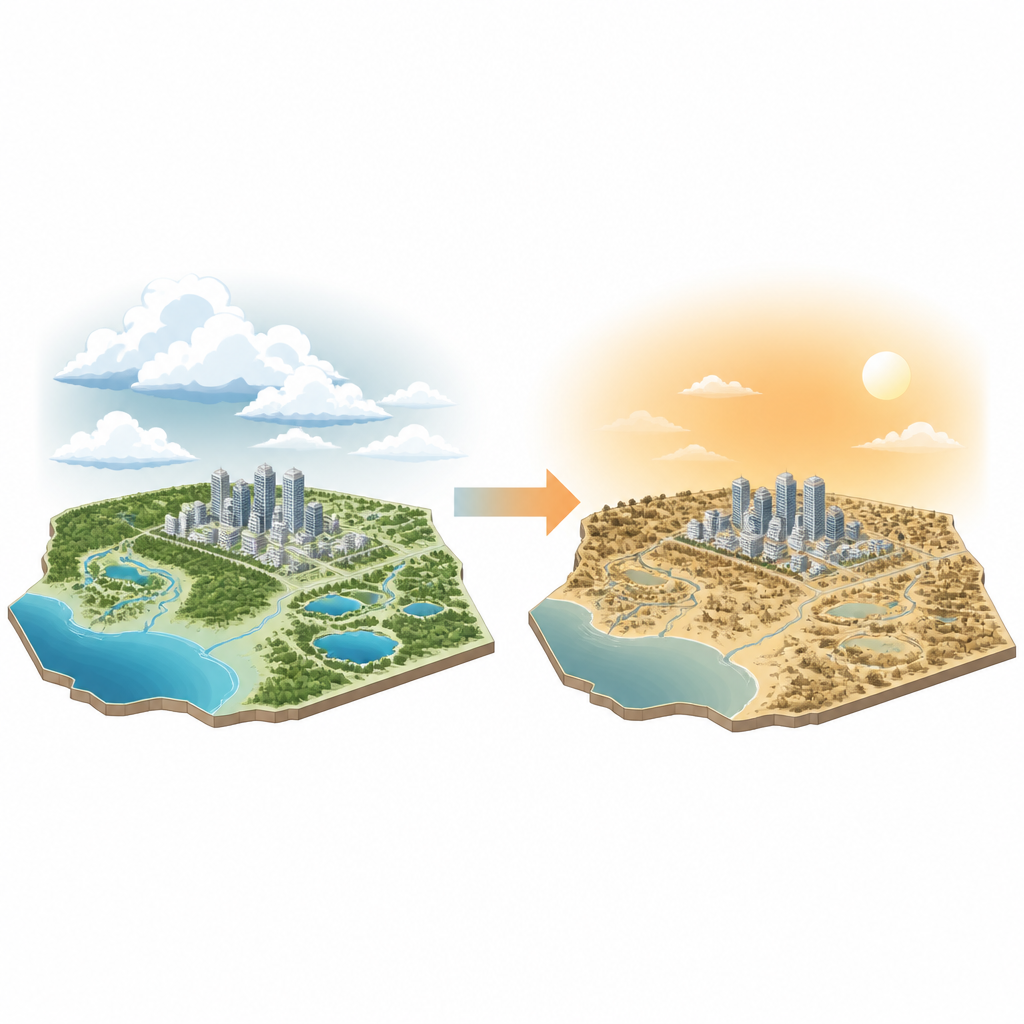
Harris County, home to Houston, is known for thunderstorms, bayous, and tropical downpours, not just dry spells. Yet this study shows that in the coming decades the county is likely to face more frequent and intense droughts that could strain water supplies, agriculture, and daily life. By zooming in from global climate models to a single Texas county, the researchers offer an early warning that today’s relatively comfortable conditions may not last.
Looking ahead with climate simulations
To peer into the future, the team used five advanced global climate models from the latest CMIP6 project and focused them on Harris County using a high resolution NASA dataset. They compared three different futures, ranging from strong climate action with lower greenhouse gas emissions to a world that keeps heavily relying on fossil fuels. For each case, they examined daily temperature and rainfall from 2026 to 2085 and compared those projections with detailed weather records from 1980 to 2024.
Measuring when wet turns to dry
Instead of looking at rainfall alone, the researchers used a drought index called SPEI, which balances how much water comes in as rain against how much is pulled back into the air by warmth and dry air. They calculated it at two time scales: about half a year and a full year. This allowed them to track both shorter dry spells and long lasting shortages. Drought events were flagged whenever the index dropped below a set threshold, and each event was scored for how long it lasted, how severe it was, and how intense the average dryness became.
An up and down pattern with a sharp turn
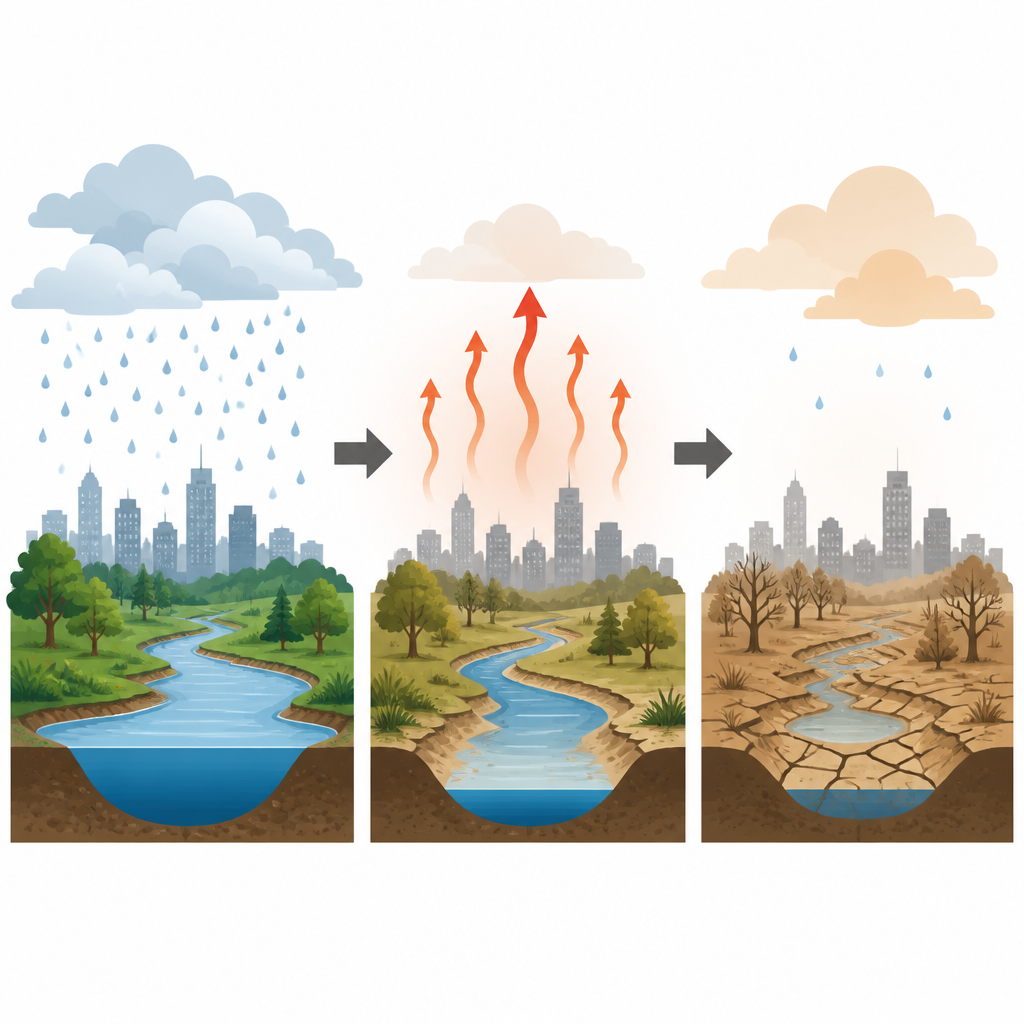
When the team looked back over the past four decades, they found an oscillating pattern. From 1980 to 2002 Harris County saw many droughts. From 2003 to 2024, however, droughts became less frequent, and the long term index even showed a slight trend toward wetter conditions. The models suggest this lull is temporary. Under all future pathways, especially those with higher emissions, droughts become more common again after mid century. Under the highest emissions case, the share of months in drought more than doubles in the 2056 to 2085 period compared with the earlier decades.
Hotter air, thirstier atmosphere
The projected shift arises from two linked changes. First, average temperatures keep rising, with the hottest scenario adding more than 4 degrees Celsius to daytime highs by late century. Warmer air can draw more moisture from soil, plants, and water bodies. Second, rainfall is expected to decline overall, with some months hit especially hard. August stands out, with projected rain drops of roughly one third under the high emissions case. This combination of less supply and greater demand means that even modest changes in rainfall can tip the balance toward long, deep dry periods.
What stronger droughts mean for the county
By analysing how often droughts of different lengths and strengths are likely to recur, the study finds that long term droughts in the future could be around five times more severe than those in the historical record. That level of stress would challenge reservoirs, groundwater, and river systems that were planned using past climate patterns. The authors argue that Harris County is in a brief window when drought risk is still relatively low, offering time to upgrade water storage, rethink landscaping and irrigation, and plan for a hotter, drier climate. Their results also underline a wider lesson: choices about global emissions today will strongly influence how hard future droughts hit communities along the Gulf Coast and across the southern United States.
Citation: Abeysingha, N.S., Ray, R.L., Kularathna, K.M. et al. Drought pattern under climate change in Harris County, Texas, USA based on CMIP6 projections. Sci Rep 16, 14948 (2026). https://doi.org/10.1038/s41598-026-42547-3
Keywords: Harris County drought, climate change Texas, future water security, CMIP6 projections, urban drought risk