Clear Sky Science · en
Microscopic insight into the origin of super-cooled NCCDW state in 1T-TaS₂ nanocrystals
Why cooling can change how crystals behave
Most of us think of cooling as a simple way to make things colder, but in some materials the cooling speed can actually change how their atoms arrange themselves and how well they conduct electricity. This study looks at an ultra-thin crystal called 1T-TaS₂ and shows, in microscopic detail, how fast cooling can trap it in a special metallic state that does not normally appear in standard temperature charts, revealing how timing can be just as important as temperature.
A stack of ultra-thin crystal sheets
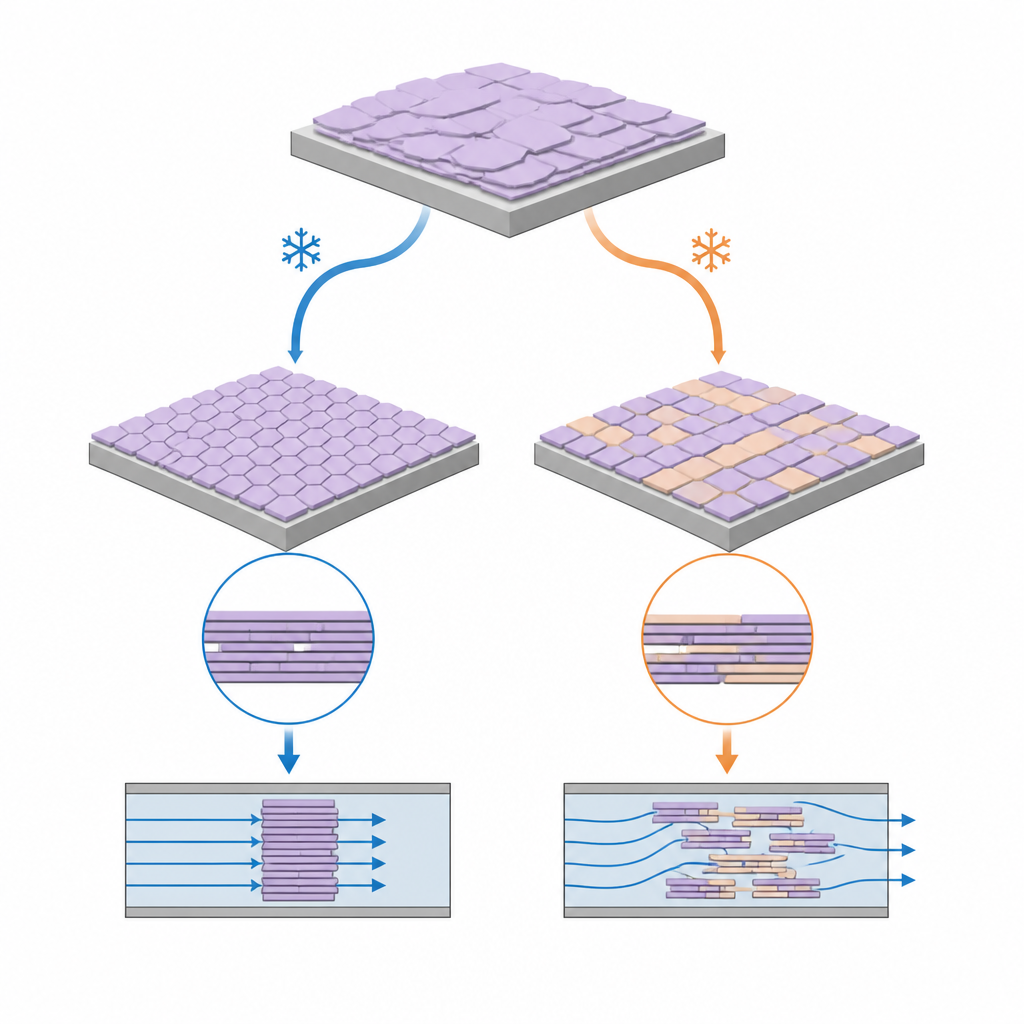
1T-TaS₂ belongs to a family of layered materials that can be peeled into flakes only a few atoms thick. Because the atoms form flat sheets stacked like a deck of cards, their electronic properties can change dramatically with temperature, pressure, or light. As this material cools, electrons and atoms team up to create repeating patterns called charge density waves, which reshape the crystal and can turn a good conductor into an insulator. At high temperature the crystal behaves like a metal, but on cooling it first enters a slightly ordered state and, at still lower temperature, can lock into a more rigid pattern that blocks electron motion and makes it strongly resistive.
How fast cooling keeps the crystal conducting
The researchers made tiny devices from exfoliated 1T-TaS₂ flakes placed on silicon chips and contacted them with gold electrodes, then measured current as they cooled and warmed the samples. When they cooled the nanocrystals slowly, the electrical resistance jumped sharply around 180 kelvin, signaling a switch from a low-resistance state to a highly insulating one. When they instead cooled the same kind of thin flakes much more quickly, the resistance stayed low across the whole temperature range, even deep into the region where an insulator would normally appear. In other words, fast cooling prevented the usual low-temperature insulating phase and held the material in a metallic state that standard phase diagrams do not capture. Larger, thicker crystals did not show this behavior: they followed the usual path and became insulating regardless of how fast they were cooled, underscoring that the effect is special to very thin samples.
Watching the lattice as it tries to rearrange
To understand what changes inside the crystal, the team used single-crystal X-ray diffraction to track the shape of the unit cell, the basic repeating block of the lattice, under different cooling protocols. During gradual cooling, both in-plane and out-of-plane lattice spacings suddenly expanded near 180 kelvin, even though the temperature was dropping. This unusual volume increase matches the formation of a more strongly distorted pattern of atoms that accompanies the insulating state. After a rapid cool, however, this expansion was almost entirely suppressed: the unit cell remained close to its high-temperature size and shape. This shows that the large-scale lattice rearrangement required for the insulating phase simply does not have time to complete when the crystal is quenched, which lines up with the electrical measurements that indicate the material stays metallic.
Frozen islands inside a mixed landscape
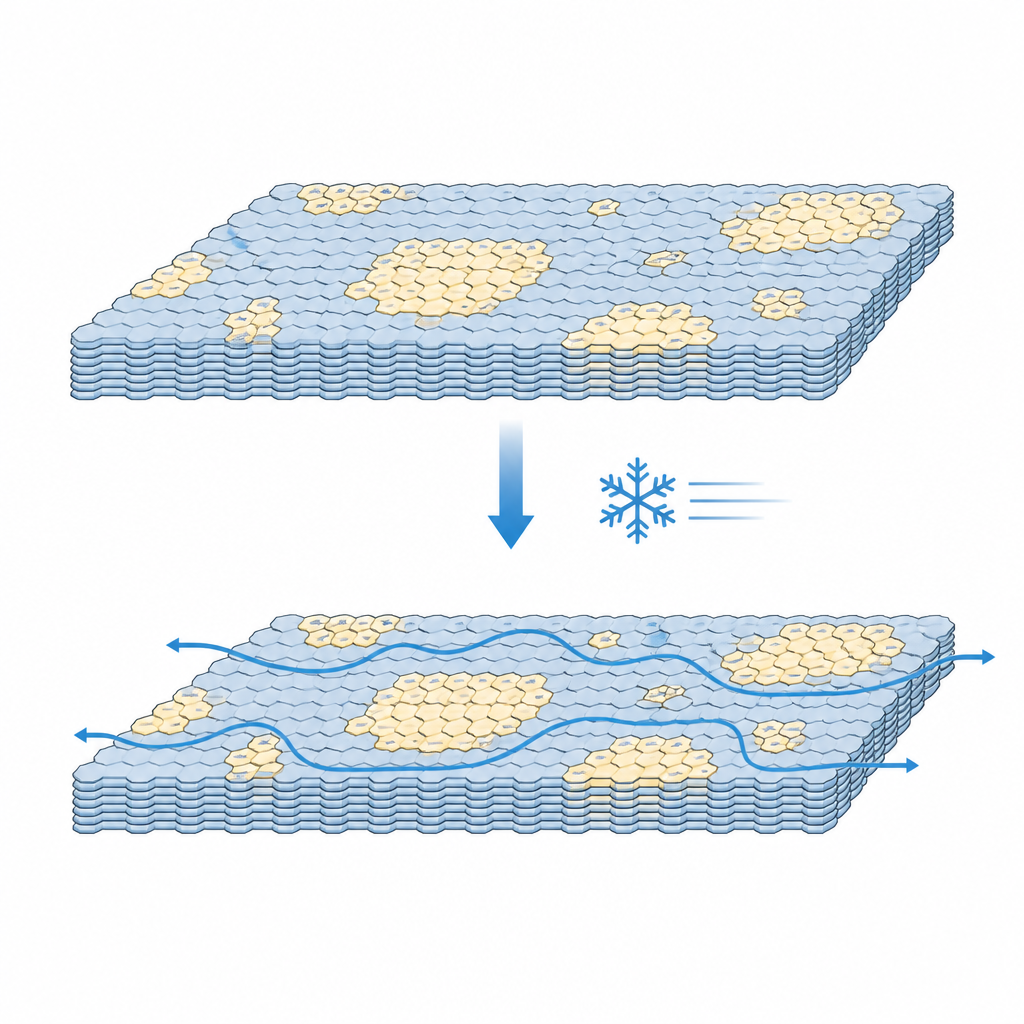
Going one step deeper, the authors turned to high-resolution transmission electron microscopy to image the atomic arrangements in fast-cooled nanocrystals. They found that, instead of becoming uniformly insulating, the cooled flakes developed tiny islands about 10 to 30 nanometers wide where the atoms had adopted the fully distorted pattern normally linked to the insulating state. These islands were scattered within a background that kept the more weakly distorted metallic pattern seen at higher temperature. In other words, fast cooling produced a patchwork in which small insulating pockets are embedded in a mostly metallic matrix. Because the metallic regions still form continuous paths through the crystal, charge can flow, and the overall device behaves like a metal even though microscopic insulating domains are present.
What this means for future devices
This work shows that by simply changing how quickly a thin 1T-TaS₂ crystal is cooled, researchers can freeze in a mixed atomic pattern that keeps the material conductive at temperatures where it would normally be insulating. The study provides direct structural evidence that the super-cooled metallic state is an intermediate configuration, held in place because the atoms cannot fully rearrange in time. For a lay reader, the key message is that timing can be used as a control knob for electronic behavior in ultrathin materials, hinting at future devices that store information or switch states not just by voltage or light, but also by how fast they are cooled or heated.
Citation: Chatzigiannakis, G., Soultati, A., Sakellis, E. et al. Microscopic insight into the origin of super-cooled NCCDW state in 1T-TaS₂ nanocrystals. Sci Rep 16, 14925 (2026). https://doi.org/10.1038/s41598-026-42525-9
Keywords: 1T-TaS2, charge density waves, metastable phases, nanocrystals, rapid cooling