Clear Sky Science · en
Effectiveness of post-grouting on the vertical response improvement for extra-long bored piles: case studies on field tests
Making Deep Foundations Safer
As cities build taller towers, longer bridges, and heavier energy infrastructure, their foundations must safely carry enormous loads without sinking or heaving. This study looks at a popular way to strengthen very deep concrete foundations, called extra-long bored piles, by injecting cement slurry at their tips after construction. Using real-world test sites rather than small laboratory models, the authors ask a practical question that matters to engineers and the public alike: when and how does this post-grouting really make foundations safer, and where are its limits? 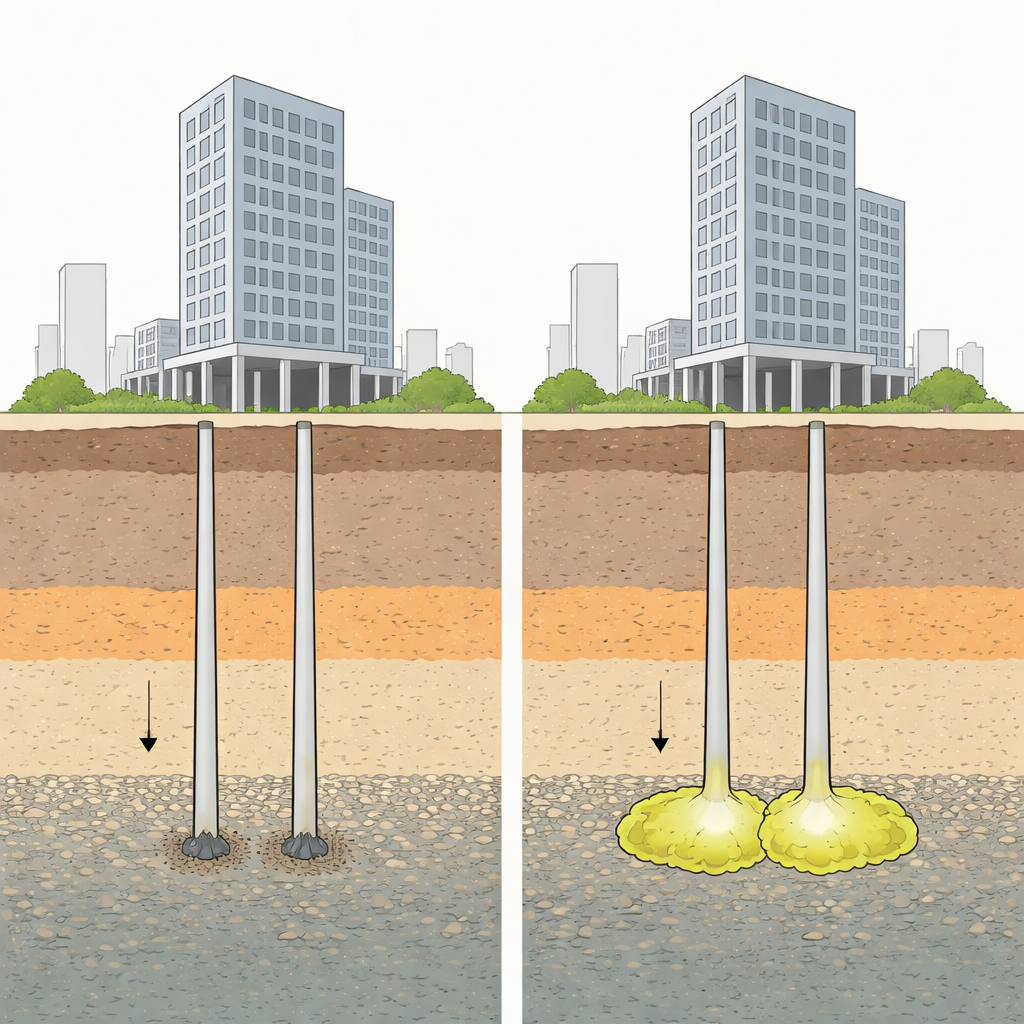
Why Engineers Inject Cement Under Piles
Extra-long bored piles are tall, slender concrete columns drilled deep into the ground to support skyscrapers, bridges, substations, and offshore structures. Drilling can loosen soil around the pile and leave sediment at its tip, reducing how well it can grip the ground. Post-grouting tries to fix this by pumping cement slurry through pipes at the pile tip or along its sides after the concrete has hardened. The grout spreads, fills gaps, squeezes the soil, and hardens into a cemented mass that improves contact between pile and ground. Earlier projects suggested that this method can greatly increase how much load a pile can carry, but many engineers still questioned whether the same benefits hold for very long piles in different kinds of soil.
What Seven Real Projects Revealed
To answer this, the authors assembled case studies from seven full-scale field tests on extra-long piles used in real buildings and power infrastructure. They examined both downward loading (compression, as in a building’s weight) and upward loading (uplift, as when buried structures are pushed up by water pressure). In one high-rise project, piles more than 50 meters long rested on a thick silt layer. Post-grouting at the pile tips turned the loose silt into a stiff cement–soil block. This sharply cut settlement at the pile head and allowed the piles to carry much higher loads before showing signs of failure. Similar tests on uplift piles for a coastal substation showed that grouted piles moved less under the same upward force than piles with enlarged bases but no grouting, and their test results were more consistent, pointing to more reliable construction quality. 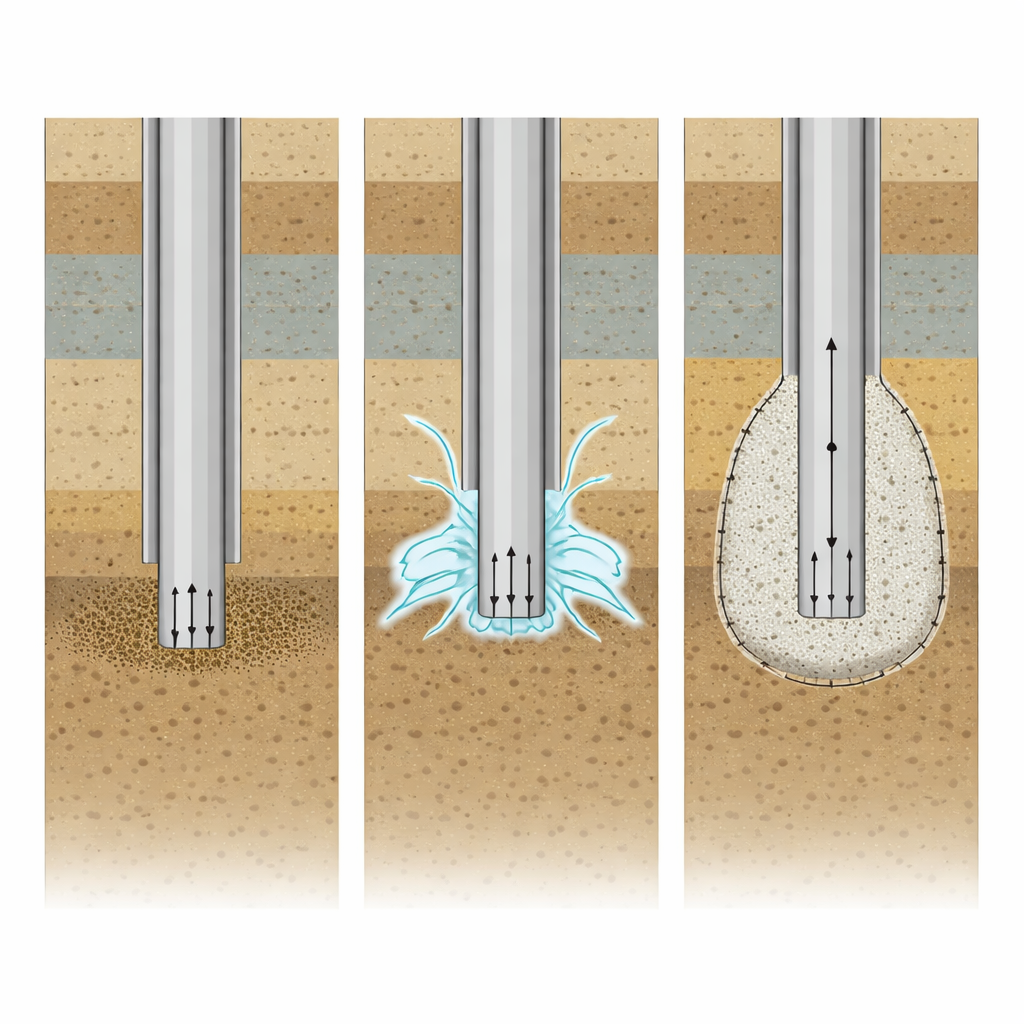
How Soil Type Changes the Benefit
The study then zoomed in on how strengthening the soil just beneath the pile tip changes the side resistance along the pile shaft in different ground conditions. In silty clay, sandy soil, and gravel, tip grouting did more than just stiffen the base; it also boosted the friction along the lower portion of the pile. By tracking how forces varied with depth, the authors found that side resistance increased by about 11% in silty clay, 39% in sand, and 46% in gravel after grouting. In these cases, grout spread upward from the tip, roughened the interface between concrete and soil, and created a stronger contact zone several meters above the tip. The end result was a pile that settled less at high loads and could carry more without sudden failure.
When Strengthening Can Backfire
However, the field tests also showed that more strength at the ultimate limit does not always mean better behavior under everyday working loads. In several projects, grouted piles actually settled more than ungrouted ones at moderate loads, even though they ultimately carried more weight before failure. This happened when grouting parameters—such as pressure, volume, or timing—were poorly controlled, leading to uneven strengthening or even local weakening of side resistance near the top of the pile. For bell-bottom piles with enlarged tips, grouting sometimes had little effect on early stiffness and, in some cases, produced larger initial settlements than traditional piles. These findings highlight that post-grouting is not a magic fix; its success depends strongly on workmanship and soil behavior.
What This Means for Future Foundations
Overall, the paper concludes that post-grouting is a powerful tool for improving the ultimate capacity and safety margin of extra-long bored piles in a wide range of soils, especially sand and gravel. By reinforcing the soil beneath the pile tip, it not only reduces deep settlement but also increases the friction along the lower shaft, which helps both compression and uplift performance. Yet, the technique has clear limits: if the grouting process is poorly controlled, early stiffness may not improve and may even worsen under normal service loads. For designers and builders, the message is twofold: post-grouting can make deep foundations safer and more reliable, but only if the construction process is carefully planned, monitored, and tuned to the local ground conditions.
Citation: Xie, X., Hu, T., Wang, L. et al. Effectiveness of post-grouting on the vertical response improvement for extra-long bored piles: case studies on field tests. Sci Rep 16, 12326 (2026). https://doi.org/10.1038/s41598-026-42485-0
Keywords: bored piles, post-grouting, deep foundations, soil reinforcement, load testing