Clear Sky Science · en
Substrate temperature effects on structure and thermoelectric transport in DC-sputtered Bi2Te3 thin films
Turning Heat into Electricity on a Chip
Every electronic gadget you own sheds heat, most of which is simply wasted. What if some of that warmth could be recycled into useful electricity, helping power sensors or cool hotspots inside devices? This study explores a promising material, bismuth telluride (Bi₂Te₃), in the form of ultra-thin films grown on glass. By carefully adjusting how hot the underlying surface is during fabrication, the researchers show they can tune how well these films turn a temperature difference into electrical power, pointing the way toward more efficient on‑chip energy harvesters and coolers.
Why a Thin Film’s Birth Temperature Matters
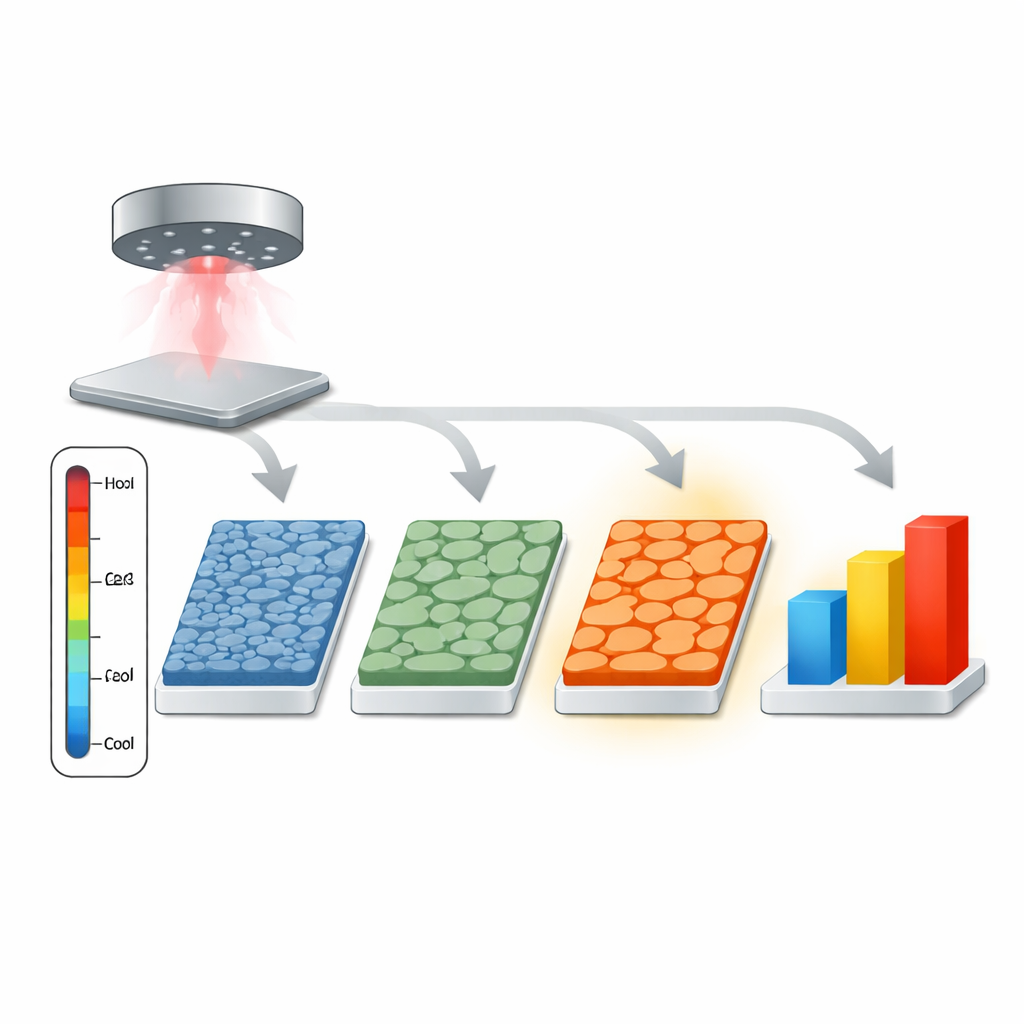
When a thin film is made by sputtering—blasting atoms off a solid target so they settle onto a surface—the temperature of that surface acts like a master dial. At low temperatures, atoms land and mostly stay where they fall, building up many tiny grains. As the temperature rises, the atoms can move around more, forming larger crystals, changing how tightly the film packs, and even altering its chemical recipe. In Bi₂Te₃, this matters because both the grain structure and the exact balance of bismuth and tellurium atoms strongly influence how easily charges move and how strongly the film responds to a temperature difference, the two ingredients that set its thermoelectric power.
Looking at the Film from Atoms to Grains
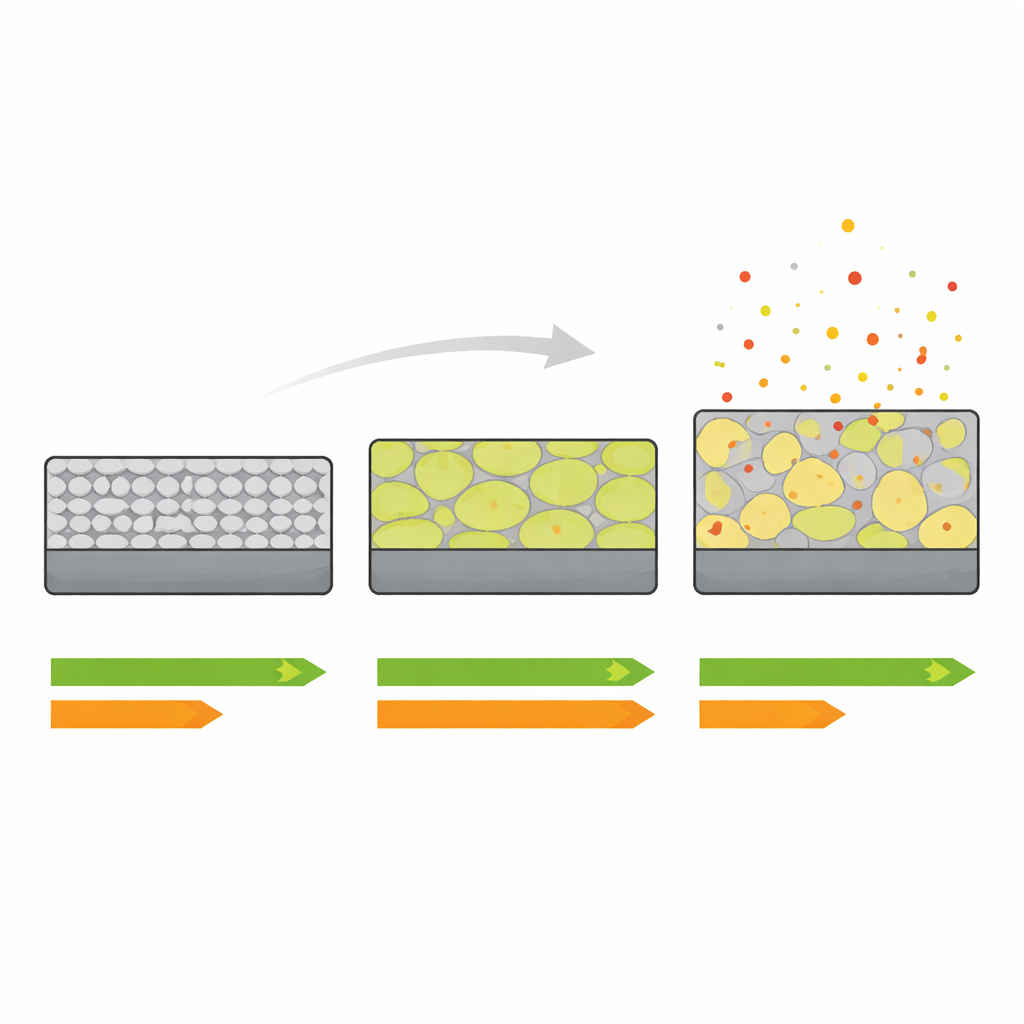
The team deposited Bi₂Te₃ films about half a micrometer thick on glass at four substrate temperatures: room temperature, 100 °C, 200 °C, and 300 °C. Using X‑ray diffraction, they confirmed that all films formed the desired crystalline phase, but the details shifted with temperature. Up to 200 °C, the crystal blocks grew larger and more orderly, with fewer defects. At 300 °C, this trend reversed slightly, hinting that the material was being pushed too hard. Electron microscope images backed this up: grains evolved from tiny, dense, and uniform at room temperature to well‑shaped, connected crystals at 200 °C, then to very large, irregular grains with noticeable voids at 300 °C. Chemical analysis showed another hidden cost of high temperature: tellurium atoms gradually escaped, leaving the hottest films richer in bismuth and less true to the ideal Bi₂Te₃ recipe.
Light, Charge, and the Sweet Spot
The researchers also shone light on the films and tracked how much was reflected across visible and near‑infrared wavelengths. The 200 °C film reflected the most, while the 300 °C film, with its rougher, more porous surface, scattered and trapped more light, reducing reflectance. By processing these spectra, the team extracted an apparent optical edge that shifted to higher energies as the growth temperature increased. Because Bi₂Te₃ is in reality a narrow‑gap semiconductor whose true bandgap lies in the mid‑infrared, these values are best viewed as a comparative optical fingerprint that mirrors how disorder, composition, and carrier concentration evolve with substrate temperature, rather than as a fundamental electronic gap.
Balancing Conductivity and Voltage
The heart of thermoelectric performance lies in balancing two opposing tendencies. High electrical conductivity lets many charges flow, while a large Seebeck coefficient means each degree of temperature difference generates a strong voltage. Changing the film’s growth temperature shifts that balance. In this work, hotter substrates (200 °C and 300 °C) produced films with higher conductivity because larger grains and better connections gave charges smoother pathways. However, the Seebeck response shrank in magnitude as temperature increased, especially at 300 °C, where tellurium loss and defects altered how carriers behaved. When the researchers combined both effects into the power factor, a standard measure of electrical thermoelectric performance, the clear winner emerged: films grown at about 200 °C reached a maximum power factor of roughly 4 microwatts per centimeter per kelvin squared, outperforming both cooler and hotter counterparts.
Finding the Goldilocks Temperature
For anyone aiming to build tiny generators or coolers directly onto glass or similar substrates, the message is simple: how hot you grow your Bi₂Te₃ films matters as much as which material you choose. Too cool, and the film is finely grained and resistive; too hot, and you lose tellurium, introduce porosity, and blunt the voltage response. Around 200 °C, this study finds a sweet spot where grains are big enough and well connected, crystallinity is high, and the composition has not drifted too far, giving the best electrical power output from a given temperature difference. While the work does not yet include a full efficiency figure—because thermal conductivity still needs to be measured—it offers practical guidance for engineers: tune the substrate temperature to this intermediate window, then refine control of tellurium loss and heat flow to push Bi₂Te₃ thin‑film thermoelectrics closer to real‑world devices.
Citation: Shahidi, M.M., Saberi Kakhki, Y., Bazrafshan, M.A. et al. Substrate temperature effects on structure and thermoelectric transport in DC-sputtered Bi2Te3 thin films. Sci Rep 16, 12968 (2026). https://doi.org/10.1038/s41598-026-42427-w
Keywords: thermoelectric thin films, bismuth telluride, waste heat recovery, magnetron sputtering, substrate temperature