Clear Sky Science · en
Mechanisms of seismic improvement in pile-sheet wall supported slopes using ECC and anchor cables
Why safer slopes matter
Many highways, rail lines, and towns in mountainous regions are built beneath steep slopes that can fail during earthquakes, sending tons of soil and rock downhill. Engineers often rely on rows of deep piles and thin concrete walls to hold these slopes in place, but in strong shaking these supports can crack and bend, reducing their protective power. This study explores a new combination of tough, bendable concrete and steel anchor cables to keep steep slopes standing during severe earthquakes and to better protect people and infrastructure below.
How engineers currently hold slopes in place
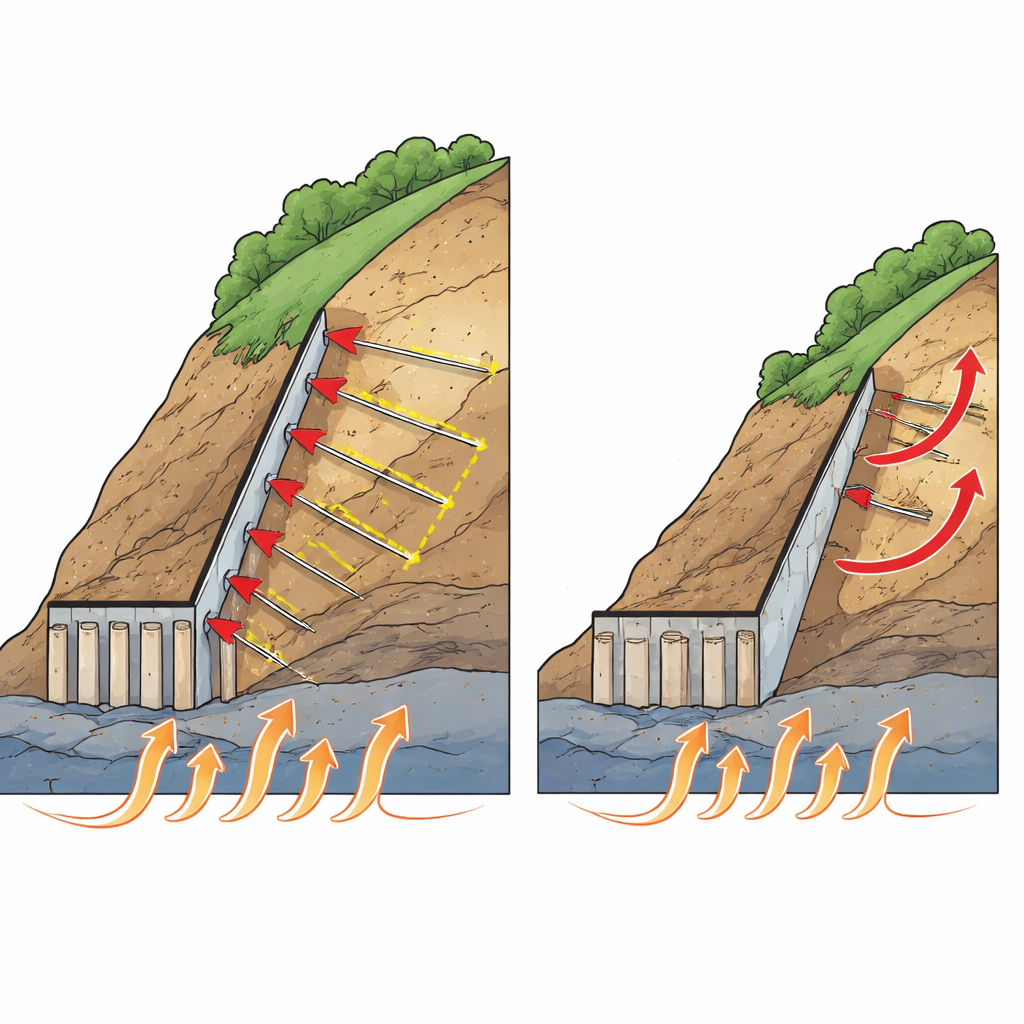
To prevent earthquake-triggered landslides, engineers commonly install “pile–sheet wall” systems: vertical piles embedded into bedrock and connected by a thin facing slab that together act like a buried fence holding back the soil. Field investigations after major Chinese earthquakes showed that these systems usually perform better than massive gravity walls, but they still suffer from a key weakness. Conventional reinforced concrete is stiff and strong but relatively brittle. Under repeated shaking it tends to form large cracks, lose stiffness, and concentrate damage at the pile bases, which can lead to permanent tilting of the wall and slow failure of the slope.
A new mix of materials and supports
The researchers tested a two-part improvement. First, they replaced ordinary reinforced concrete with engineered cementitious composite, or ECC—a fiber-rich cement-based material that can stretch under tension and form many tiny cracks instead of a few wide ones. Second, they added steel anchor cables that tie the upper part of the wall back into more stable ground. Using a reduced-scale physical model on a shaking table, they built steep slopes supported either by traditional concrete walls with anchors or by ECC walls with the same anchor layout, and then shook them with steadily increasing earthquake motions while carefully measuring motion, pressures, strains, and permanent displacements.
What happened during simulated earthquakes
At modest shaking levels, both types of anchored walls behaved similarly and the entire slope–wall system moved together elastically. As shaking intensified, differences emerged. Slopes supported by traditional concrete developed networks of wide cracks near the crest and a few major cracks in mid-slope, while the concrete piles showed distinct through-cracks at their fixed bases. In contrast, the ECC-supported slopes showed only localized surface cracking, and the ECC piles remained intact at their bases. Measurements of the system’s natural frequency and damping showed that ECC slowed the loss of stiffness and limited internal damage as shaking grew stronger. Acceleration sensors revealed that motions were amplified with height for all cases, but the ECC-and-anchor system consistently transmitted smaller peak accelerations toward the slope crest, indicating better energy dissipation and less internal amplification of shaking.
How anchors and bendable concrete share the work
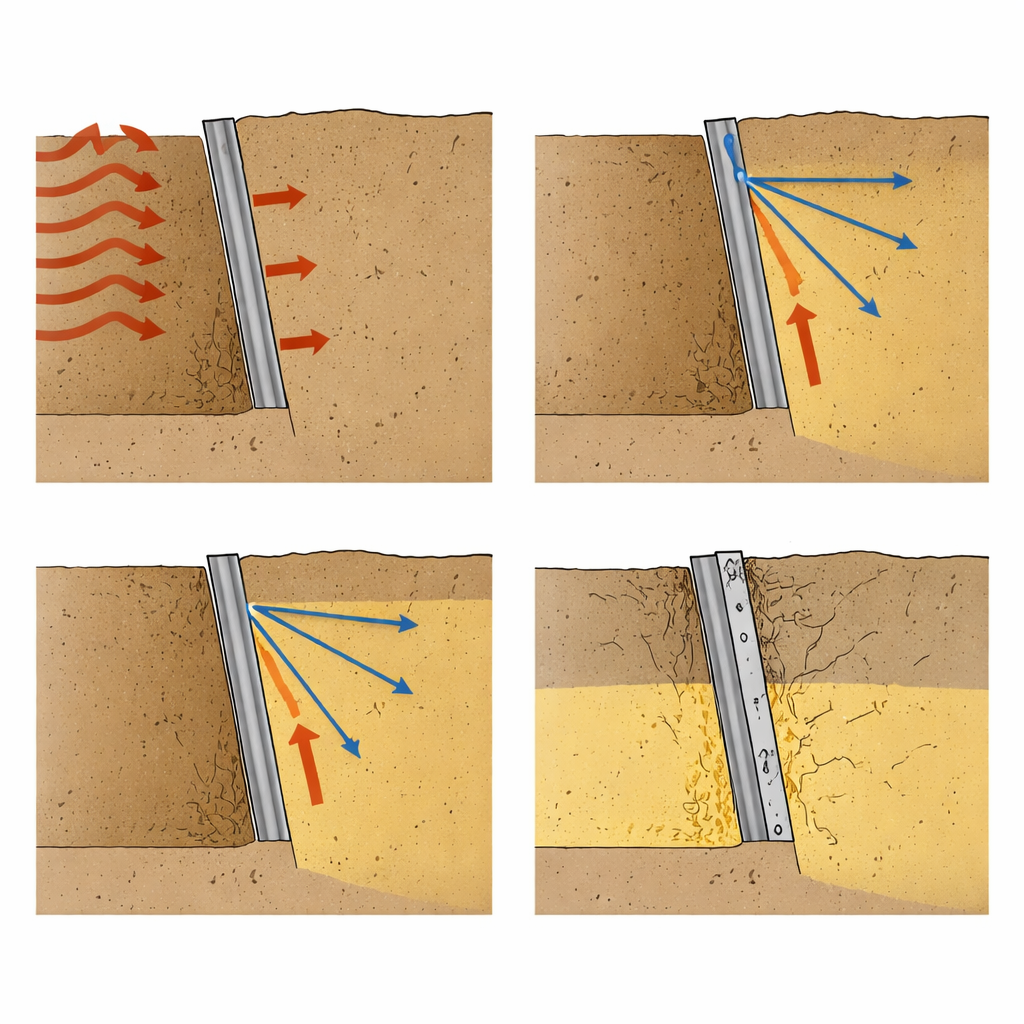
The study also parsed the different roles of material and structural changes. Anchor cables mainly altered the way loads travel through the soil–wall system. They created a “kink” in the bending pattern along the piles, taking part of the force that would otherwise concentrate at the pile base and spreading it upward and backward into the anchored zone. This greatly reduced permanent sideways movement of the wall and kept the pressure pattern on the wall stable even under strong shaking. ECC’s main contribution was to resist damage: by allowing controlled micro-cracking and strain hardening, it limited stiffness loss, reduced bending moments and dynamic soil pressures at the upper slope, and cut residual displacements, especially in stronger motions where conventional concrete degraded quickly.
Putting the pieces together for safer design
When ECC and anchor cables were combined, the benefits compounded. Compared with conventional unanchored concrete walls, the anchored ECC walls showed the smallest accelerations, forces, and permanent deformations among all tested configurations. In simple terms, the anchors reduce how much the slope tries to move, and the bendable concrete ensures that whatever movement does occur does not cause serious cracking or loss of strength. The authors conclude that optimizing both the material (using ECC) and the structure (adding anchors) offers a promising path to more reliable slope-support systems in earthquake-prone mountains, helping keep transport routes and nearby communities safer when the ground shakes.
Citation: Wang, R., Shen, J., Ding, X. et al. Mechanisms of seismic improvement in pile-sheet wall supported slopes using ECC and anchor cables. Sci Rep 16, 11482 (2026). https://doi.org/10.1038/s41598-026-42397-z
Keywords: earthquake slopes, slope stabilization, engineered cementitious composites, anchored retaining walls, seismic performance