Clear Sky Science · en
Evaluating mammographic density polygenic risk score for contralateral breast cancer risk prediction
Why this research matters to breast cancer survivors
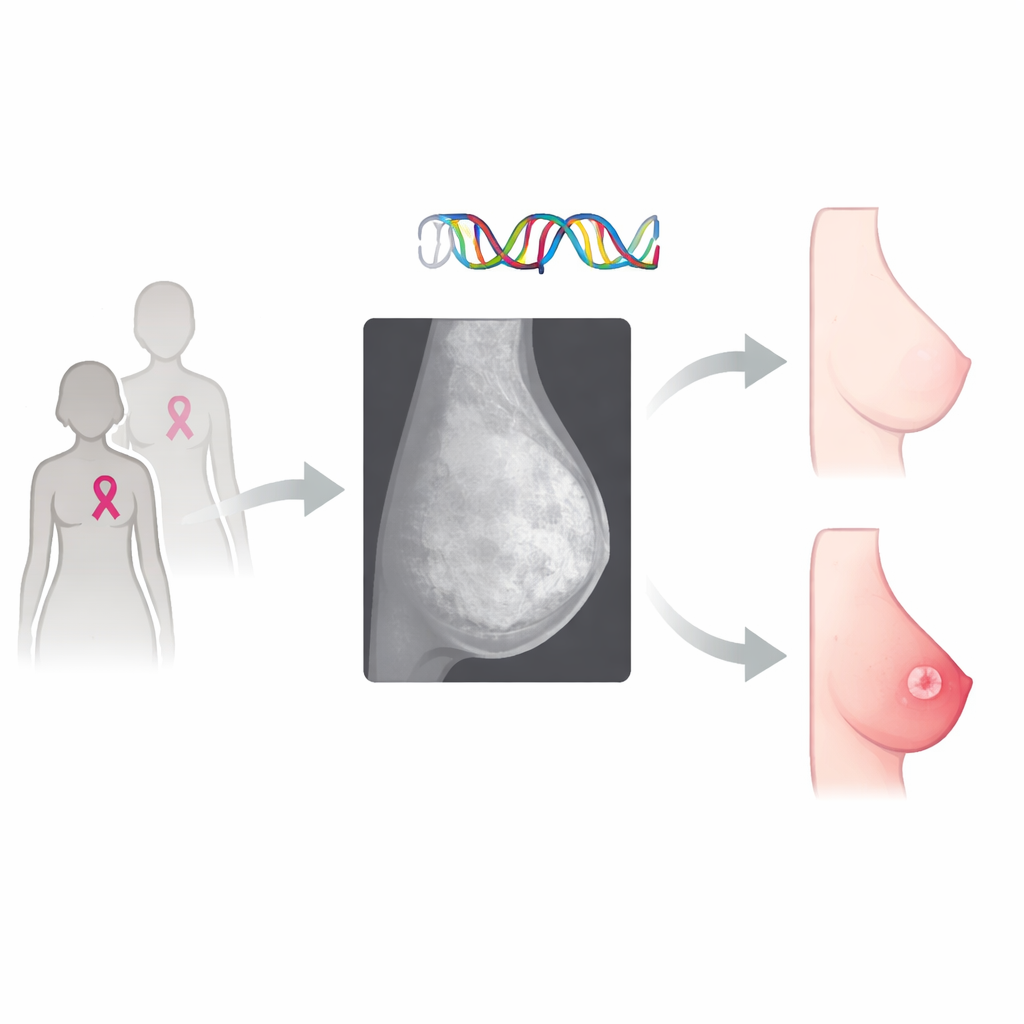
For women who have already faced breast cancer once, a key worry is whether cancer will appear in the other, previously healthy breast. Doctors would like to identify which survivors carry the highest risk so that follow-up screening and prevention can be tailored to them. This study asks whether combining two types of information—what a woman’s mammogram looks like and what her genes say about breast tissue—can sharpen predictions of who is most likely to develop a new cancer in the opposite breast.
The role of dense breast tissue
On a mammogram, some breast tissue appears white and cloudy, known as mammographic density. Women whose breasts contain more of this dense, white area have long been known to face a higher chance of getting breast cancer in the first place. Earlier work from the same research group also showed that breast density measured around the time of an initial diagnosis is linked to the risk of a new cancer forming later in the other breast. In particular, very bright regions on the image, captured with stricter brightness cutoffs, seem to be especially informative about future risk.
Adding genes into the picture
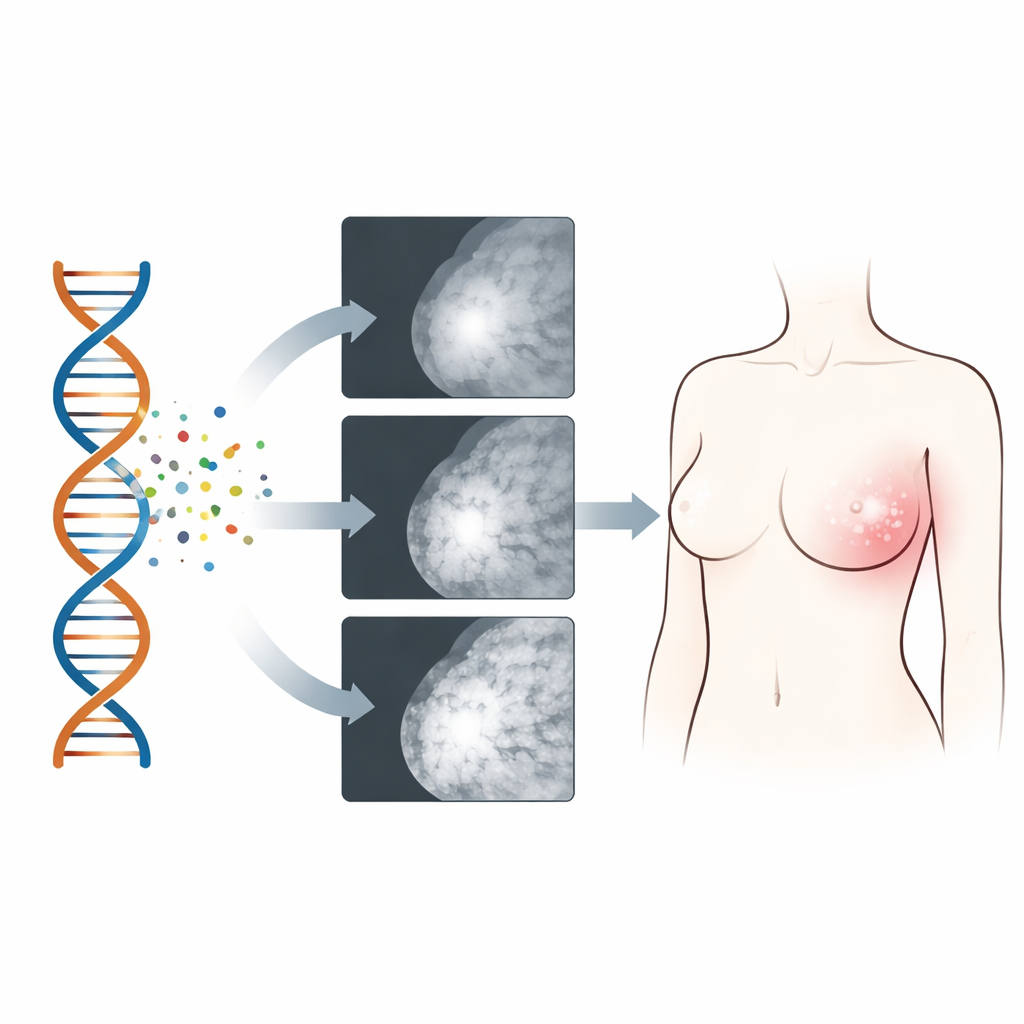
Dense breast tissue is influenced not only by hormones and aging but also by inherited factors. Many small genetic differences across the genome each nudge breast density slightly up or down. Researchers can combine dozens of these differences into a single “polygenic risk score” that reflects a woman’s inherited tendency toward higher or lower density. In this study, the team used results from large genetic scans of mammographic density to build such a score and then asked whether this genetic summary could help explain which women had denser mammograms and whether it could signal who would later develop cancer in the opposite breast.
What the study did
The researchers drew on the WECARE Study, an international project that follows women diagnosed with breast cancer at relatively young ages. They focused on 399 women of European ancestry who had mammograms taken before their first diagnosis and who had provided DNA samples. Some of these women later developed a new cancer in the other breast, while others did not. The team carefully measured dense areas on each mammogram using three brightness levels, from standard dense regions to the very brightest spots, and calculated each woman’s polygenic score based on 64 known genetic markers linked to density.
What the study found
The genetic score behaved as expected in some ways: women with higher scores tended to have more dense tissue on their mammograms, especially when density was measured using the standard and moderately bright cutoffs. However, the score was less clearly related to the very brightest regions, which previous research suggests may be most strongly tied to contralateral breast cancer. When the team examined actual risk of a new cancer in the opposite breast, mammographic density itself was a clear and consistent predictor across all three brightness measures. In contrast, the polygenic score on its own was not linked to risk, and adding it on top of density measurements produced only tiny, statistically uncertain improvements in how well the models separated women who did and did not develop a second cancer.
What this means for patients and care
For now, the message for breast cancer survivors is that what can be seen on the mammogram remains more informative than currently available genetic summaries of dense tissue. Dense and especially very bright regions on the mammogram signal a higher chance of cancer appearing in the opposite breast, and these image-based measures stand on their own as strong risk indicators. While the genetic score did capture some inherited tendency toward denser breasts, today’s version explains only a small slice of the biological complexity behind density and does not yet add meaningful power to prediction tools. As genetic studies grow larger and identify more influential variants, stronger scores may eventually help when mammograms are unavailable, such as in younger women or in regions with limited imaging. For the moment, however, careful attention to mammographic density itself remains a key component of planning follow-up screening and prevention for women who have already been treated for breast cancer.
Citation: Naderi, E., Watt, G.P., Knight, J.A. et al. Evaluating mammographic density polygenic risk score for contralateral breast cancer risk prediction. Sci Rep 16, 12125 (2026). https://doi.org/10.1038/s41598-026-42365-7
Keywords: contralateral breast cancer, mammographic density, polygenic risk score, breast cancer survivors, genetic risk prediction