Clear Sky Science · en
Influence of web openings on the cyclic response of RC coupling beams
Why Small Openings Matter in Big Buildings
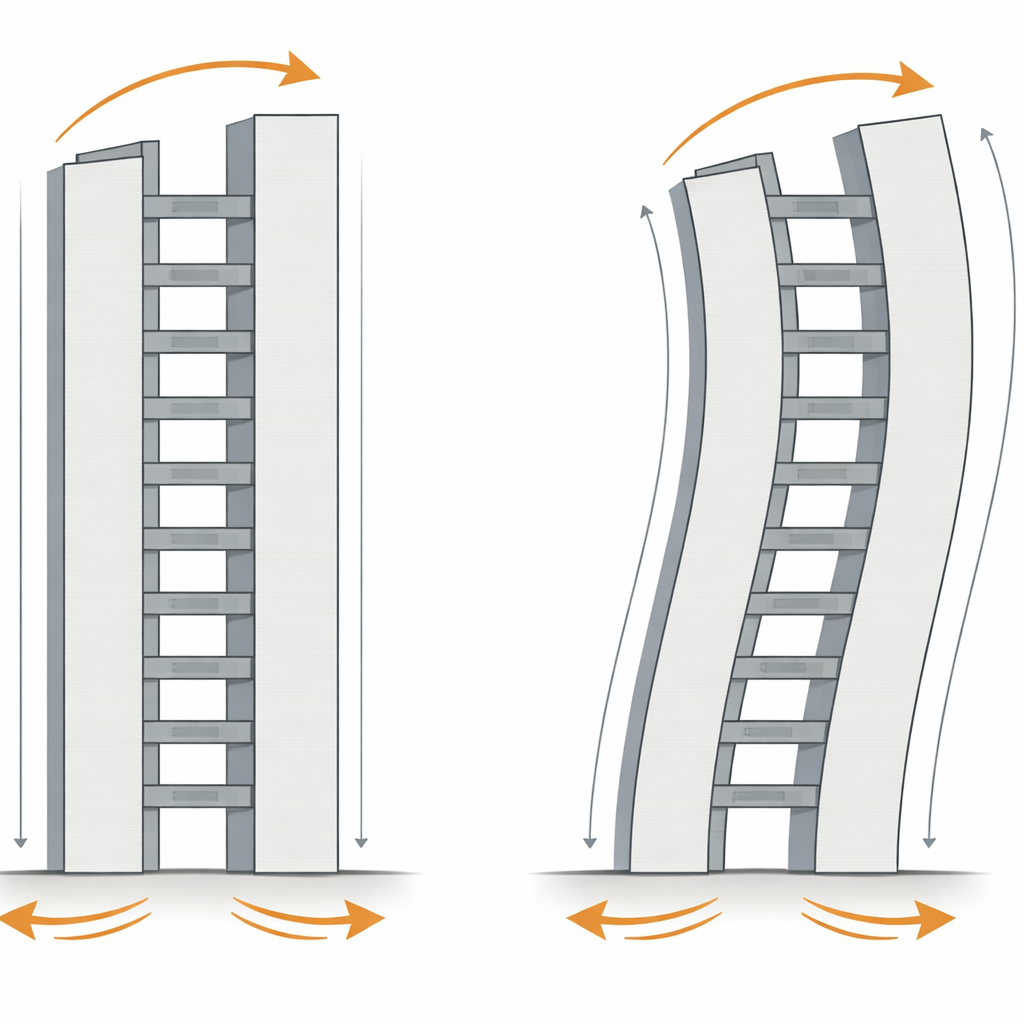
Modern high‑rise buildings in earthquake zones often rely on pairs of thick concrete walls linked by short horizontal beams that act like structural fuses. These beams must rock and deform during shaking so the building can safely dissipate energy. At the same time, architects and engineers routinely punch holes through these beams to run pipes and cables. This study asks a deceptively simple question with big safety implications: when you cut service openings through these critical links, how much weaker and more brittle do they become, and can smart steel layouts inside the concrete recover that lost strength?
How Coupling Beams Protect Tall Structures
In many towers, elevator and stair cores are formed by two parallel concrete walls connected by short, deep beams called coupling beams. When an earthquake pushes the building sideways, these beams are meant to yield and deform in a controlled way, absorbing energy and protecting the main walls from severe damage. For very short beams, traditional straight reinforcing bars tend to fail suddenly in a brittle shear pattern. Building codes therefore favor diagonal steel layouts that cross the beam like an X, which past experiments have shown to be more ductile and better at dissipating energy. However, codes give only limited guidance on what happens when practical needs force engineers to cut rectangular openings through these beams.
Simulating Earthquake Cycles Instead of Breaking Many Beams
Because large experimental test programs are expensive, the authors built a detailed three‑dimensional computer model of reinforced‑concrete coupling beams using the finite‑element software ABAQUS. First, they checked that their model could reproduce real laboratory tests on short beams with both conventional and diagonal reinforcement under monotonic and back‑and‑forth loading. The simulations captured where cracks formed, how damage spread, and how the shear force‑versus‑rotation curves evolved, closely matching measured peak strengths, degradation, and energy dissipation. With this validation in hand, they simulated twelve short beams, all the same size, but with four different steel layouts and with or without rectangular openings at either the beam end or mid‑span.
What Happens When You Punch Holes Through the Beam
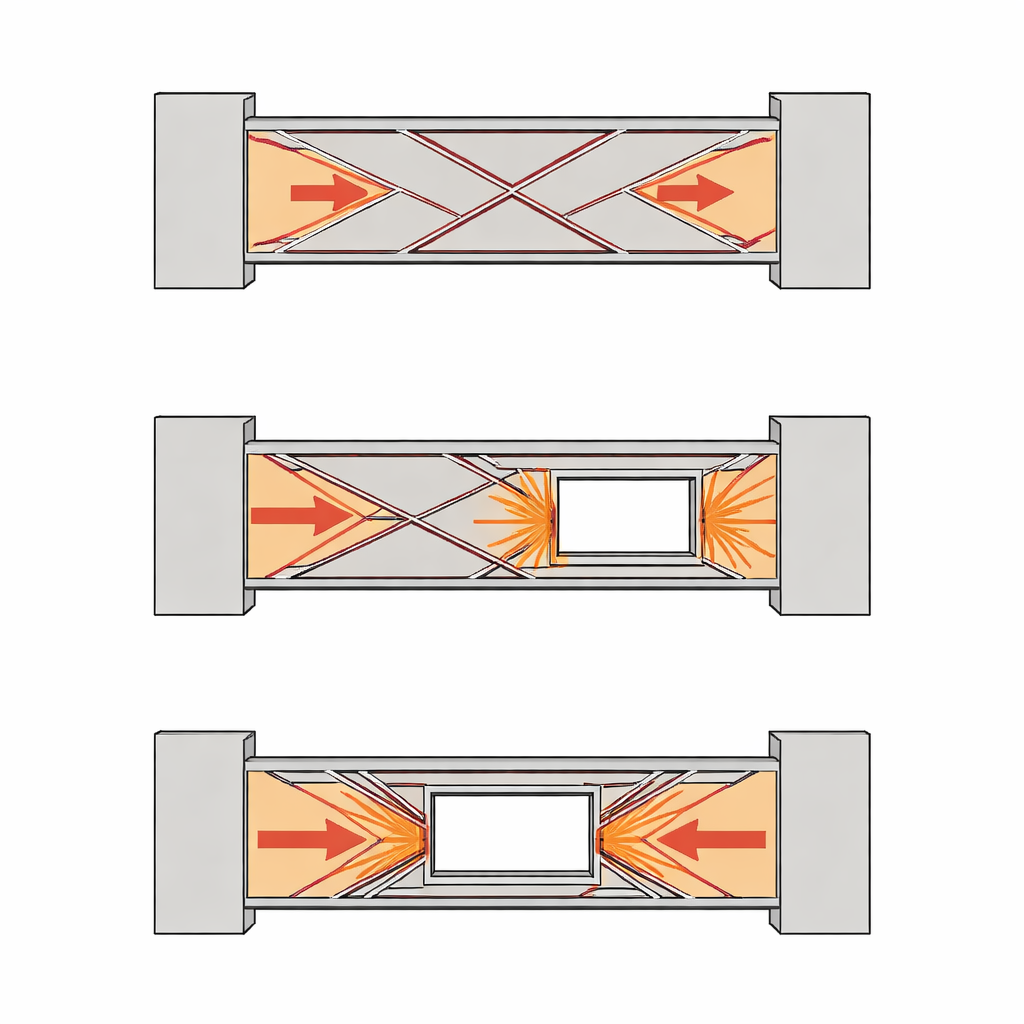
The study compared three reinforcement strategies—simple straight bars (conventional), diagonal bars wrapped in confinement (diagonal confinement), and two rhombus‑like patterns—to see how each handled openings. Across the board, beams without openings performed best, and those with diagonal confinement were standouts: they showed smooth, stable hysteresis loops, gradual stiffness loss, and the highest energy absorption. Introducing an opening always reduced strength and ductility, but the location and shape of the opening mattered greatly. Small openings near the beam ends weakened the beams, yet diagonal confinement limited the drop in shear strength to about 6% and kept much of the rotation capacity, while conventional and rhombic layouts became far more brittle.
Why Mid‑Span Openings Are Especially Dangerous
When an opening was placed at the center of the beam, the primary diagonal compression path that carries shear was cut in two, and behavior degraded sharply. In conventional beams with a tall, narrow opening, shear capacity fell by roughly one‑third and the maximum rotation by more than half, leading to quick, brittle failure after only a few load cycles. Rhombic patterns also lost a large share of their ductility and energy dissipation, sometimes over 80%. Even the best case—diagonal confinement with a central opening—suffered nearly 50% loss of rotation capacity, although it still outperformed solid beams with less effective steel layouts. The simulations also showed that simply changing the opening proportions, making it longer and lower while keeping the same area, could significantly reduce the damage by keeping the critical diagonal concrete path more intact.
Design Lessons for Safer Earthquake Performance
From a practical standpoint, the findings deliver clear messages. For short, shear‑dominated coupling beams, diagonally confined reinforcement should be the default choice, especially when openings are unavoidable, because it best preserves strength, ductility, and energy dissipation. Openings near the beam center are far more harmful than those near the ends because they cut through the main diagonal strut that resists shaking. If a mid‑span opening is necessary, it should be kept low in height, longer in the beam direction, and set back from the faces so that the internal diagonal load path is not severed. In simple terms, the paper shows that where and how you cut service holes in these small but vital links can decide whether a tall building bends and survives an earthquake—or cracks and fails too soon.
Citation: Ramadan, O.M.O., Elghool, A., Elshafey, N. et al. Influence of web openings on the cyclic response of RC coupling beams. Sci Rep 16, 10475 (2026). https://doi.org/10.1038/s41598-026-42360-y
Keywords: reinforced concrete coupling beams, seismic performance, structural openings, finite element analysis, earthquake engineering