Clear Sky Science · en
Air classification of copper granules from recycled electrical cables using a zig-zag separator
Why old cables matter for a cleaner future
Behind every light switch, electric car, and solar panel lies an unsung hero: copper wire. As the world builds more clean energy systems and electric vehicles, our hunger for copper is soaring. Mining new copper is costly and energy‑intensive, but copper can be recycled over and over without losing quality. This article explores a clever way to squeeze more value from discarded electrical cables by cleaning up recycled copper granules so thoroughly that they can rival metal made from freshly mined ore.
What is really inside a power cable?
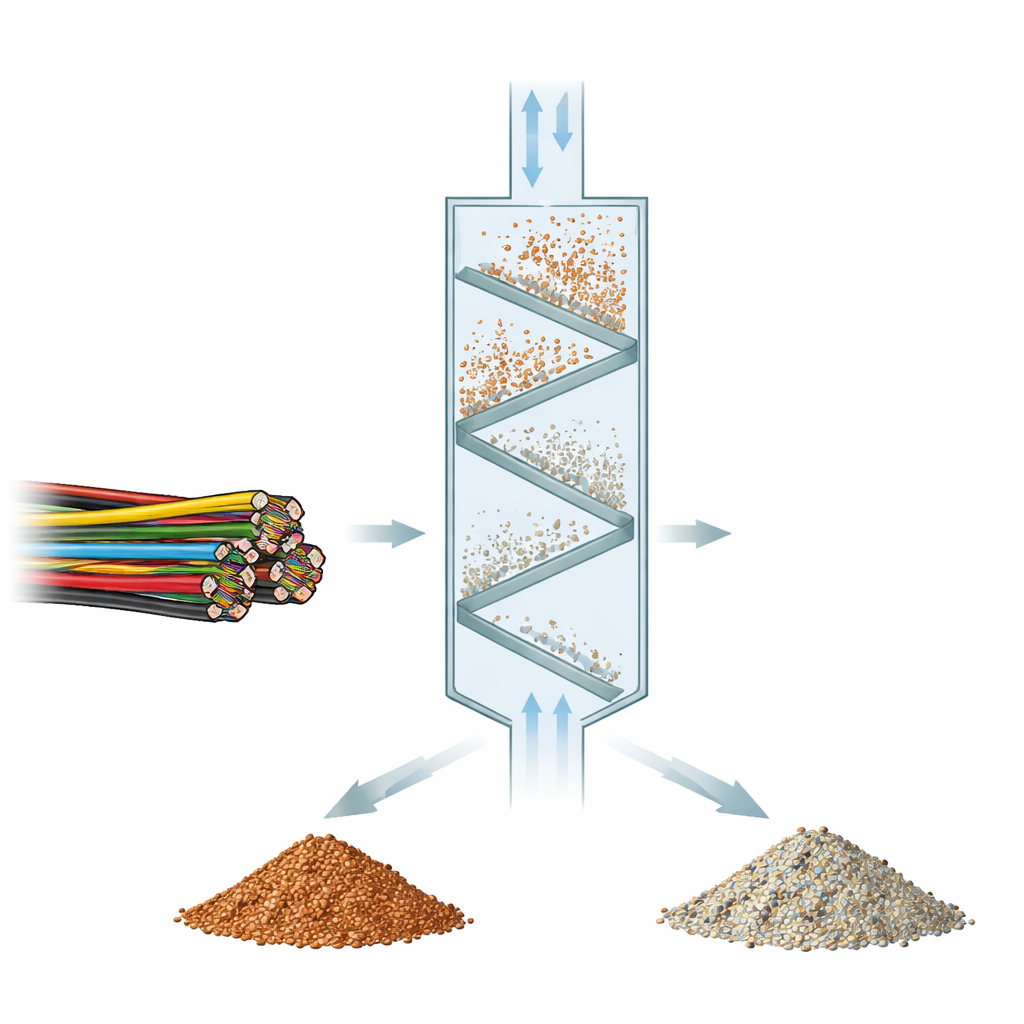
At first glance, a power cable looks simple, but it is a layered composite product. On the outside are tough plastic sleeves that protect against moisture, abrasion, and electric shock. Inside are metallic shields, often of aluminum or lead, and at the heart lies the conductive core, usually made of copper or sometimes aluminum. Many cores are built from bundles of very thin copper wires, which are often dipped in tin to protect them from corrosion and help them connect reliably to plugs and terminals. When such cables reach the end of their life, they are shredded into a mixture of plastic bits, pure copper granules, and tin‑coated copper pieces that all look frustratingly similar.
From mixed scrap to high‑grade copper
Modern recycling plants attack this jumble in several steps. First, cables are cut and shredded, and magnets pull out any steel. Next, mills grind the material into smaller granules, and various separators peel away plastics and other metals. Even after all this, the supposed “copper” product still contains a stubborn impurity: tiny, elongated pieces of copper whose surfaces are covered with tin. These tinned granules lower the purity of the final metal, which matters to smelters and high‑tech applications. Traditional gravity tables, which shake and blow air through the material, cannot fully separate these awkwardly shaped particles from clean copper.
How a zig‑zag column sorts particles with air
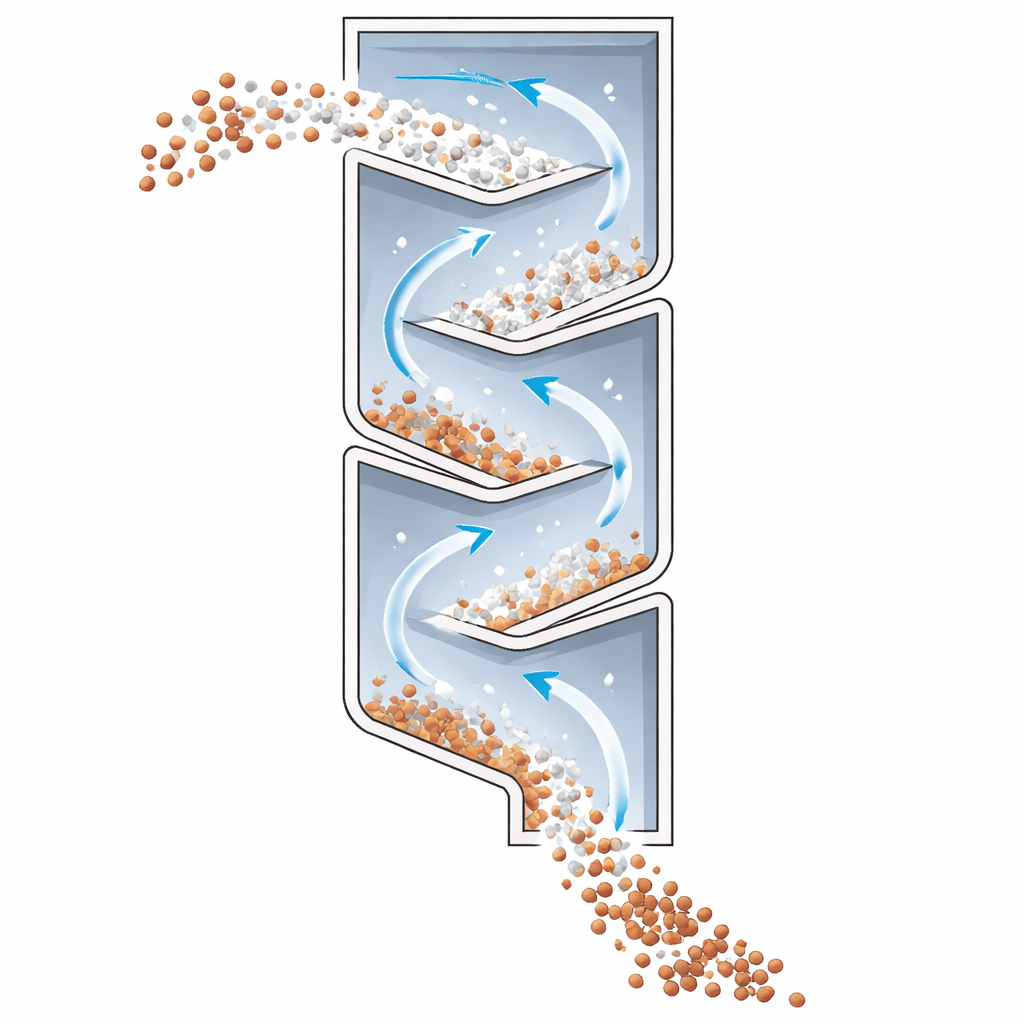
The researchers investigated a different tool: a tall, narrow channel made of repeating angled sections, forming a zig‑zag column. Air is blown upward from the bottom while mixed copper granules fall through from above. Inside each bend, two opposing streams form—one moving upward along the outer wall and one slipping downward along the inner wall. Whether a particle is carried up or falls down depends on a tug‑of‑war between its weight and the lifting force of the air. Light or flat particles are more easily swept upward and leave at the top as the “light” fraction; heavier, more compact particles drop out at the bottom as the “heavy” fraction. By adjusting the air flow, the team can tune where the balance point lies and thus which particles end up in which outlet.
Testing real scrap and virtual flows
To find out how well this works in practice, the authors tested four types of copper granulate from an industrial recycling line. Each batch had a different mix of particle sizes, shapes, and impurities. They ran 500‑gram samples through a laboratory zig‑zag separator at two air settings and measured how much copper and how much tin, lead, iron, and other elements ended up in the heavy and light fractions. At the same time, they built a detailed computer model of the air and particle motion using computational fluid dynamics. In this virtual separator, thousands of particles with measured size distributions were tracked through the zig‑zag pathways to predict which outlet they should reach and how long they would stay suspended in the column.
What the experiments and simulations revealed
For several of the tested materials, especially one labeled Granulate 2, the zig‑zag separator significantly boosted copper purity. With the higher air flow, the heavy fraction reached nearly 99.9% copper, while the lighter stream carried away more of the tinned and other contaminated particles. The computer simulations captured the overall trends, such as how increasing air speed shifts smaller and then larger granules into the light fraction and increases their residence time in the column. However, the agreement between model and reality depended strongly on particle shape. For granulates made of straight, wire‑like pieces or with many non‑spherical grains, the model’s errors grew large because it assumed a single, average “roundness” value for all particles.
What this means for recycling and design
For non‑specialists, the key takeaway is straightforward: with a carefully tuned stream of air in a zig‑zag tube, recyclers can clean copper from old cables to very high purity using only mechanical means and far less energy than melting everything down from scratch. The study also shows that computer models can help design and optimize such equipment, but only if they account for the quirky shapes of real scrap particles. By refining these models and tailoring them to specific waste streams, recycling plants can better predict how to run their separators, maximize copper recovery, and support the growing demand for this critical metal while easing the pressure on mines and the environment.
Citation: Madej, P., Zybała, R., Rządzka-Madej, A. et al. Air classification of copper granules from recycled electrical cables using a zig-zag separator. Sci Rep 16, 12000 (2026). https://doi.org/10.1038/s41598-026-42336-y
Keywords: copper recycling, electrical cable waste, air classification, zig-zag separator, computational fluid dynamics