Clear Sky Science · en
MultiScaleWave: a wavelet-based multiscale framework for univariate time series forecasting
Why predicting patterns in time matters
From stock prices and solar power output to changing weather, much of our world unfolds as a series of values over time. Being able to foresee where those values are heading can help with everything from managing investments to balancing electric grids. Yet real-world time series are messy: they are noisy, change their behavior over time, and mix fast wiggles with slow swings. This paper introduces MultiScaleWave, a new forecasting framework designed to untangle that complexity and deliver more reliable predictions from a single stream of past data.
Breaking complex signals into simple pieces
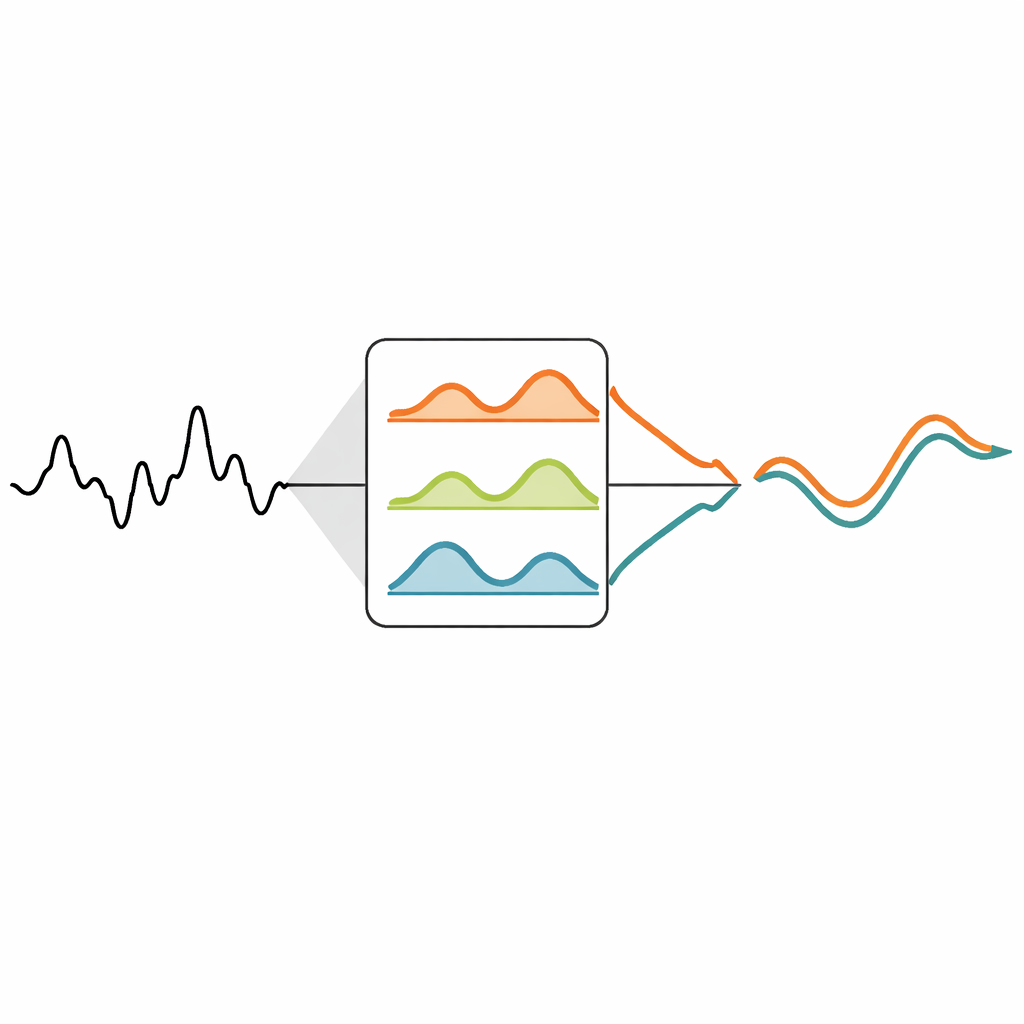
Traditional forecasting tools often stumble because they try to handle all aspects of a time series at once. MultiScaleWave takes a different approach by first splitting the incoming signal into several layers of detail using a mathematical tool called a wavelet transform. In simple terms, the original curve is peeled apart into components that capture quick jolts, mid-speed changes, and very slow trends. This multi-layer view keeps track of when things happen while naturally filtering out some of the random noise that hides useful patterns.
Specialized pathways for different kinds of change
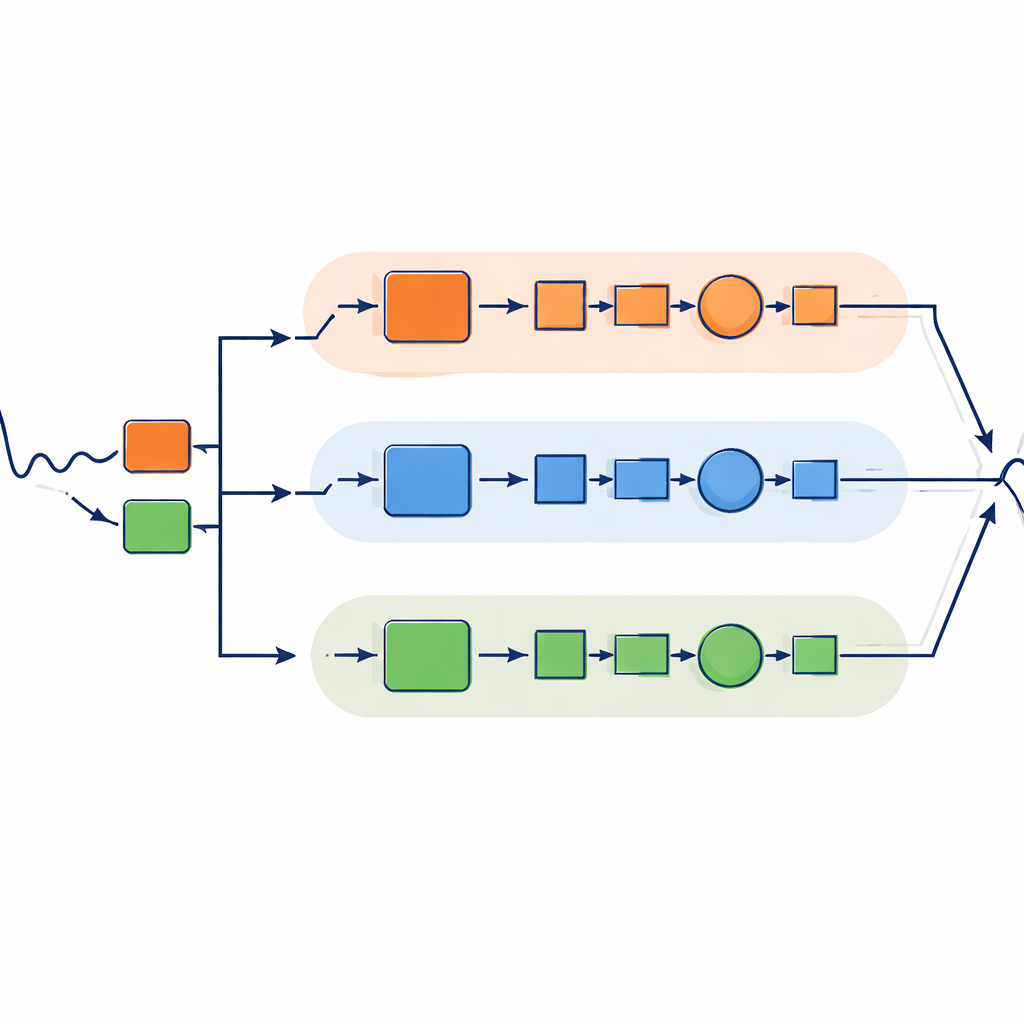
Once the signal is separated into fine, medium, and coarse layers, MultiScaleWave sends each one through its own specialized processing path. The fine-detail path focuses on rapid ups and downs, combining short-range pattern detectors with a memory-like structure that can track longer sequences. The medium-detail path uses a chain of dilated convolutions, a design that can see many time steps into the past while preserving the order of events. The coarsest path treats the slowly changing background trend more simply, using a compact network of fully connected layers to capture broad movements without wasting computation.
Weaving the pieces back into a forecast
After these three pathways have extracted features at their respective time scales, MultiScaleWave carefully stitches them back together. It uses the inverse of the original wavelet operation to recombine the processed high- and low-frequency components in stages, gradually reconstructing a full-length signal. This rebuilt series is then passed through a small prediction head that converts the learned features into a forecast of the next values. By fusing short-term wiggles and long-term trends in this structured way, the framework aims to produce predictions that are both sharp and stable.
Putting the method to the test
The authors evaluated MultiScaleWave on a wide range of real-world datasets, including daily stock prices from several major financial indices and companies, as well as high-frequency measurements of weather conditions and solar power generation. They compared its performance to classic statistical models, common deep learning architectures such as convolutional and recurrent networks, and more recent state-of-the-art methods that also try to break time series into components. Across nearly all tests and error measures, MultiScaleWave came out ahead, particularly in long-range prediction tasks and in situations where the input data were deliberately corrupted with artificial noise.
Why the multiscale design makes a difference
To see whether wavelet-based splitting truly mattered, the researchers built a variant that used simple averaging instead. That version consistently performed worse, especially on data with sharp jumps and reversals, highlighting the importance of preserving fine details during decomposition. At the same time, MultiScaleWave remained relatively lightweight and fast, using far fewer parameters and shorter computation times than some competing advanced models. This suggests that the deliberate combination of multiscale decomposition, scale-aware processing paths, and careful fusion is an efficient way to handle the tangled nature of real-world time series.
What this means for everyday forecasting
For non-specialists, the key message is that better forecasts come from respecting the different rhythms hidden inside a single line of data. MultiScaleWave shows that by first teasing apart fast fluctuations, medium-paced variations, and slow drifts, then modeling each with tools suited to its behavior, and finally weaving them back together, it is possible to predict future values more accurately and more robustly. This framework could strengthen decision-making in finance, energy, and environmental monitoring, and it points toward a broader design principle: the most reliable predictions emerge when models see time not as a flat sequence, but as a tapestry of intertwined time scales.
Citation: Zheng, C., Zhao, H. MultiScaleWave: a wavelet-based multiscale framework for univariate time series forecasting. Sci Rep 16, 13236 (2026). https://doi.org/10.1038/s41598-026-42317-1
Keywords: time series forecasting, wavelet decomposition, deep learning, multiscale modeling, univariate prediction