Clear Sky Science · en
Delayed goal-directed processing underlies inhibitory control challenges in adult ADHD
Why everyday focus can feel like a battle
Many adults with ADHD describe a familiar struggle: they know what they should be doing, yet their attention and actions keep getting pulled off course. This study digs into that everyday experience with unusually fine detail, asking a deceptively simple question: when people with ADHD get distracted, is it because their “bad habits” are too fast or because their “good intentions” are too slow? The answer matters, because it can reshape how we understand ADHD and how treatments are designed.
Habits versus goals in the mind
Whenever we react to the world, two forces are at work. One is quick and automatic, relying on habits and shortcuts. The other is slower and more deliberate, guiding us toward our goals even when the situation is tricky. In real life—like ignoring your phone to finish a work email—these two forces can compete. ADHD has long been linked to weak “inhibitory control,” the ability to block out irrelevant information and resist tempting but off-task actions. But most previous tests only looked at overall speed or accuracy, which masks what is happening second by second as habits and goals race to control behavior.
A new way to watch decisions unfold
To peek inside this split-second race, the researchers used a “forced-response” method paired with computer modeling. Instead of letting people respond whenever they wanted, the tasks made everyone respond at a fixed moment, cued by simple shapes that slowly filled in. What changed from trial to trial was when the important stimulus appeared before that response moment, giving more or less time to process it. Adults with and without ADHD completed two well-known conflict tasks: in one, the color of a square mattered more than where it appeared on the screen; in the other, the direction of a central arrow mattered more than the distracting arrows beside it. By sampling many different preparation times, the team could trace how accuracy changed over the full processing window, rather than just averaging reaction times. 
Slower goals, not wilder impulses
Using a computational model, the researchers separated two key ingredients of performance: how quickly a habitual response is prepared and how quickly a goal-directed response is prepared. They also allowed for the possibility that a prepared habit might be more likely to “slip out” in ADHD. Across both tasks, and in two complementary comparisons—ADHD versus neurotypical adults, and the same adults with ADHD off versus on their usual medication—the pattern was strikingly consistent. Adults with ADHD off medication did not show faster or more powerful habitual responses than others. Instead, their goal-directed responses came online later and with more timing variability. This delay created a longer window of time when only the habitual response was ready to drive behavior, making it more likely that the wrong, distraction-driven action would be expressed before the goal caught up.
What medication seems to change
When participants with ADHD took their prescribed medication, the timing picture shifted. In the Simon task, medication mainly sped up goal-directed processing, helping the deliberate response become available earlier and narrowing the vulnerable window when habits could dominate. In the Flanker task, medication sped up both habits and goals, but goal processes still gained ground. Importantly, the model did not find evidence that medication simply “shuts down” habits; rather, it makes the goal-directed system faster and more competitive. This helps explain why stimulants can reduce day-to-day interference from distractions without turning people into robots: they improve the timing of the goal system rather than erasing automatic tendencies. 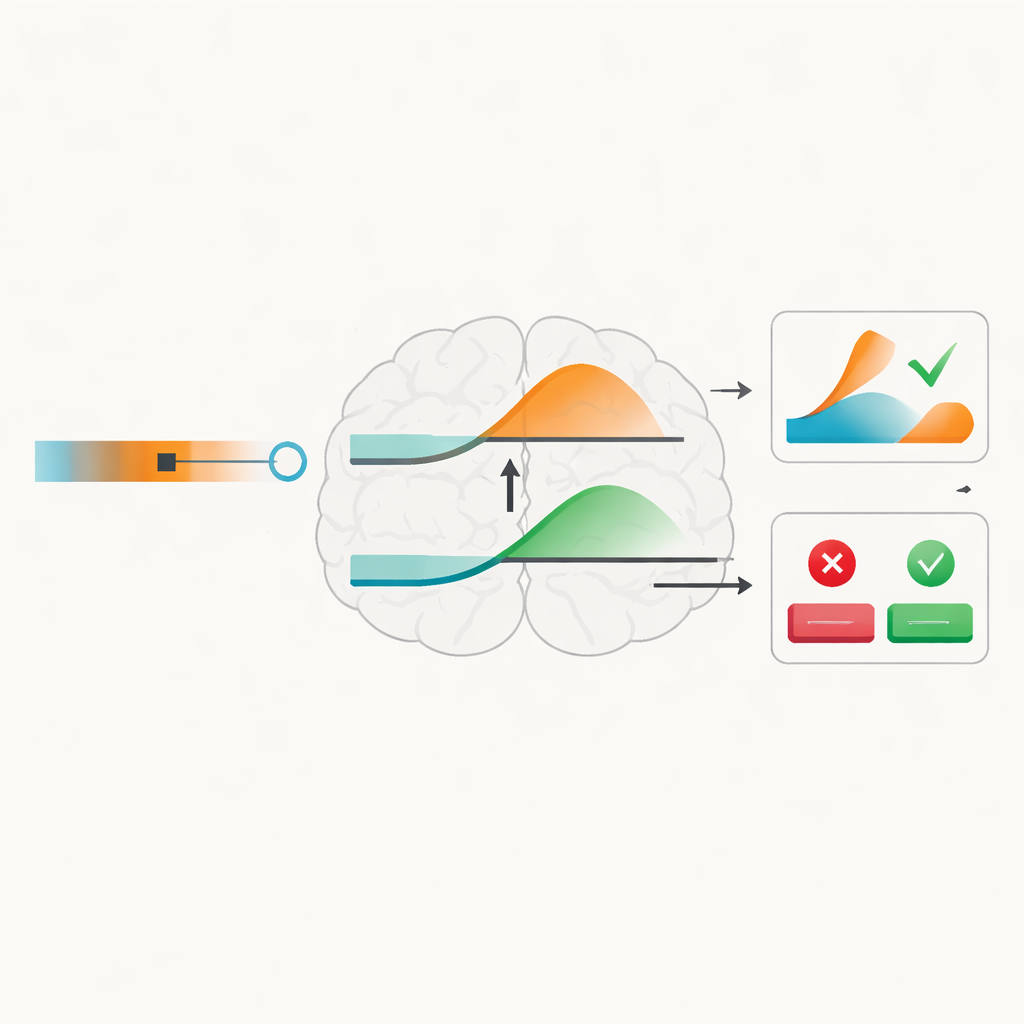
What this means for life with ADHD
Viewed through this lens, ADHD is not about having uncontrollable impulses so much as having goal-directed processing that gets a slower start. In practical terms, it may mean that when something distracting pops up, people with ADHD linger on it longer before their goals can reassert control. The same mechanism may even help explain “hyperfocus,” when attention locks intensely onto one thing and becomes hard to shift. By pinpointing delayed goal processing as a core issue, this work suggests new directions for interventions—whether medications, training, or environmental supports—that give goals a better head start. For adults with ADHD, that could translate into less mental tug-of-war and more days when intentions and actions finally line up.
Citation: Osborne, J.B., Sellers, J., Zhang, H. et al. Delayed goal-directed processing underlies inhibitory control challenges in adult ADHD. Sci Rep 16, 13706 (2026). https://doi.org/10.1038/s41598-026-42307-3
Keywords: adult ADHD, inhibitory control, goal-directed processing, cognitive modeling, response conflict tasks