Clear Sky Science · en
Seismic performance of weak-axis steel beam-to-column connections with a T-adapter
Why safer building joints matter in earthquakes
When an earthquake strikes, the way steel beams meet steel columns can make the difference between a damaged building and a life‑threatening collapse. Most modern steel frames are designed so their main connections can bend and yield without snapping. But many real buildings also have beams framing into the “weaker” side of a column, a situation that current design rules largely treat as if the joint were loose rather than firmly fixed. This study explores a practical new way to create strong, bolt‑together joints on that weaker side, aiming to make everyday buildings more resilient to shaking while remaining easy to fabricate and assemble on site. 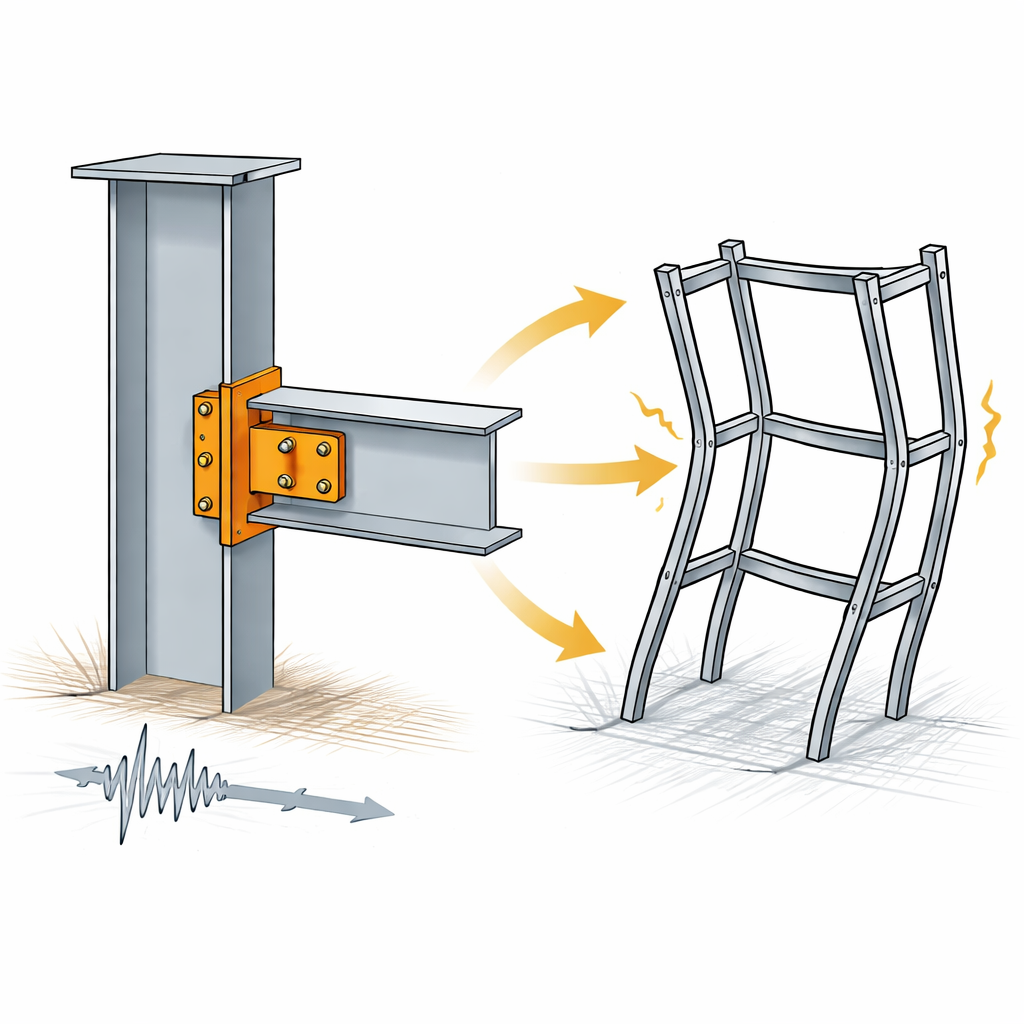
A new way to bolt beams to the weak side of a column
The research focuses on a specific steel joint where a horizontal beam meets the web, or thin middle plate, of a vertical column—the column’s weak axis for bending. Instead of relying on difficult field welding in a tight corner, the author proposes a “T‑adapter”: a short T‑shaped steel piece welded to the column web, to which the beam is then bolted through a flat end‑plate. High‑strength bolts clamp the beam’s end‑plate to the adapter’s flange, while additional plates inside the column help share forces. This layout improves access for workers, simplifies installation, and shifts much of the fabrication into the controlled conditions of a workshop, all while aiming to behave like a robust, fully rigid joint during an earthquake.
Testing the idea with virtual experiments
To see how well this connection could perform, the study built detailed three‑dimensional computer models using finite element analysis. First, the modeling approach was checked against past laboratory tests of well‑known strong‑axis and weak‑axis connections, ensuring that the simulations could reproduce measured strength, deformation patterns, and damage. After this validation, six versions of the new joint were analyzed, all with the same general geometry but different thicknesses for three key plates: the T‑adapter flange, the beam’s end‑plate, and the continuity plates inside the column. The models were subjected to back‑and‑forth cyclic loading intended to mimic earthquake‑induced story drifts up to 6 percent, following current U.S. seismic design protocols.
How thickness changes where damage goes
The simulations show that all six versions of the joint can satisfy the demanding criteria for “Special Moment Frames,” a category used for buildings in high‑seismic areas. Each configuration reached at least 4 percent story drift while maintaining a moment capacity of at least 80 percent of the beam’s plastic strength, and in many cases exceeded the beam’s nominal capacity. However, where the inelastic action occurred depended strongly on plate thickness. In the stiffest models, with thicker T‑adapter flanges and end‑plates, most of the bending damage and energy dissipation took place in the beam flanges, just as designers intend, while the joint hardware stayed mostly elastic. When the T‑adapter flange or end‑plate was made thinner, the joint became more flexible and a growing share of the plastic deformation shifted into the adapter and end‑plate themselves, changing the joint from rigid to semi‑rigid behavior and reducing damping efficiency. 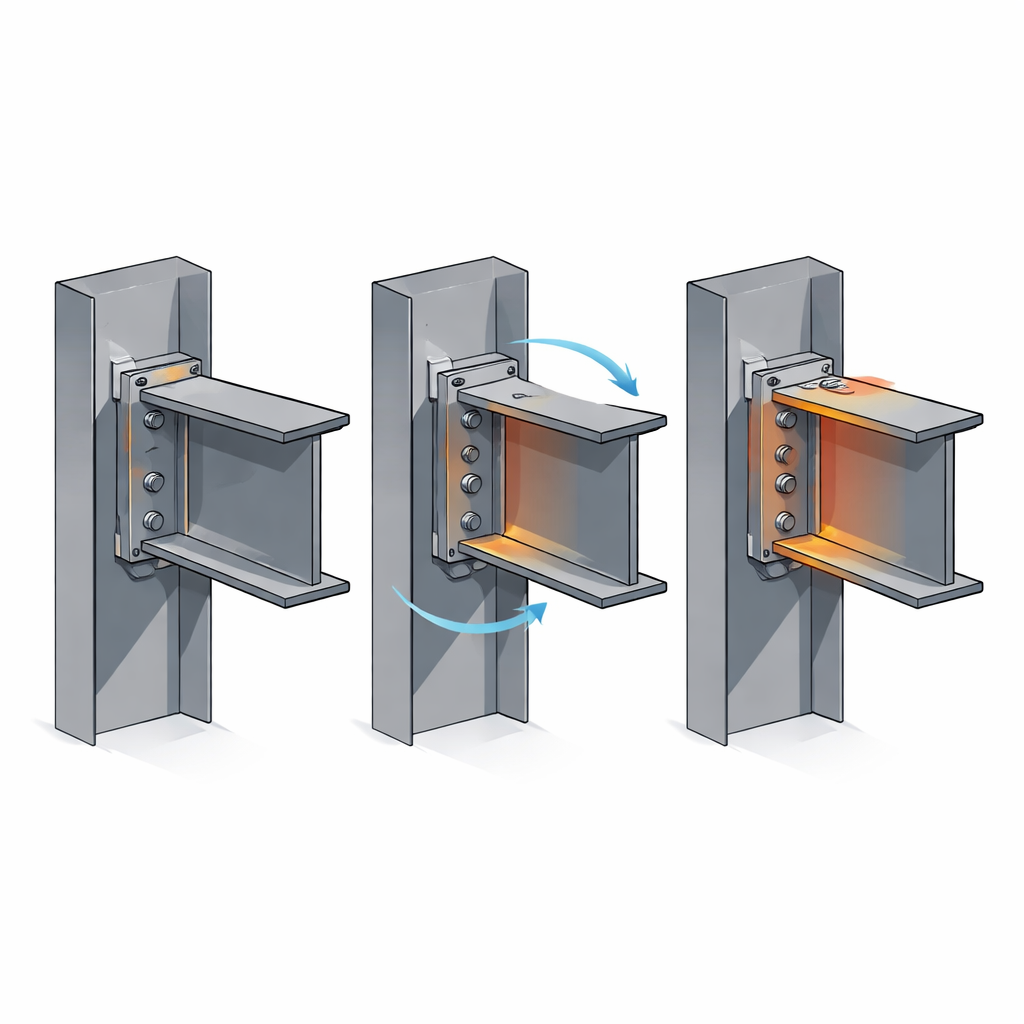
Energy dissipation, ductility, and bolt safety
Beyond overall strength, the study examined how well the different joints could absorb and release energy through repeated cycles, how much rotation they could tolerate before losing capacity, and how forces built up in the bolts. All models showed ductile behavior, with ductility ratios above two and no brittle failure of bolts in the simulations. The stiffest configuration provided high energy dissipation but also concentrated strains, leading to earlier local buckling and somewhat lower rotation capacity. More flexible versions spread demands more evenly and achieved higher ductility but at the cost of reduced rigidity and more pronounced pinching in the hysteresis curves. Detailed calculations confirmed that a significant part of the bolt force increase came from prying action—local bending of the plates that amplifies bolt tension—highlighting the need to account for this effect in design.
Applying the detail to different beam sizes
To test whether the concept is limited to a single beam‑column pair, the author also modeled two additional frame segments with very different beam depths and flange widths, while keeping the same T‑adapter idea and design philosophy. In both cases, the connections again met the seismic performance targets: they developed more than 80 percent of the beam plastic strength at 3 percent plastic rotation, maintained stable cyclic behavior, and kept most of the plastic deformation in the beam rather than in the joint hardware. The rotational stiffness of these additional assemblies remained high enough to classify the joints as rigid according to common structural criteria, suggesting that the detail scales well across realistic ranges of member sizes.
What this means for real buildings
For non‑specialists, the key takeaway is that it appears possible to design practical, bolt‑together joints on the “weak” side of steel columns that still behave like robust earthquake‑resisting connections. By carefully choosing the thicknesses of a few plates in a T‑adapter system, engineers can steer where damage occurs—preferably into the beam—while achieving the strength, rotation capacity, and stiffness required by modern seismic codes. Although the conclusions are based on advanced computer simulations and still need confirmation in full‑scale lab tests, the work suggests that existing design rules for more common strong‑axis joints can serve as a reasonable starting point. This could eventually make it easier to design and build safer, more economical steel frames in regions where earthquakes are a real concern.
Citation: Yılmaz, O. Seismic performance of weak-axis steel beam-to-column connections with a T-adapter. Sci Rep 16, 11415 (2026). https://doi.org/10.1038/s41598-026-42306-4
Keywords: steel moment frames, weak-axis connections, bolted end-plate, seismic design, finite element analysis