Clear Sky Science · en
Quantum dynamics, master equation and equilibrium for a qubit coupled to a thermal boson field
Why tiny quantum systems can warm up like everyday objects
When you leave a hot cup of coffee on the table, it cools down until it reaches room temperature. But what happens when the “coffee” is not a cup of liquid, but a single quantum bit—an idealized two-level system at the heart of quantum technologies—exchanging energy with a sea of light-like particles? This paper tackles that question in exact mathematical detail, showing how a single qubit settles into thermal equilibrium when it is coupled to a large, warm environment made of bosons (quantum particles such as photons or phonons). The authors manage to track this process without the usual approximations, clarifying when and how true thermalization actually occurs.

A simple quantum toy model with a big message
The study focuses on a standard workhorse of quantum physics called the spin–boson model. Here, the “spin” is a two-level system—a qubit—that can be in a ground or excited state, while the “boson field” is a collection of many independent oscillators that form a thermal reservoir at some temperature. This setup is not just a mathematical curiosity: it underlies how atoms interact with light, how solid-state qubits feel vibrations in a crystal, and how quantum devices lose energy to their surroundings. The authors impose a widely used simplification, the rotating-wave approximation, which keeps only energy-conserving interactions and allows them to follow the full quantum evolution analytically.
Following the qubit’s fate without guesswork
In many treatments of open quantum systems, one first writes down a so-called master equation—a differential equation for the qubit’s reduced state—and then solves it, typically using approximations that blur short-time memory effects. Here, the authors invert that logic. They first solve the joint evolution of qubit plus reservoir exactly, starting from an initially uncorrelated state where the reservoir is in any “phase-invariant” configuration, including a thermal state. By tracing out the reservoir, they obtain an explicit dynamical map that tells how the qubit state at any later time depends on its initial state. From this exact map, and only then, they derive a master equation. The result is a time-local equation of the celebrated Gorini–Kossakowski–Lindblad–Sudarshan type, with time-dependent coefficients that capture nontrivial memory effects while avoiding uncontrolled approximations.
When losing information means gaining equilibrium
The key to understanding thermalization lies in whether the map from initial to final qubit states remains invertible. If it can be reversed, the qubit never truly forgets its starting point; if it becomes noninvertible, many different initial states merge into the same final state—precisely the hallmark of equilibration. Mathematically, this is controlled by a determinant, called D in the paper, built from a small set of functions that encode how likely the qubit is to be found in its ground or excited state at any time. The authors show that when D gradually shrinks to zero at long times, the qubit’s final probabilities no longer depend on where it started. Under weak coupling and reasonable assumptions about the reservoir, D is proven to decrease monotonically, vanishing only in the infinite-time limit, thereby certifying the emergence of a unique equilibrium state.
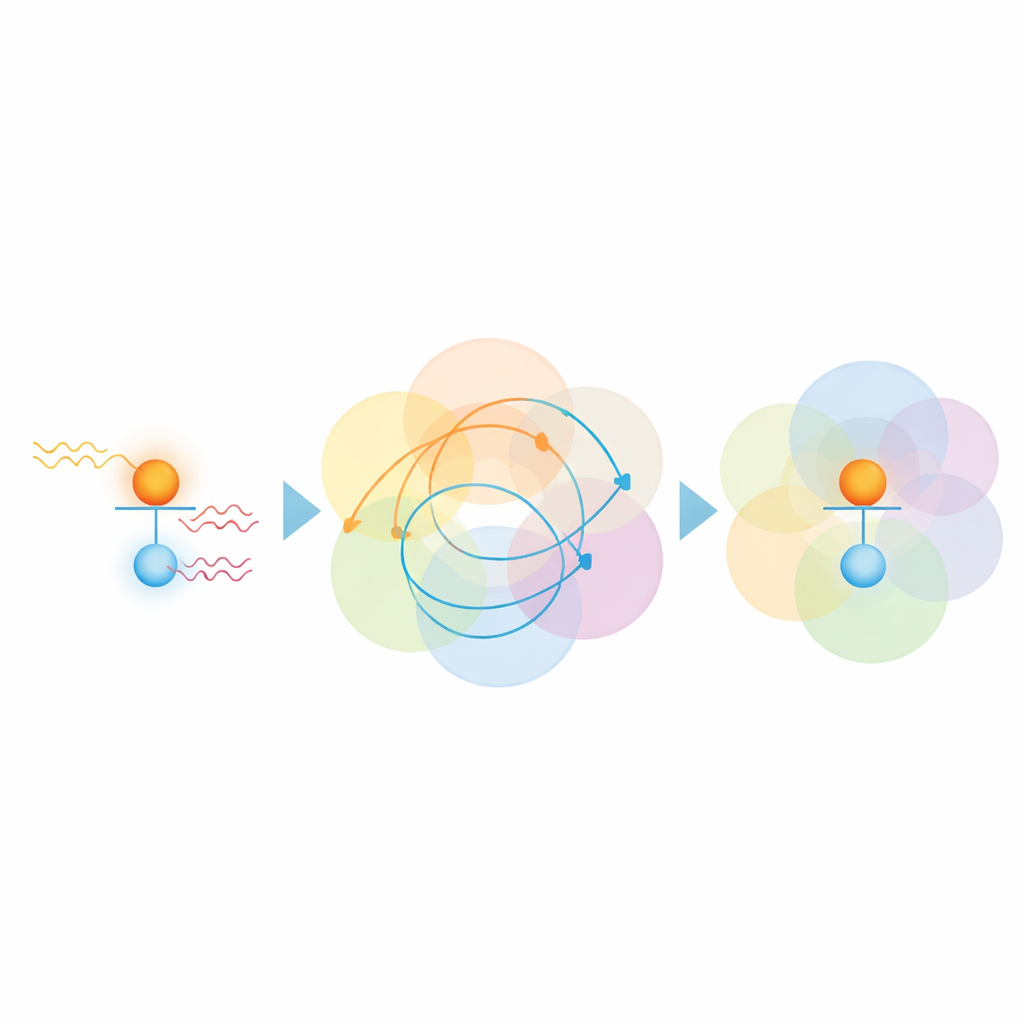
How the environment forgets while the qubit relaxes
An important part of the story is what happens to the reservoir itself. Because the authors have exact formulas for its time evolution, they can show that the environment is only briefly disturbed by the qubit. On short “microscopic” timescales, the many bosonic modes rearrange themselves, but due to energy-conserving (on-shell) processes and the huge number of degrees of freedom, the reservoir quickly returns to its original thermal state. By contrast, the qubit relaxes on a much longer, “macroscopic” timescale that scales inversely with the square of the coupling strength. During this slow evolution, the qubit experiences the reservoir as essentially stationary, justifying the common physical picture used in many approximate theories, but now anchored in an exactly solvable model.
What it all means for quantum thermalization
Putting these pieces together, the authors demonstrate that a single qubit coupled to a thermal bosonic field will, in the long run, settle into a thermal state at the same temperature as its environment, regardless of how it was initially prepared—as long as the technical conditions ensuring D tends to zero are met. The reservoir itself returns to its starting thermal configuration, while the qubit’s excited and ground-state populations approach the familiar Boltzmann factors determined by the energy gap and temperature. Beyond confirming an intuitive picture of quantum relaxation, this work highlights how exact models can reveal the delicate interplay between reversibility at the level of the full quantum world and the emergence of irreversibility and equilibrium for small subsystems.
Citation: Nakazato, H., Pascazio, S. Quantum dynamics, master equation and equilibrium for a qubit coupled to a thermal boson field. Sci Rep 16, 12970 (2026). https://doi.org/10.1038/s41598-026-42305-5
Keywords: open quantum systems, qubit thermalization, spin–boson model, quantum master equation, quantum thermodynamics