Clear Sky Science · en
Giant-magnetocaloric effect and phonon dynamics in (GdCe)CrO3
Cooling with Magnets Instead of Gases
Refrigerators and low-temperature cooling systems mostly rely on gas compression cycles that can harm the environment. An appealing alternative is magnetic refrigeration, which uses changes in a material’s magnetism to pump heat. This paper explores a specially engineered oxide compound, Gd0.9Ce0.1CrO3, that shows an unusually strong cooling response to magnetic fields at low temperatures, while also revealing how subtle shifts in its atomic vibrations are linked to its magnetic behavior.
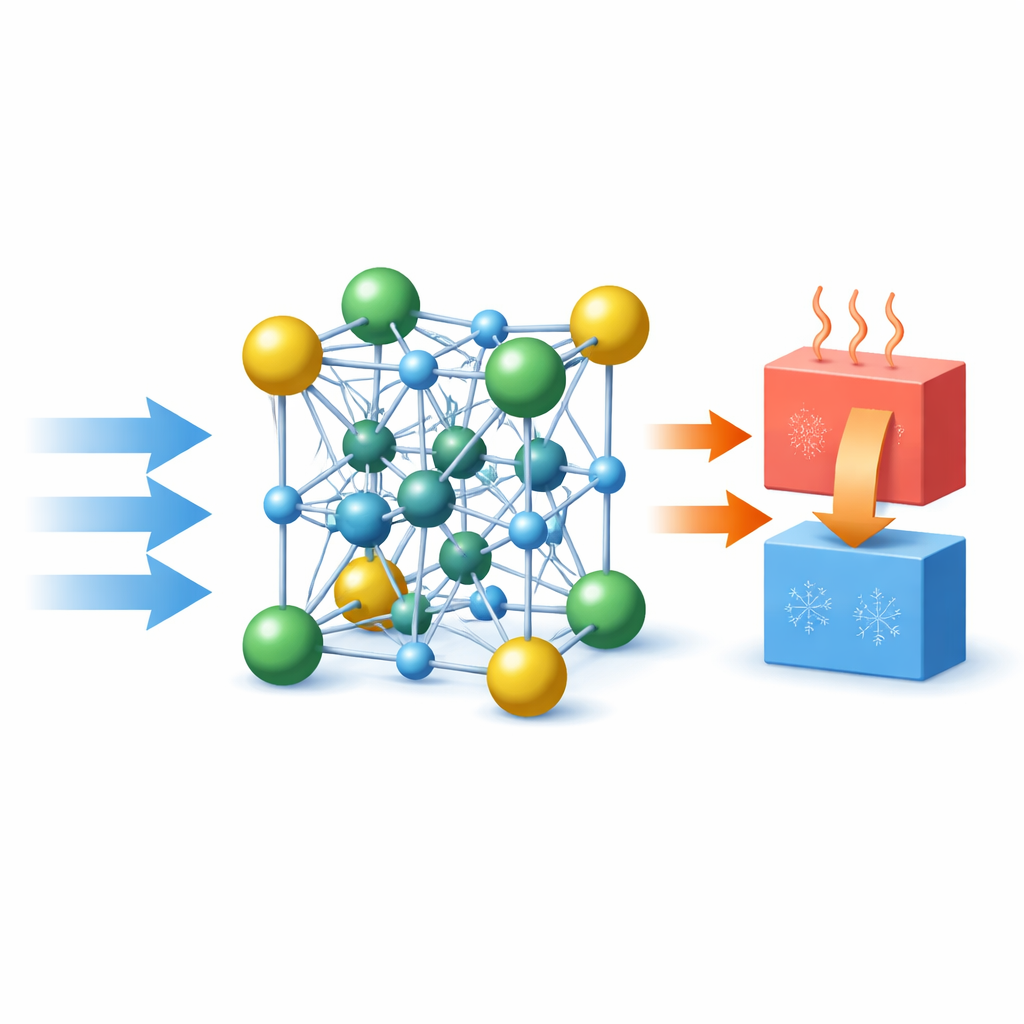
A Tailor-Made Crystal for Extreme Cooling
The material at the heart of this study belongs to a family of oxides known as rare-earth chromites, where magnetic atoms sit in a three-dimensional framework called a perovskite structure. By replacing a small fraction of the gadolinium (Gd) atoms with slightly larger cerium (Ce) atoms, the researchers gently stretched and distorted this framework without changing its basic arrangement. X-ray diffraction confirmed that the compound remains a single, orderly crystal phase, while precise refinements of the atomic positions showed small but meaningful changes in distances and angles between chromium and oxygen atoms. These nanoscale tweaks shift how the magnetic building blocks in the crystal talk to each other.
Listening to Atoms Vibrate
To understand how the lattice responds to this chemical substitution, the team used Raman spectroscopy, a technique that listens to the vibrational “notes” of atoms in the crystal. They found several vibrational modes, with one particular symmetric stretching mode of the CrO6 octahedra standing out. In the Ce-doped compound, this mode becomes significantly stronger and shifts slightly in frequency compared with undoped GdCrO3. As the temperature is varied, this vibrational line moves in a way that cannot be explained by simple thermal effects alone. Around the temperature where the chromium spins order into an antiferromagnetic pattern, the mode displays a subtle kink, signaling that magnetism and lattice vibrations are coupled. This spin–phonon interplay shows that changing the crystal’s geometry directly influences both how it vibrates and how it magnetizes.
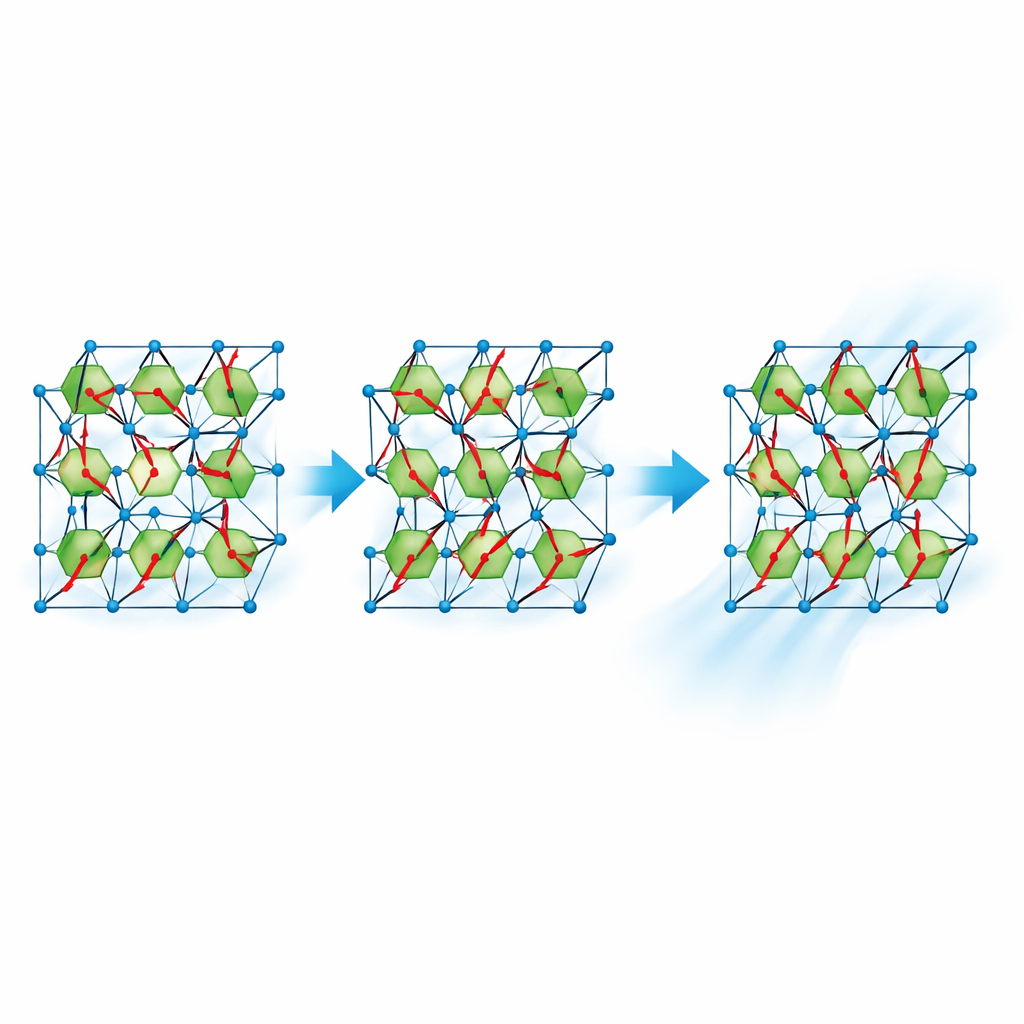
Magnetization That Flips and Switches
Magnetization measurements reveal that the Ce-doped compound orders magnetically around 173 K, forming a slightly canted antiferromagnet in which neighboring spins mostly oppose each other but do not cancel perfectly. As the sample is cooled in a weak magnetic field, the total magnetization can become negative, meaning that some magnetic sublattices align opposite to the applied field. At very low temperatures, near 10 K, the system undergoes a spin-flip transition: under sufficient field, the direction of a subset of spins abruptly changes, reorienting the magnetic pattern. Time-resolved experiments show that this flipped state is stable and can be toggled reproducibly by adjusting either temperature or field strength. Such controllable switching of magnetization polarity, without loss of stability over thousands of seconds, points to possible uses in magnetic memory elements or thermo-magnetic switches.
A Record-Like Magnetic Cooling Response
The most technologically exciting feature of Gd0.9Ce0.1CrO3 is its giant magnetocaloric effect: when a strong magnetic field is applied and removed near a few kelvin, the material shows a very large change in magnetic entropy, a measure closely tied to how much heat it can absorb or release. By analyzing a series of magnetization curves taken at different temperatures and fields, the authors calculate a peak entropy change of about 45 J per kilogram per kelvin at 3 K for a 90 kOe field change—among the highest values reported for this class of oxides and even for many gadolinium-based materials in general. This enhancement is traced back to the modified crystal geometry and strengthened coupling between the magnetic ions and the vibrating lattice, which sharpen the response of the spins to temperature and field.
From Atomic Distortions to Future Coolers
In accessible terms, this work shows how swapping just one in ten Gd atoms for a slightly larger Ce atom can subtly twist a crystal lattice, alter its vibrations, reorganize its magnetic patterns, and ultimately boost its ability to act as a magnetic refrigerant. The combination of controllable magnetization reversal, robust low-temperature spin-flip behavior, and record-high magnetocaloric performance suggests that carefully designed perovskite oxides like Gd0.9Ce0.1CrO3 could become key ingredients in future solid-state cooling technologies and magnetic switching devices, especially for applications that require very low temperatures without environmentally harmful gases.
Citation: Dokala, R.K., Das, S. & Thota, S. Giant-magnetocaloric effect and phonon dynamics in (GdCe)CrO3. Sci Rep 16, 12050 (2026). https://doi.org/10.1038/s41598-026-42301-9
Keywords: magnetocaloric effect, magnetic refrigeration, perovskite oxides, spin-phonon coupling, rare-earth chromites