Clear Sky Science · en
Intelligent monitoring and CNN-based performance evaluation of borehole-pipe-pump gas drainage systems in coal mines
Why keeping mine gas under control matters
Deep underground, coal mines must constantly remove methane gas to prevent explosions and to capture a useful energy resource. That job is done by a web of boreholes, pipes, and pumps that suck gas out of the rock. But leaks, blockages, and unstable operation can quietly erode the system’s performance long before anyone notices. This study shows how carefully designed experiments and modern artificial intelligence can turn routine sensor readings into an automatic “health check” for mine gas drainage, helping to keep miners safe while making better use of the gas that is captured.
How gas is drawn out of the coal seam
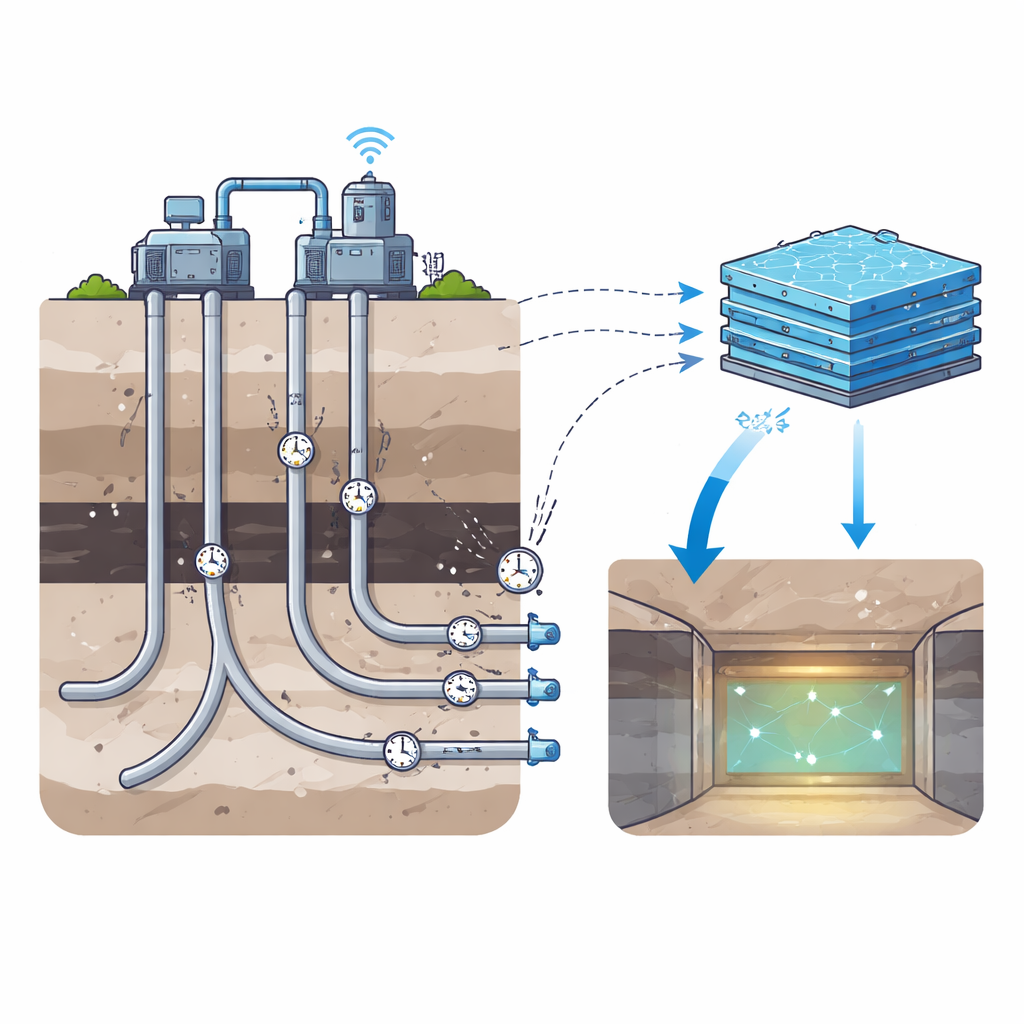
In a typical mine, holes are drilled into the coal seam and connected to a network of pipes leading to powerful vacuum pumps. These pumps create negative pressure—essentially a suction force—that pulls methane and air out of the rock. The gas mixture then travels through steel pipelines to the surface for treatment or use. In theory, engineers can track pressure, flow rate, and gas concentration with sensors along the pipes and use those numbers to judge whether the system is working well. In practice, harsh underground conditions, corrosion, and complicated pipe layouts make the data noisy and hard to interpret, especially when relying on human judgment alone.
What goes wrong when pipes leak or clog
To understand how the system behaves under stress, the researchers built controlled experiments that mimic real underground drainage networks. They introduced leaks and blockages at specific points in the pipes and monitored how the pressure and flow changed along the line. When the main pipeline near the pumps leaked, the suction dropped sharply while the measured flow rose—a sign that a lot of extra air, not useful methane, was being pulled in. Leaks in side branches, by contrast, barely affected the pump itself but greatly reduced suction and gas removal in downstream boreholes. Blockages produced their own telltale pattern: a sudden change in how fast pressure fell along the pipe, followed by partial recovery. These laboratory signatures form a kind of fingerprint library for different fault types.
Turning expert rules into a simple score
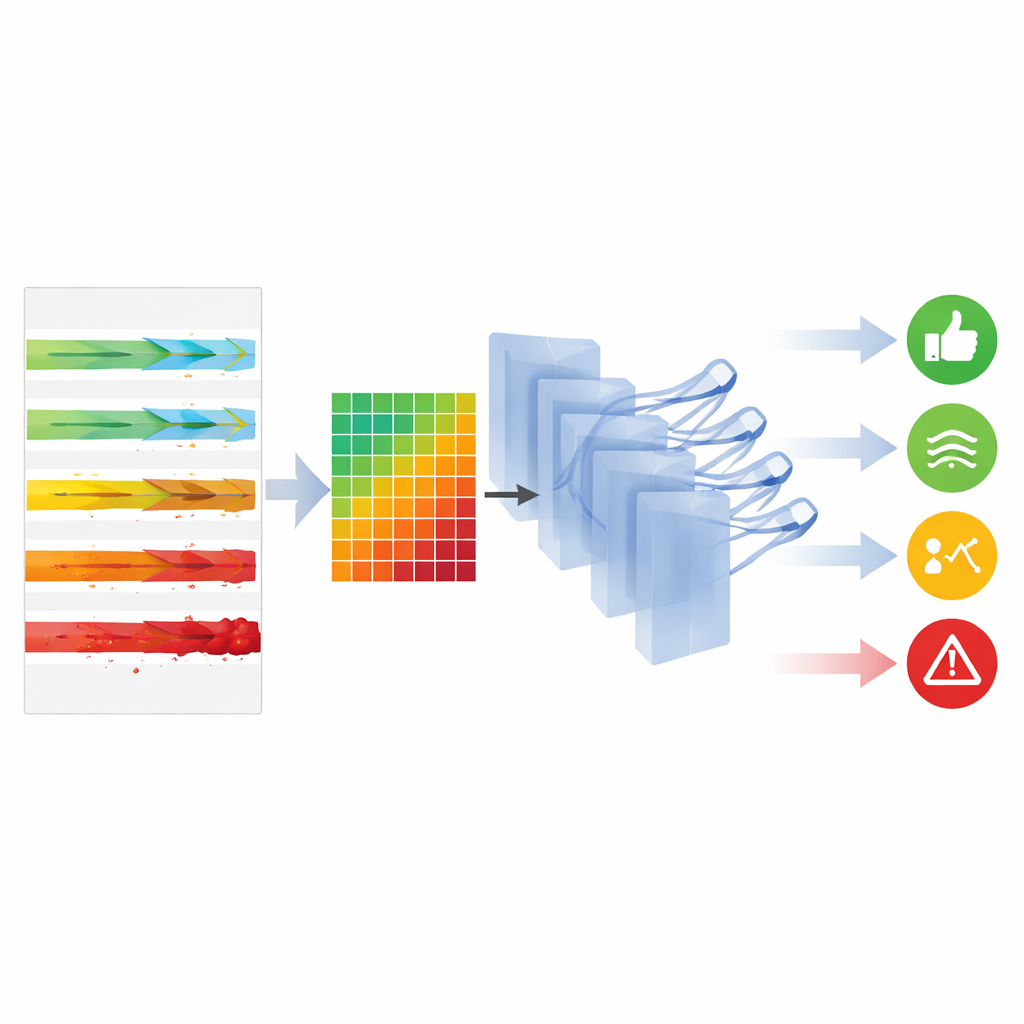
Building on practical mine standards, the team designed an evaluation system that rolls many factors into a single satisfaction score between zero and one. They grouped the indicators into two main themes: safety and effectiveness. Safety covers how air is distributed in the working area and how much gas is still being released near miners. Effectiveness reflects how much gas is drained each day, how strong the suction is, how concentrated the methane is, and how much pure gas is actually captured. Using a structured decision method, experienced engineers assigned relative importance to each factor. The final score is then mapped into five grades, from excellent (Grade I) to unqualified (Grade V), mirroring how real mines judge whether drainage meets national standards.
How a neural network learns the system’s “feel”
Instead of asking humans to continually apply these rules, the authors trained a convolutional neural network (CNN)—a type of deep-learning model—to recognize drainage quality directly from sensor data. They sliced time series of seven monitored variables into short windows and arranged each window as a small matrix, much like an image. This format lets the CNN pick out subtle patterns in how pressure, flow, and gas concentration change together over time, including the fingerprints discovered in the leakage experiments. The grade for each data sample was first obtained from the expert-based scoring method and then used as the teaching signal for the CNN. With 10,000 samples from China’s Xinfa Coal Mine, the network architecture and training settings were tuned to balance accuracy and computing cost.
How well the intelligent monitor performs
Under its best settings, the CNN correctly classified all samples rated as excellent, good, or medium, and almost all that were merely qualified. Its weakest performance was on the rare, severely unqualified cases, where it correctly identified about half. This shortfall stems partly from the scarcity of such dangerous states—mines work hard to avoid them—and partly from the fact that their sensor readings can overlap with borderline but acceptable conditions. Even so, the model is lightweight enough to run in real time on standard mine computers, using the same pressure, flow, and gas sensors already installed in most operations. The authors argue that retraining with data from other mines could extend the approach widely, while additional techniques for handling rare events may improve detection of the most serious faults.
What this means for safer and cleaner mining
By combining physical experiments, expert knowledge, and deep learning, this work turns a complex gas drainage network into a system that can largely judge its own performance. The approach offers mine operators a continuous, automated rating of how well their borehole–pipe–pump systems are working, flagging subtle degradations before they become hazards. That can reduce the risk of gas accidents, support more stable coal production, and increase the share of methane that is captured as a useful fuel instead of being vented to the atmosphere. In short, smarter monitoring of underground gas not only protects miners but also helps make coal mining cleaner and more efficient.
Citation: Tong, Y., Yang, Y., Niu, J. et al. Intelligent monitoring and CNN-based performance evaluation of borehole-pipe-pump gas drainage systems in coal mines. Sci Rep 16, 11802 (2026). https://doi.org/10.1038/s41598-026-42294-5
Keywords: coal mine safety, gas drainage, pipeline leakage, deep learning monitoring, methane extraction