Clear Sky Science · en
Comparison of explosively driven shock tube and open-air blast wave propagation
Why blasts in air still surprise scientists
Explosions are sadly common in war zones, industry accidents, and mining, but the pressure waves they create are far trickier than textbook diagrams suggest. Many safety standards, medical studies, and equipment tests assume a simple, single pressure spike followed by a smooth decline. This paper shows that the way we set up experiments—whether a blast happens out in the open, near the ground, or inside a tube—can radically change the shape and duration of that pressure wave, even when the blast strength is the same. Those differences matter for how we design protective gear, buildings, and lab models of blast injury.
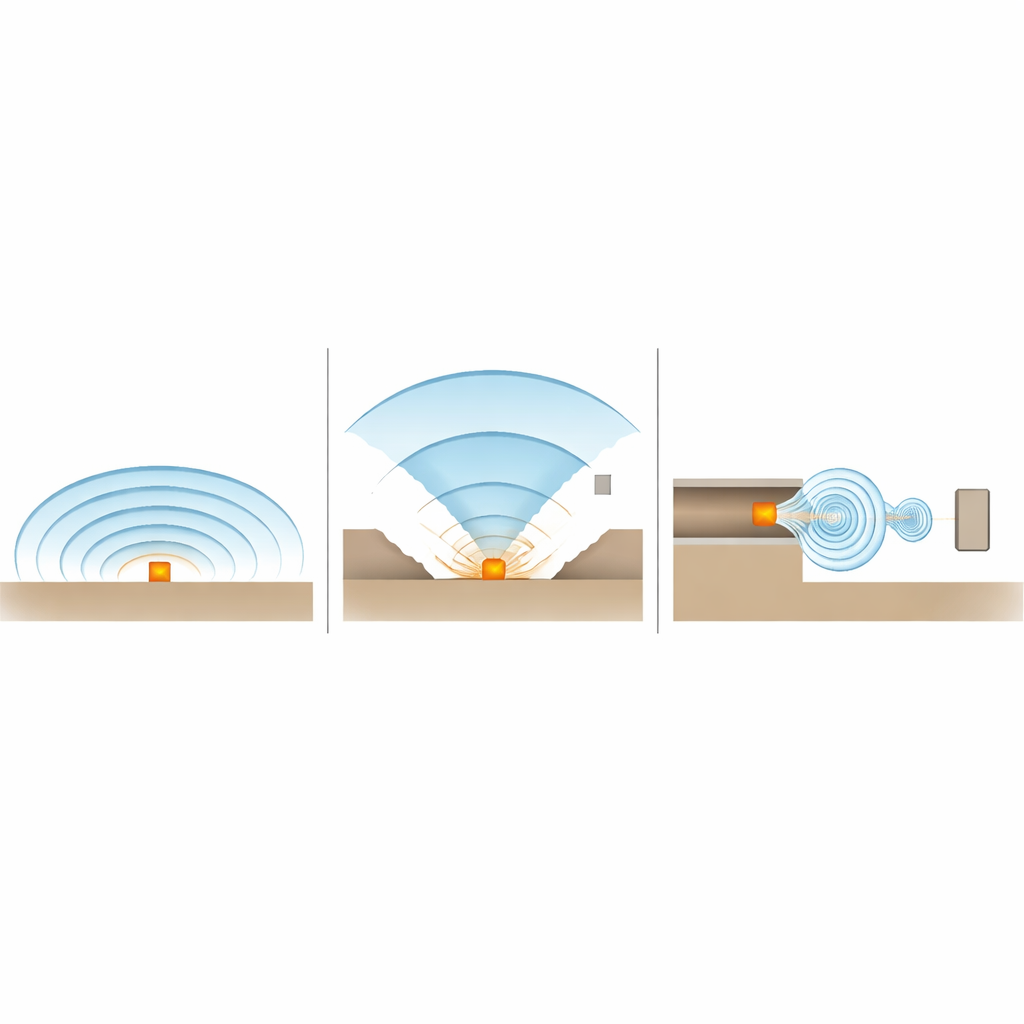
Three ways to make the same small explosion
The researchers used a very repeatable, pencil‑thin “explosion” created by vaporizing a tiny gold wire with a high‑voltage pulse. They then placed this same energy source in three different setups: lying flat on a floor in open air (unconfined), raised slightly above the floor so the wave could bounce off the ground (partially confined), and buried inside a short 3D‑printed tube (confined). High‑speed cameras visualized how the shock waves moved, while a pressure sensor mounted in a large wooden block recorded what a target would actually feel. By carefully matching the speed of the incoming shock wave in each setup, the team ensured they were comparing geometry, not differences in explosive strength.
What happens in wide open space
When the wire sat directly on the ground, the blast behaved most like the ideal textbook curve. The pressure at the target jumped quickly to a peak, then fell off and dipped below normal air pressure before settling back to ambient. This “negative phase” is important because it pulls on structures and body tissues in the opposite direction of the initial push. In this unconfined case, the positive and negative phases carried almost the same overall load over time, and repeated tests gave nearly identical results. This open setup produced a clean, single shock wave without extra reflections returning to the sensor, making it a strong baseline for comparison.
When the ground fights back
Raising the charge only a few millimeters above the ground changed the story. Now the wave raced outward, struck the floor, and bounced upward, merging with the original wave into a stronger front called a Mach stem. At the lowest heights, this merged wave hit the sensor almost as a flat wall of air, boosting both peak pressure and the total “push” delivered during the positive phase—up to about 16.5% more than in the open tests. As the charge was moved higher, the reflected wave arrived later and lined up less perfectly with the first wave. Peak pressure then dropped, and the total push could fall below the unconfined case, even though the blast source was the same. Across these partially confined tests, the negative phase generally weakened and became more erratic, because small timing shifts in the reflected wave could cut into the low‑pressure portion of the signal.
Inside a tube, the blast never really lets go
The confined setup—where the gold wire sat inside a narrow tube—looked most like many laboratory shock devices used to study blast injury. Here, the shock front shot out of the tube, trailed by a rolling vortex ring and a train of weaker waves reflected from the closed back end. At the target, the very first pressure spike looked roughly similar in height to the open‑air case, but what followed was entirely different. Instead of a strong dip below normal pressure, the tube kept feeding air and reflected shocks forward, stretching the positive phase and nearly wiping out the negative phase. The overall push during this positive phase was about two‑thirds higher than in the unconfined tests, even though the peak pressure was slightly lower. In practical terms, a specimen placed in front of the tube experiences a milder “hit” but a much longer “shove.”
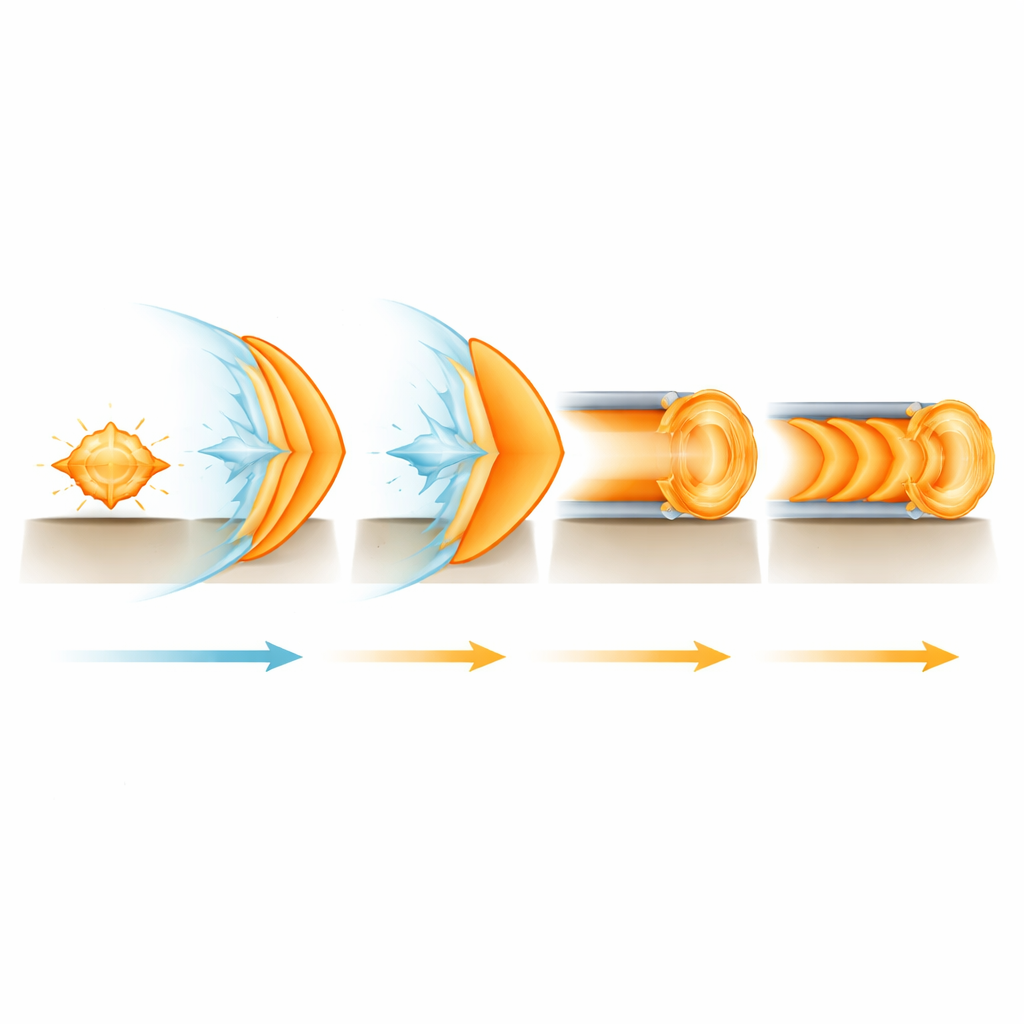
Why the full pressure story matters
The authors conclude that it is not enough to match a single number such as peak pressure when trying to mimic real‑world blasts in the lab. The same input energy, delivered through different geometries, produced waveforms that differed in how long the pressure stayed high, how strong the negative phase was, and how many extra peaks appeared. Since injury risk and structural damage depend on both the size and the duration of these loads, a shock tube test may over‑ or underestimate what would happen in open air. For anyone studying blast‑related brain injury, armor, vehicles, or buildings, this work underscores the need to report and interpret the entire pressure‑time curve—and to choose test setups that truly represent the real scenario of interest.
Citation: Bauer, R.L., Johnson, C.E. Comparison of explosively driven shock tube and open-air blast wave propagation. Sci Rep 16, 12841 (2026). https://doi.org/10.1038/s41598-026-42282-9
Keywords: blast waves, shock tubes, explosion testing, blast-induced brain injury, protective structures