Clear Sky Science · en
Probabilistic seismic demand assessment of special truss moment frames with Vierendeel panels under geometric variations
Why long span buildings in earthquakes matter
Modern malls, airports, and parking structures often need very wide, open floors without many interior columns. That layout is great for people and equipment but can be risky in strong earthquakes. This study looks at a special type of steel frame that uses trusses and carefully weakened zones so that damage during shaking is steered into safe, replaceable regions instead of critical columns. The work shows how simple geometric choices in these frames can make wide open buildings more earthquake resilient and easier to assess in advance.
How these special steel frames work
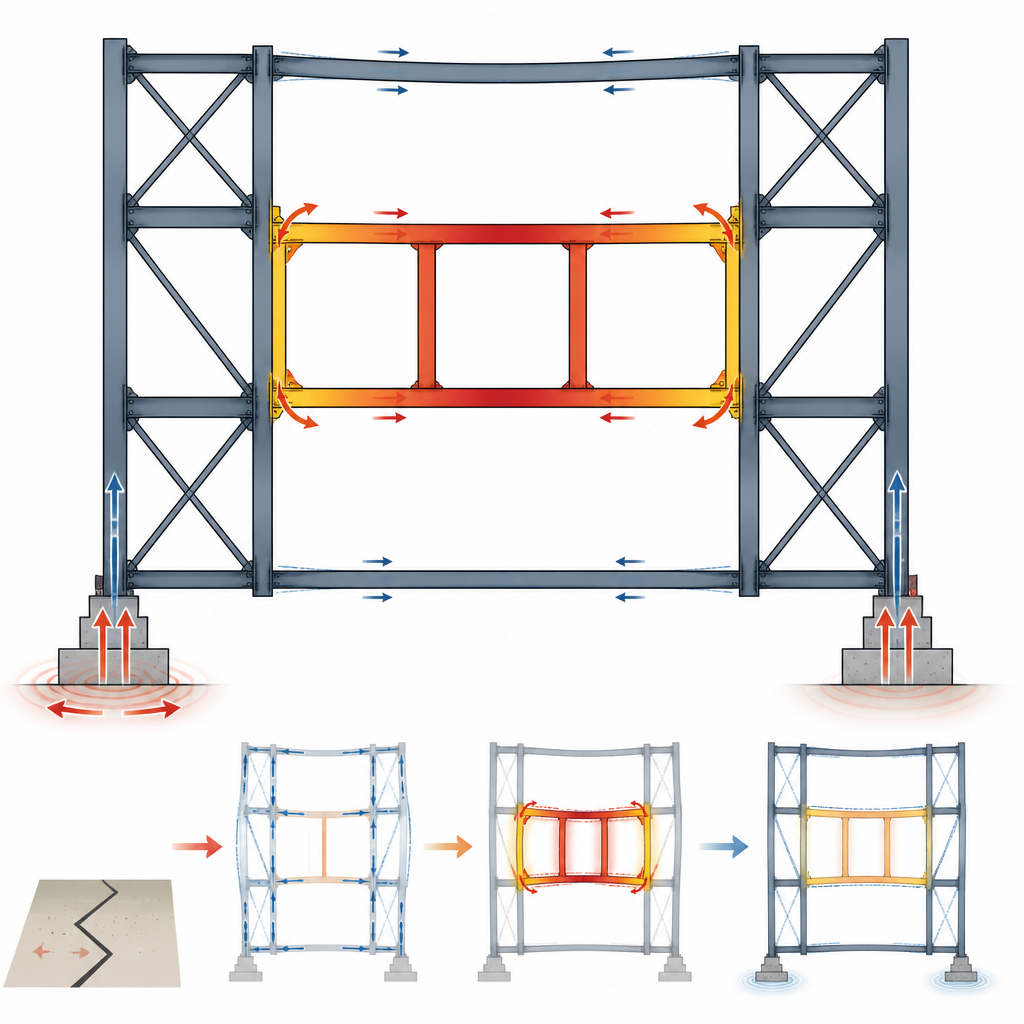
Instead of solid beams, the buildings studied use truss beams, which are light, strong, and naturally provide space for ducts and pipes. In the middle of each truss, where gravity loads are smaller, some diagonal bars are removed to form a rectangular opening known as a Vierendeel panel. This central zone, called the special segment, is deliberately made weaker so that it bends and yields first during an earthquake. The rest of the frame, especially the columns, is kept strong and mostly elastic so the overall structure remains stable even when the special segment deforms significantly.
What the researchers tested
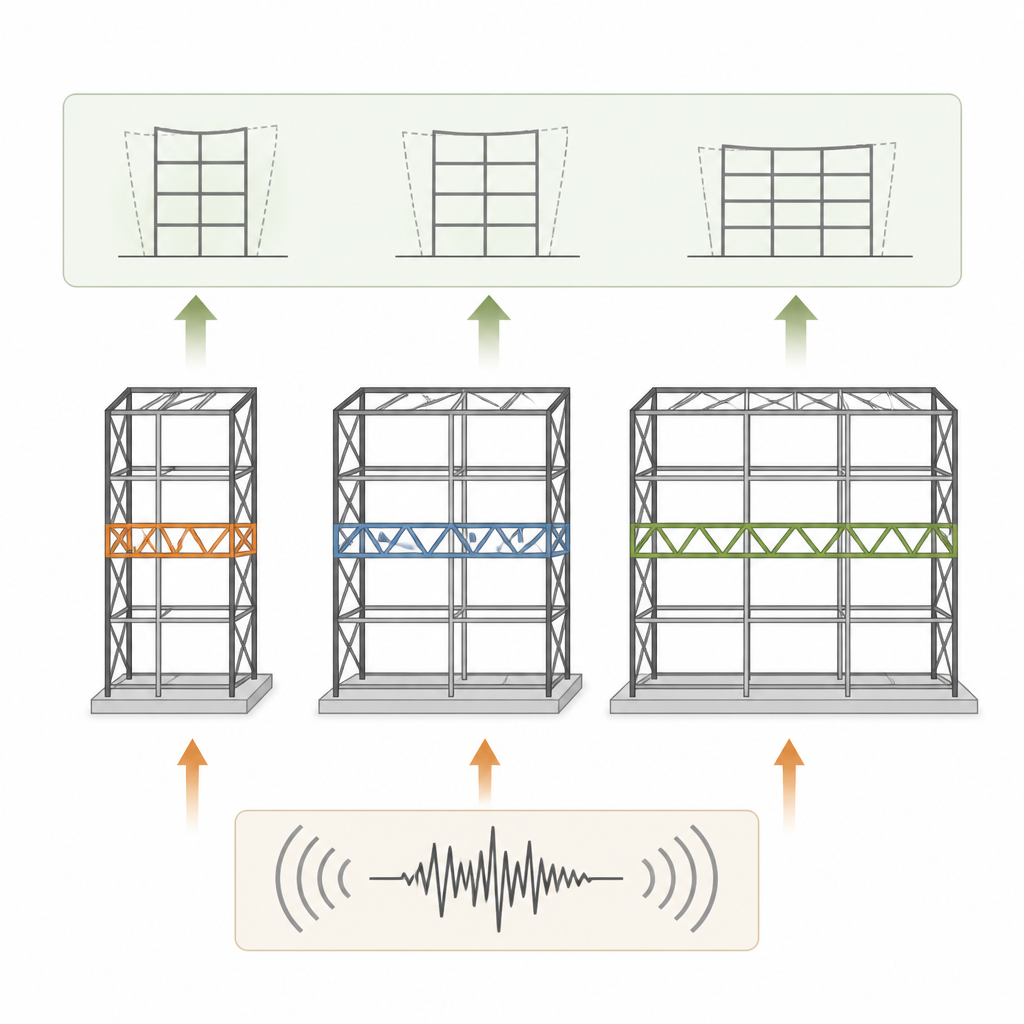
The team examined 27 different frame layouts, all with three side by side spans but with three, six, or nine stories, spans of 10, 15, or 20 meters, and three lengths of the special segment. Using advanced computer models, they shook each frame with 22 real strong ground motion records that were progressively scaled in intensity. This technique, called incremental dynamic analysis, tracks how the building’s story drifts grow as shaking becomes stronger and identifies the point where the frame can no longer respond stably. From these results, the researchers built statistical models that relate earthquake intensity and building drift to simple measures of building shape, such as the ratio of total height to span length and the ratio of special segment length to span.
Turning complex behavior into simple rules
Because earthquakes and structural response are uncertain, the study uses a probabilistic approach that treats key quantities as ranges rather than single numbers. For each geometry, the team derived a mathematical line that links the intensity of shaking to the maximum sideways drift the building experiences before collapse, and then captured how much scatter there is around that line. They applied Bayesian statistics to extract these relationships from relatively limited data, and then distilled the results into prediction formulas that depend only on the two main geometric ratios. These formulas reproduce the detailed simulation results with modest error and can be used to sketch out expected drift demands and the drift level at collapse without repeating the full simulations.
Assessing risk of collapse
The researchers also built what are known as fragility curves, which show the probability that a frame will collapse for different levels of shaking. For the example city of Bojnord in Iran, they combined these curves with local earthquake hazard information to estimate how likely each frame is to exceed certain drift levels over a 50 year period. They found that taller, more slender frames tend to reach collapse at lower shaking intensities than their shorter, stockier counterparts. Frames with shorter special segments relative to their span not only experience lower drifts before collapse but also show higher median collapse capacities, meaning they can withstand stronger shaking before losing stability.
What builders and planners can take away
The central message of the study is that a few clear geometric choices strongly shape how these long span steel frames behave in earthquakes. Keeping buildings shorter relative to their span and limiting the length of the weakened special segment both reduce typical earthquake drifts while also increasing the shaking level at which collapse is expected. The prediction equations developed here let engineers quickly estimate drifts, collapse tendencies, and fragility curves for frames within the studied range, offering a practical tool for early design and for screening options before more detailed analysis. For the public, this means that with thoughtful proportions and targeted weak zones, wide open buildings can be laid out to rock and sway in major earthquakes without giving way.
Citation: Yahyaabadi, A., Gholami, M. & Garivani, S. Probabilistic seismic demand assessment of special truss moment frames with Vierendeel panels under geometric variations. Sci Rep 16, 14570 (2026). https://doi.org/10.1038/s41598-026-42239-y
Keywords: earthquake engineering, steel structures, truss moment frames, seismic risk, building drift