Clear Sky Science · en
The role of future planning, patience, and risk tolerance for prospective reciprocity in human adults
Why thinking about future favors matters
Imagine doing a favor for someone today because you hope they will help you tomorrow. This everyday intuition sits at the heart of a more complex kind of cooperation called “prospective reciprocity.” In this study, researchers asked what helps adults make these forward-looking choices: the ability to plan ahead, the willingness to wait for rewards, and comfort with taking risks. By testing nearly 300 people in a carefully designed online experiment, they explored how these traits shape when and how we invest in others for possible future payoffs.

Two ways of trading favors
Cooperation through “you help me, I help you” can work in at least two ways. In retrospective reciprocity, people return favors because of what happened in the past: if someone has already helped you, you feel inclined to help them back. This backward-looking pattern is found in many animals. Prospective reciprocity is different. Here, you help first, hoping your partner will repay you later. It requires thinking ahead about future interactions and accepting that you might not be paid back at all. So far, this future-focused form of cooperation has been clearly shown only in humans, and the authors wanted to know which psychological abilities make it possible and why people differ in how often they use it.
Testing planning, waiting, and risk-taking
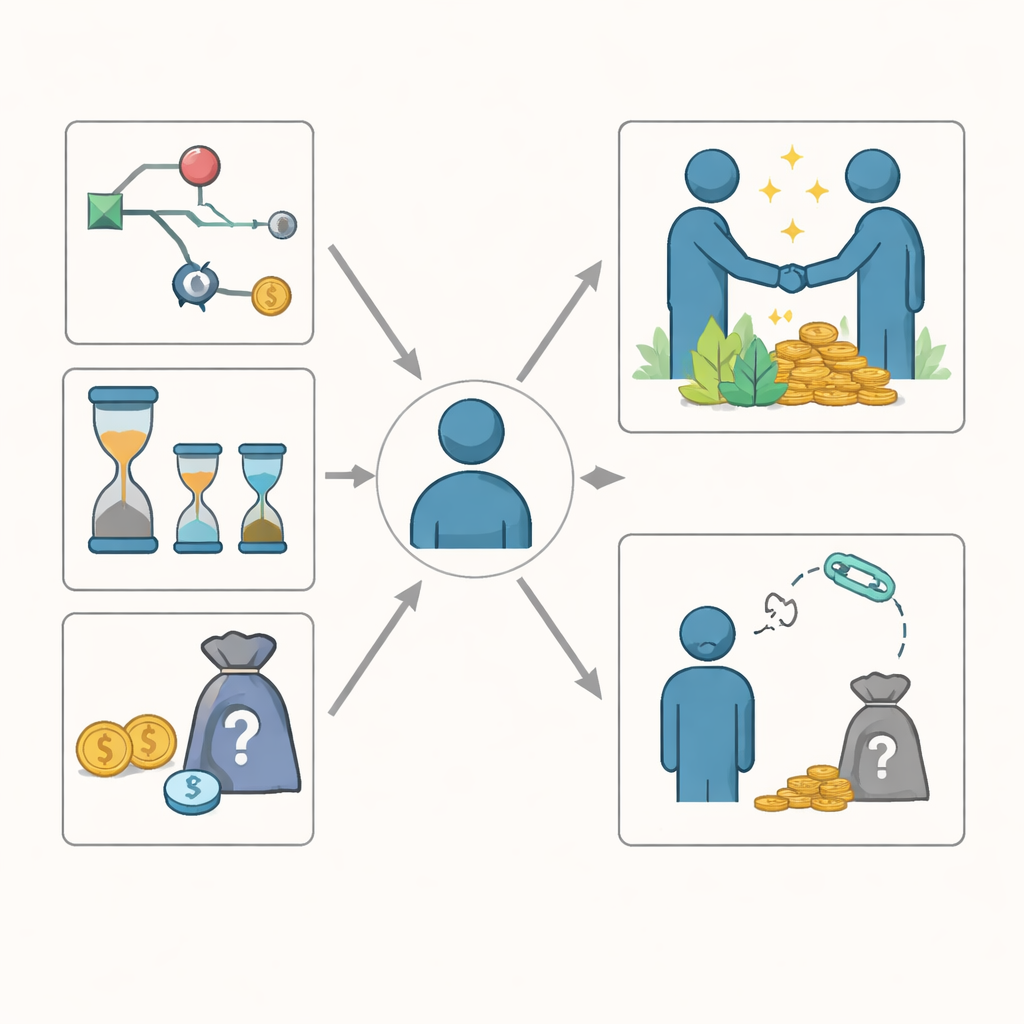
The team built a ten-task test battery that participants completed online over several sessions. To measure planning, they used a puzzle task where people had to move colored balls between pegs in the fewest possible steps. Patience was captured with three tasks that forced people to choose between smaller, sooner rewards and larger, later ones, including an experience-based “coin accumulation” game and a boat task where reaching a faraway island took longer but paid more. Risk tolerance was measured with three different tasks: a balloon game where pumping more increased both reward and chance of losing it, a choice between described lotteries, and a choice between risky options learned from experience rather than from written probabilities.
To capture prospective reciprocity itself, participants played three interactive games. In a Trust Game, they decided how much money to send to another player who could, but did not have to, return some of it. In a Centipede Game, two players took turns either continuing a shared investment for higher joint payoffs later or stopping early to secure a smaller personal gain. In a modified Zürich Prosocial Game, participants could help a partner in ways that might later be repaid, or help in situations where no payback was possible. Across all three games, the crucial feature was that people had to act first, under uncertainty, with a chance of future cooperation from the partner.
What the experiment revealed
Patience emerged as the most reliable ally of forward-looking cooperation. People who more often chose to wait for larger rewards tended to invest more strategically in partners across all three reciprocity games. This suggests that resisting immediate temptation is important for starting cooperative exchanges that only pay off later. Risk attitudes were more complicated. In the balloon task, greater willingness to take risks went along with more cooperation in two games. But in a different risk task where options had equal overall value but different volatility, people who were more cautious actually showed more strategic helping. Planning ability also did not behave as expected: better planners helped less strategically in the Zürich game, perhaps because careful thinkers were more alert to the chance of being exploited or needed only a basic level of future thinking to engage in such cooperation.
Different games, different kinds of cooperation
One striking finding was that the three reciprocity tasks did not strongly correlate with one another. Someone who was highly cooperative in one game was not necessarily so in the others. This suggests that prospective reciprocity is not a single, broad trait but a family of related behaviors shaped by the details of each situation, such as the timing, stakes, and how information is presented. The authors argue that instead of treating “future-oriented cooperation” as one hidden tendency that shows up the same way everywhere, it may be better understood as the combined result of multiple ingredients—planning, patience, and risk tolerance—mixed in different proportions depending on the context.
What this means for everyday life
For a layperson, the take-home message is that being willing to wait, to some extent, helps people build cooperative relationships that unfold over time. Yet, the decision to help now for a possible future return is not driven by patience alone. How we handle uncertainty and how we think ahead matters, but their effects change with the structure of the situation. The study shows that forward-looking cooperation is subtle and context-dependent, and that simple lab measures do not capture a single “cooperative personality.” Instead, different settings draw on different psychological strengths. Understanding these nuances could help design better policies, workplaces, and communities that make it easier for people to see the benefits of helping one another over the long run.
Citation: Keupp, S., Grüneisen, S., Olschewski, S. et al. The role of future planning, patience, and risk tolerance for prospective reciprocity in human adults. Sci Rep 16, 12383 (2026). https://doi.org/10.1038/s41598-026-42226-3
Keywords: cooperation, reciprocity, patience, risk taking, future planning