Clear Sky Science · en
Dynamic analysis and structural parameters optimization of reciprocating double-action cutter for ramie based on FEM
Why Cutting Tough Stalks Matters
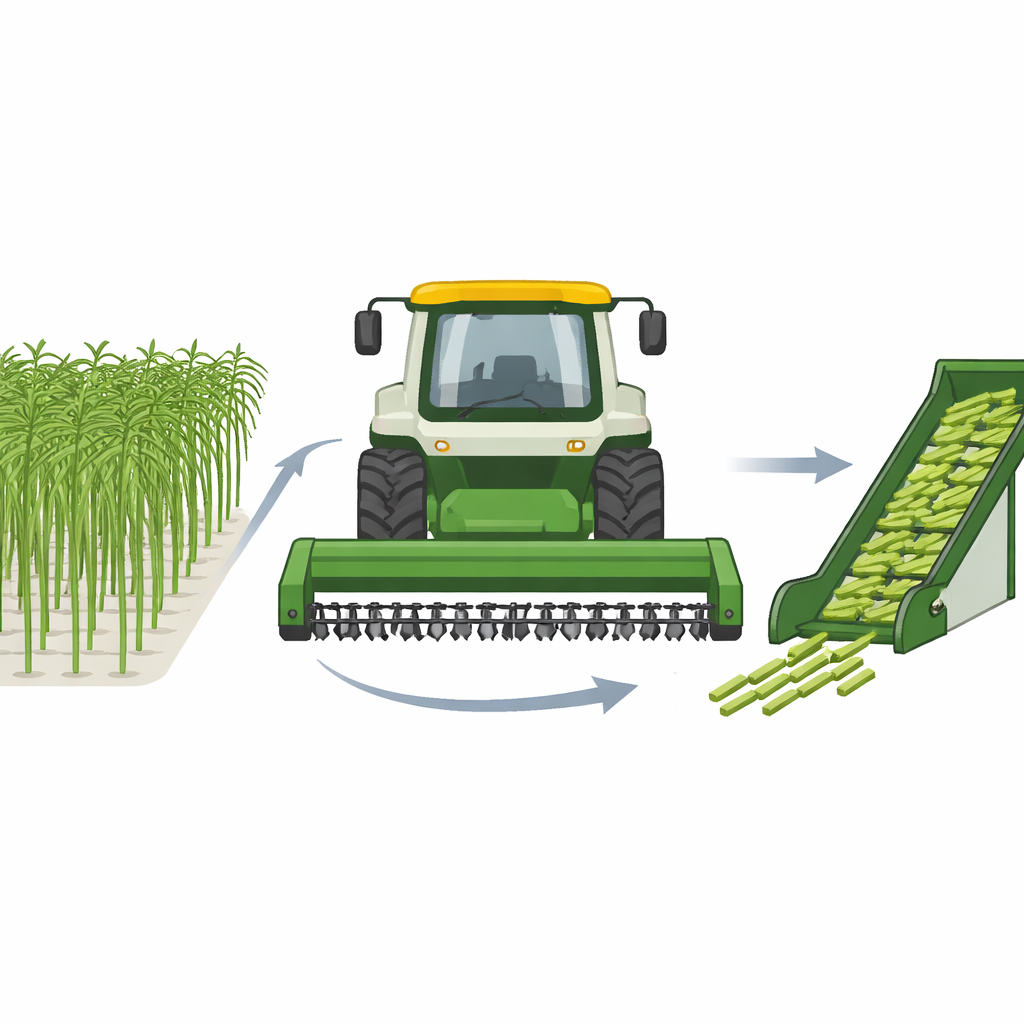
Ramie, sometimes called “Chinese grass,” is a strong, fast-growing fiber plant used in textiles and composites. China grows almost all of the world’s ramie, and demand is rising. Yet much of the crop is still harvested by hand, which is slow, exhausting work. A key bottleneck is simply cutting the tough, fibrous stalks cleanly without wasting energy or damaging the plants. This study uses computer simulations and bench tests to redesign a special double-action cutting knife that can slice ramie more efficiently, pointing the way to faster, cheaper, and more sustainable harvesting machines.
A New Look at a Familiar Cutting Tool
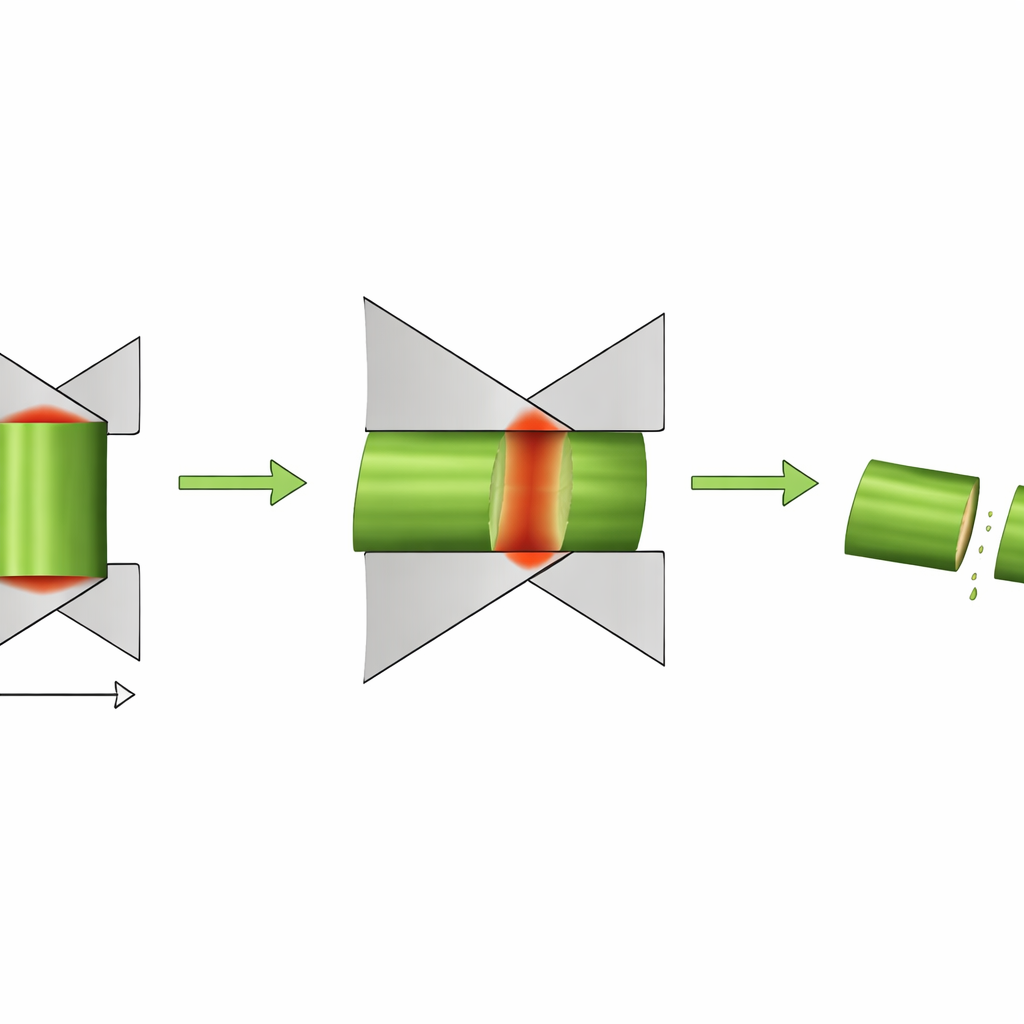
Modern harvesters for crops like wheat or rice already use reciprocating cutters—bars lined with triangular blades that slide back and forth. For ramie, the authors focus on a reciprocating double-action cutter, where a row of upper blades and a row of lower blades move in opposite directions at the same time. This opposing motion doubles the effective cutting speed while cancelling much of the vibration that usually shakes a machine. Because ramie fibers are especially tough, even good cutters can draw a lot of power and still struggle to make smooth cuts. The team set out to tune the cutter’s shape so that it grips each stalk firmly, shears it cleanly, and uses as little energy as possible.
Using Virtual Stems to Test Real Blades
Instead of fabricating dozens of different cutters and testing them all in the field, the researchers built a detailed virtual version of the cutting process using finite element modeling. They recreated the lower portion of a ramie stem as a hollow cylinder with layers that mimic the plant’s outer bark and woody core. The blade was modeled as rigid steel, while the stem behaved like an elastic, anisotropic material that can bend, stretch, and eventually break. In the simulation, upper and lower blades slide toward each other while the stem is held at the base, just as it would be on a real harvester. This allowed the team to watch how forces build up, how the stem deforms, and how cracks form and spread as the cut progresses.
What the Simulations Revealed
The study focused on three simple design knobs: the cutting angle (how the blade edge is tilted relative to the stem), the blade angle (how sharp or blunt the wedge is), and the thickness of the cutter. Using a structured set of simulated trials, the researchers measured two key outcomes: the maximum force needed to cut and the total energy used per cut. They found that cutter thickness had the largest impact on both force and energy, followed by cutting angle and then blade angle. Thicker blades and larger angles tended to increase friction and reduce the helpful sliding motion that makes shearing easier, while more favorable angles encouraged the stalk to be cleanly sliced instead of crushed or torn. By mapping how these three factors interact, the team could see which combinations kept stresses low while still maintaining a robust blade.
From Screen to Workbench
To see whether the computer model matched reality, the team built a physical test bench with a controllable cutter and feeding system, instrumented with torque and force sensors. They harvested ramie stems from a test field and cut them at controlled speeds using both “central” settings and the simulated best-performing design. The optimized combination—roughly a 24° cutting angle, a blade angle near 23°, and a blade thickness of 2.5 mm—reduced the peak cutting force to around 163 newtons and the energy needed to about 1.5 joules per cut. These measured values were within 10% of the simulation predictions, confirming that the virtual model captured the essential behavior of real stalks under cutting.
What This Means for Future Harvesters
In practical terms, the study shows that carefully choosing just three geometric parameters of a double-action cutter can make ramie harvesting more energy-efficient while still delivering clean cuts. Lower cutting forces mean smaller motors, less fuel or electricity use, reduced wear on machine parts, and gentler treatment of the remaining plant stubble, which is important for the next year’s growth. Because the simulation method proved accurate, designers can now explore new cutter shapes on the computer first, saving time and cost. This work offers a roadmap for building smarter harvesting heads not only for ramie, but potentially for other tough-stemmed crops as well.
Citation: Zhang, B., Kong, F., Huang, J. et al. Dynamic analysis and structural parameters optimization of reciprocating double-action cutter for ramie based on FEM. Sci Rep 16, 11487 (2026). https://doi.org/10.1038/s41598-026-42183-x
Keywords: ramie harvesting, reciprocating cutter, finite element simulation, cutting force reduction, agricultural machinery design