Clear Sky Science · en
Research on precision prediction of heavy-duty lathes based on hybrid PINNS neural network
Why big machines need smart predictions
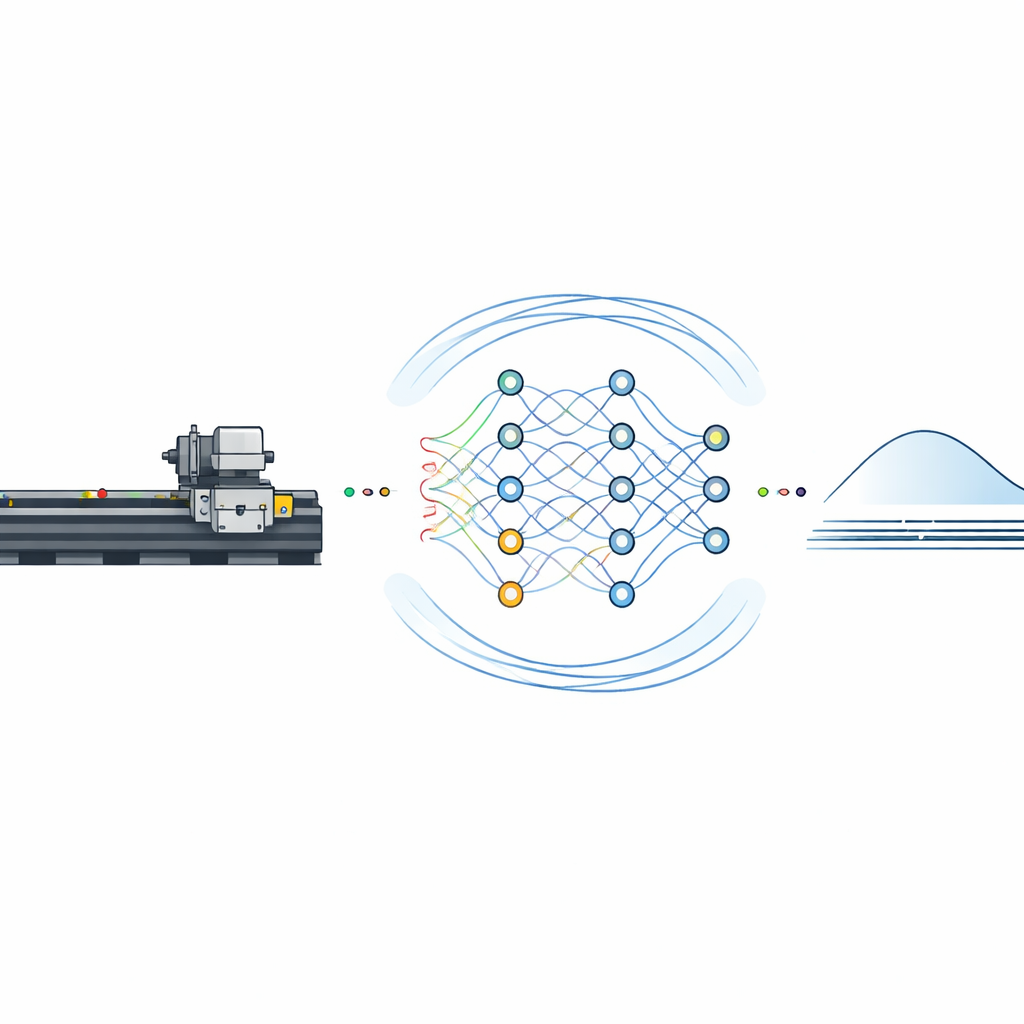
Heavy-duty lathes—room-sized machines that cut and shape metal—are the backbone of industries from power plants to shipbuilding. But as these machines stretch over many meters, tiny positioning errors can add up, quietly bending parts out of tolerance and wasting time and materials. Measuring every point along their travel is slow and expensive, so engineers often see only a few scattered data points. This paper explores a new way to use those scarce measurements, combined with basic physical insight, to reliably predict how a large lathe will behave across its full range of motion.
Big machines, small clues
In an ideal world, the moving parts of a lathe would go exactly where the control system tells them to. In reality, heat, weight, and structural flexing cause the machine’s sliding axes to deviate by tens of micrometers—small on their own, but critical for precision work. For huge lathes with travel spans of many meters, fully mapping these errors with high-end laser tools is costly and disruptive to production. Engineers typically measure only a few short segments, leaving most of the machine’s length unobserved. Traditional mathematical fits and standard neural networks can fill in the gaps, but when data are sparse they often produce unstable or unrealistic curves that wiggle in ways no real machine would.
Blending data with simple physical sense
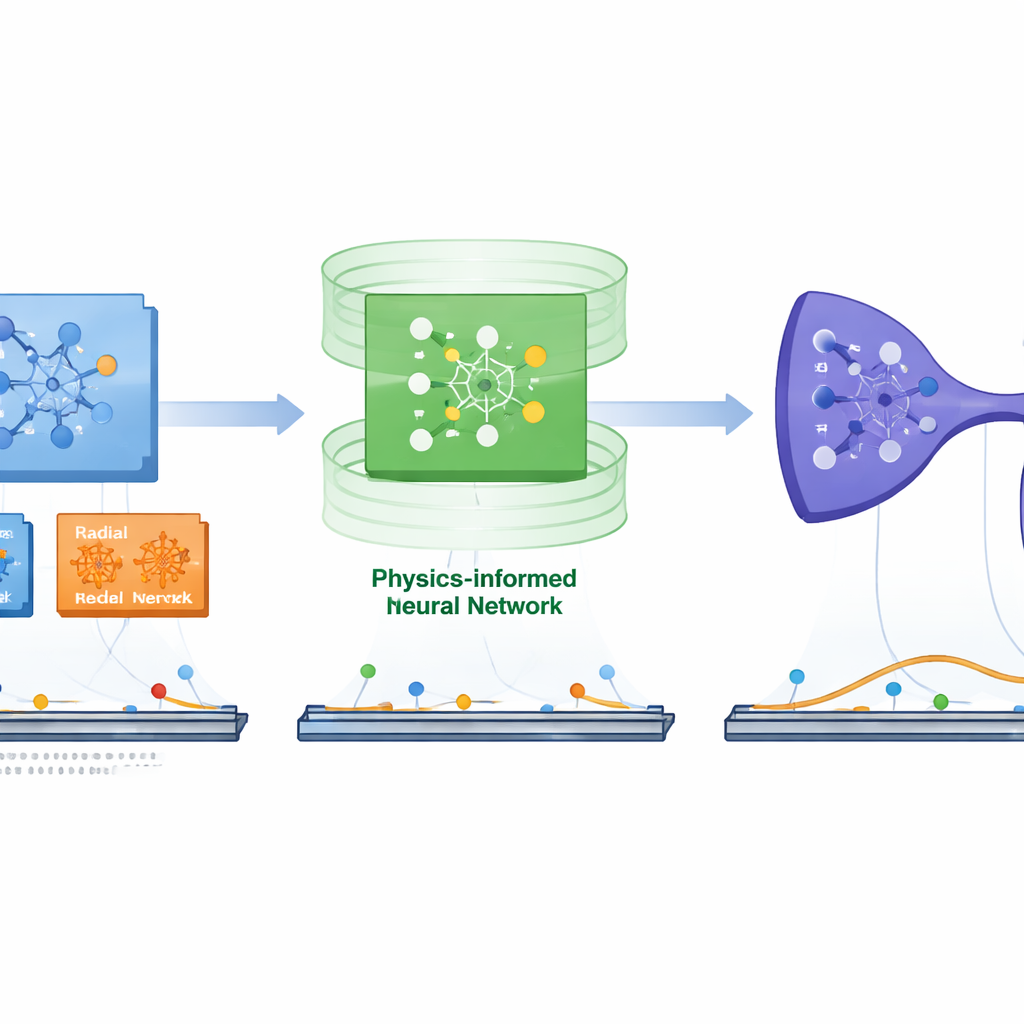
The authors focus on the Z-axis of a heavy-duty CNC lathe and design a prediction method that respects two simple facts about real machines: error changes along the axis are usually continuous and reasonably smooth. They first enhance the limited measurement set by fitting a gentle sixth‑order curve to one well-measured 300 mm training section and then resampling it evenly, creating a denser but still realistic dataset. On top of this, they build several models: a standard backpropagation neural network, a radial basis function network, and a physics‑informed neural network that is explicitly penalized whenever its predicted error curve becomes too jagged or changes too abruptly along the axis.
How the hybrid brain works
Instead of betting on a single model, the study combines their strengths in a hybrid framework. First, each model is trained using the same preprocessed data. Then a one-time linear calibration nudges each model’s raw predictions into closer alignment with the measured values, correcting any consistent scaling or offset. Next comes a soft fusion step: the calibrated models are compared on validation data, and those that make smaller mistakes are automatically given higher weight in the final prediction. A minimum weight is reserved for the radial basis model so that it can still contribute to capturing fine local variations without overpowering the result. Throughout, the physics‑informed model acts as the backbone, using continuity and smoothness constraints to keep the predicted error pattern realistic even in unmeasured regions.
Sharper predictions with fewer surprises
The method is tested on two separate 300 mm segments of the same Z‑axis, located roughly 8 m and 17.7 m away from the training section. These sections are used only for checking how well the models extrapolate. Across all tests, the hybrid approach significantly outperforms the individual models, slashing overall error by roughly 80% or more compared with standard neural networks and radial basis networks. Not only does it bring down the average discrepancy, it also trims the long “tails” of rare but large mistakes. Statistical views of the residuals show that the hybrid predictions cluster tightly around zero and avoid extreme outliers, a key requirement for safe use in industrial compensation systems.
What this means for real-world machining
For manufacturers, the study offers a practical recipe: with only a small, carefully measured portion of a long axis, it becomes possible to infer the full-length error profile in a way that is both data-driven and physically sensible. That makes it easier to monitor machine health, correct errors in real time, and extend the useful life of heavy-duty lathes without constant, time-consuming recalibration. While the work is demonstrated on one specific machine under steady conditions, the authors argue that the framework can be expanded to include temperature, load, and more detailed physical models. In plain terms, they show that adding a bit of physics-inspired discipline to neural networks can turn sparse, expensive measurements into reliable guidance for keeping very large machines cutting accurately.
Citation: Wang, R., Jing, H. & Yang, M. Research on precision prediction of heavy-duty lathes based on hybrid PINNS neural network. Sci Rep 16, 12883 (2026). https://doi.org/10.1038/s41598-026-42143-5
Keywords: heavy-duty CNC lathes, physics-informed neural networks, machine tool accuracy, error prediction, industrial calibration