Clear Sky Science · en
A hybrid RSM–spherical fuzzy WASPAS framework for robust tribological optimization of directionally rolled copper rods under manufacturing uncertainty
Why smoother tiny parts matter
From miniature medical implants to hair‑thin channels that guide drops of blood in a lab‑on‑a‑chip, many modern devices rely on tiny metal parts formed from copper. If the surface of the copper wears out, heats up, or grips too hard during forming, these parts can crack, change size, or fail early in service. This study explores how to tune the way copper rods are rolled and slid in contact so that manufacturers can make consistent, long‑lasting micro‑parts even when real‑world conditions are not perfectly controlled.
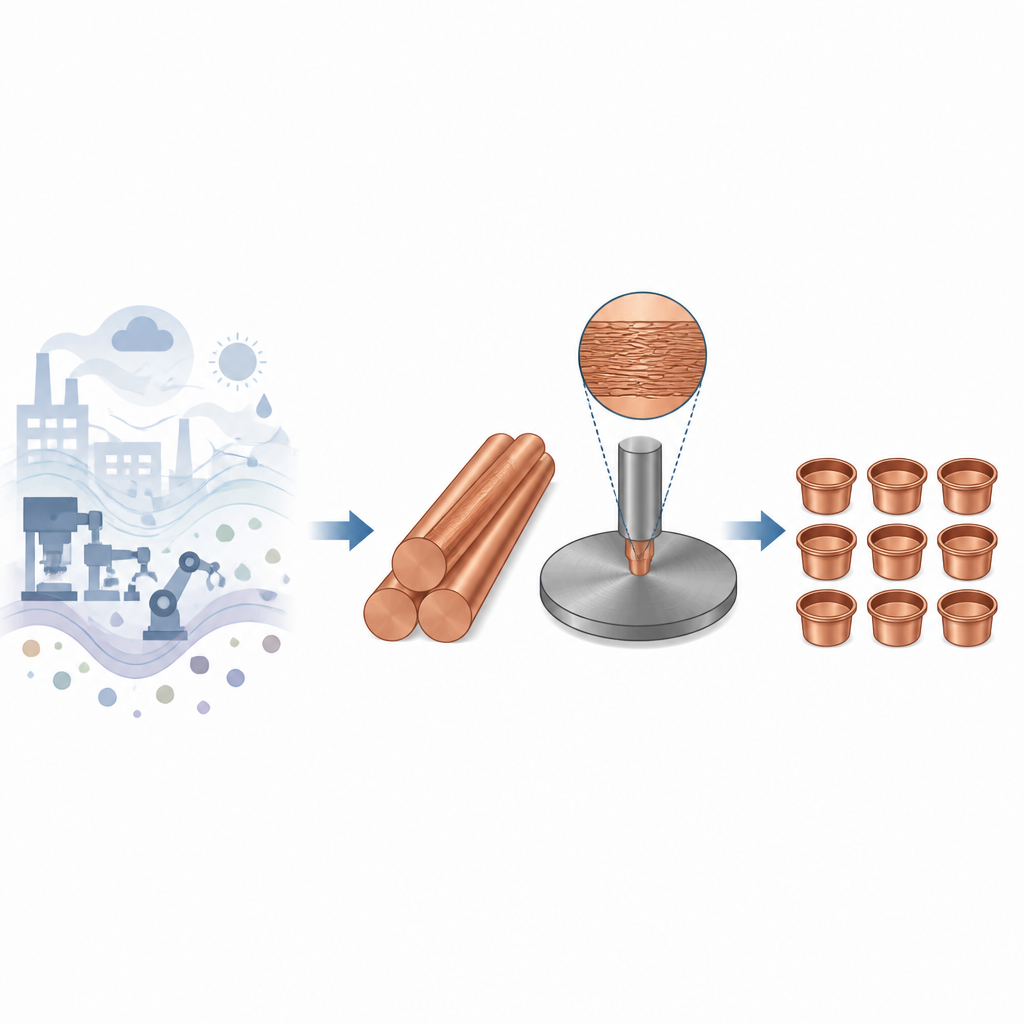
How copper rods become tiny cups
The work starts with highly pure copper rods that are directionally rolled, meaning they are squeezed and stretched in one main direction. This rolling changes the internal grain structure of the metal, making it stronger and more resistant to wear but also more sensitive to how it is handled. The rolled rods are then tested on a standard pin‑on‑disk setup, where a rounded pin slides over a copper surface under controlled load, speed, and distance. At the same time, the researchers use these rods to deep‑draw tiny cup‑shaped parts, similar to miniature cans, to see how surface behavior during sliding translates into real forming performance.
Measuring wear, heat, and friction
To understand how the process behaves, the team tracks six key quantities: how fast material is worn away, how hard the surfaces rub against each other, how much mass is lost, how large the worn spot becomes, how much force is needed to keep sliding, and how much the temperature rises. They vary four main knobs the factory can control: the pushing force on the pin, how fast it slides, how far it travels, and how aggressively the copper sheet is drawn into a cup. Using a statistical tool called response surface modeling, they build smooth equations that link these knobs to the six results, and then stress‑test these equations with cross‑checks, error analysis, and random simulations to make sure they remain reliable when conditions fluctuate.
Choosing the best settings under uncertainty
Real manufacturing lines are messy: sensors are not perfect, friction can change from part to part, and experts may disagree about which outcome matters most. To cope with this, the authors add a second layer of analysis that treats decision making more like human judgment. They use a "spherical fuzzy" method that allows each possible setting of the process to be described not just as good or bad, but with degrees of confidence, doubt, and disagreement. A ranking method then blends two common ways of scoring options, one based on adding up weighted scores and the other on multiplying them, to decide which combination of load, speed, distance, and draw ratio gives the best overall balance of low wear, low friction, low heat, and stable dimensions.
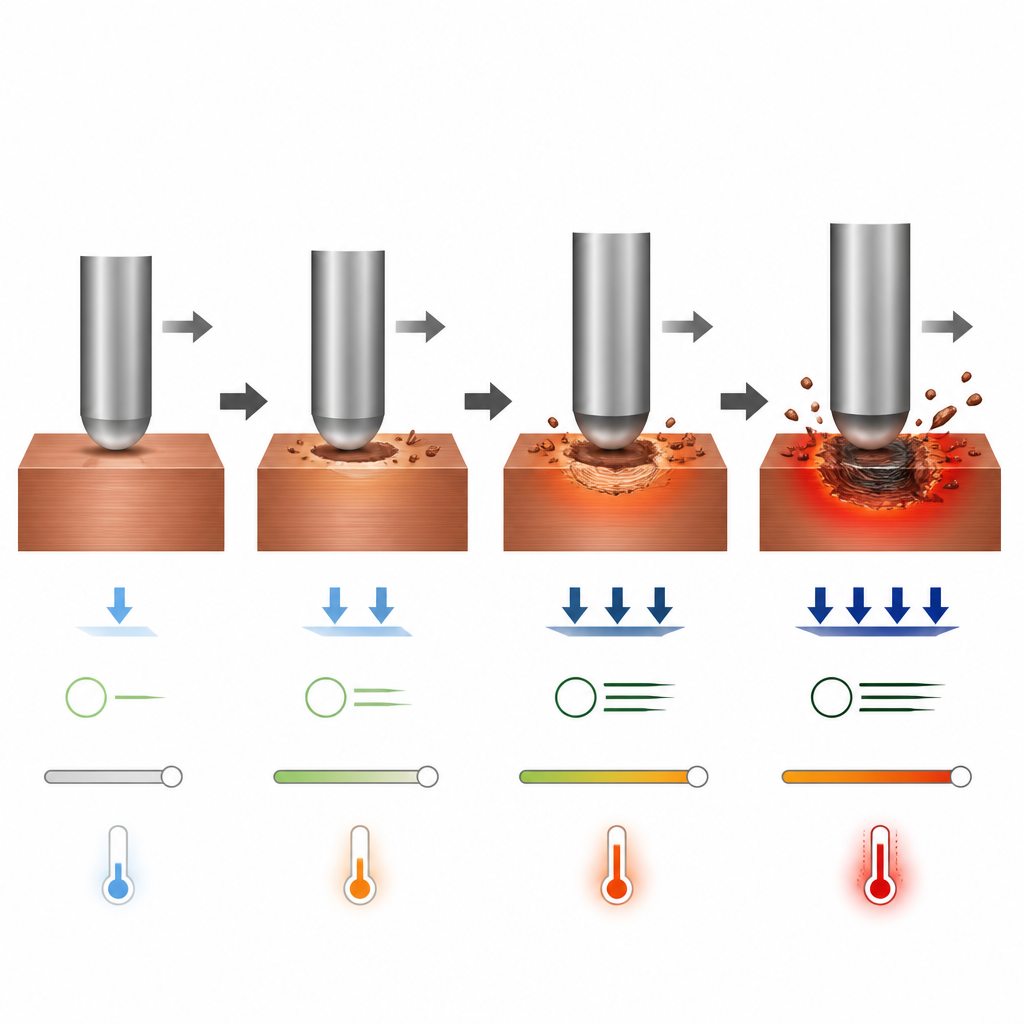
What the optimal and worst conditions look like
The hybrid framework points to a clear winner and a clear loser. The most favorable condition uses a high load, fast sliding, short sliding distance, and the smallest draw ratio. Under this recipe, the copper shows low wear rate, modest friction, small temperature rise, and stable cup dimensions, with model prediction errors below five percent when compared with experiments. At the other extreme, combining the same high load with slow speed, a long sliding path, and the largest draw ratio leads to pronounced heating, deeper and wider wear scars, and more aggressive removal of material. Wear maps built from the data show a smooth shift from mild, mainly oxidative and gently adhesive wear in the good regime to severe adhesive and abrasive wear when conditions turn harsh.
Why this framework matters
For a non‑specialist, the key message is that the study offers a practical recipe for making tiny copper parts more reliable by treating both the physics of wear and the fuzziness of real factory decisions at the same time. Instead of relying on a single test or rule of thumb, the framework blends careful experiments, statistical modeling, and a flexible decision system that can handle uncertainty and conflicting goals. While this work focuses on dry sliding of copper rods, the same strategy can be extended to new bio‑friendly metals such as magnesium and zinc, and to lubricated conditions, helping engineers design smoother, safer micro‑formed components for medical and other high‑precision uses.
Citation: Sivam, S.P.S.S., Kesavan, S. & Johnson Santhosh, A. A hybrid RSM–spherical fuzzy WASPAS framework for robust tribological optimization of directionally rolled copper rods under manufacturing uncertainty. Sci Rep 16, 15097 (2026). https://doi.org/10.1038/s41598-026-42132-8
Keywords: copper wear, micro forming, tribology, surface optimization, fuzzy decision making