Clear Sky Science · en
Tuning the electronic and electrochemical properties of 2D SiC by defect insertion for next-generation metal-ion battery anodes: first principles prediction
Why new battery materials matter
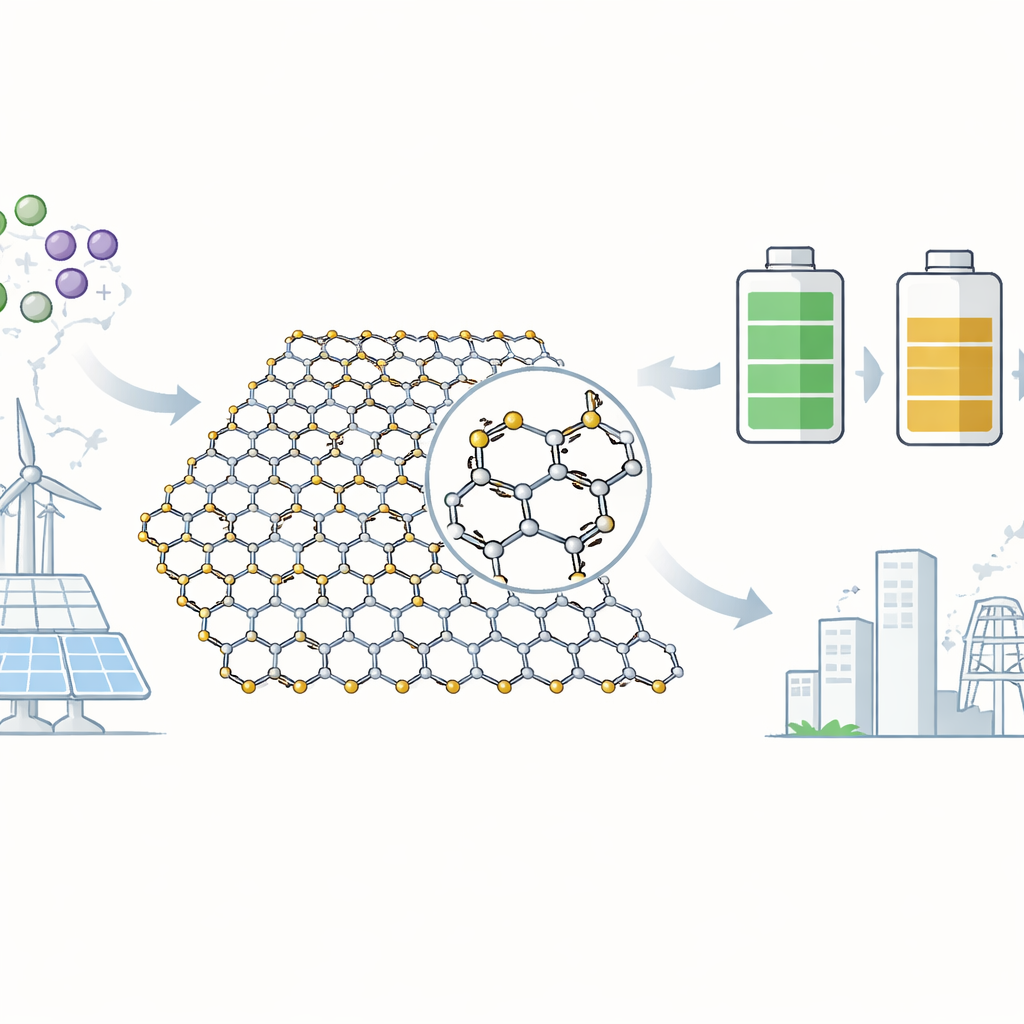
As the world leans more heavily on solar panels, wind farms, and electric vehicles, we need batteries that are cheaper, safer, and made from elements that are plentiful on Earth. Today’s lithium-ion batteries work well but rely on lithium, a metal that is relatively scarce and unevenly distributed around the globe. This study explores how an ultra-thin sheet of silicon carbide—a material already known for its toughness—can be subtly rearranged at the atomic level to store energy using more abundant metals like sodium and potassium instead of lithium.
A flat sheet with a twist
The heart of the work is a one-atom-thick layer of silicon and carbon atoms arranged in a honeycomb pattern, much like graphene. In its perfect form, this sheet behaves like a semiconductor, which means it does not conduct electricity as freely as a metal. The researchers examined what happens when they deliberately “misplace” one bond in this pattern, creating what is called a Stone–Wales defect: four neighboring hexagons are reshaped into a pair of a five-sided ring and a seven-sided ring. Using quantum-level computer simulations, they showed that this small topological twist is easy enough to form and does not destabilize the sheet.
Making a better landing pad for ions
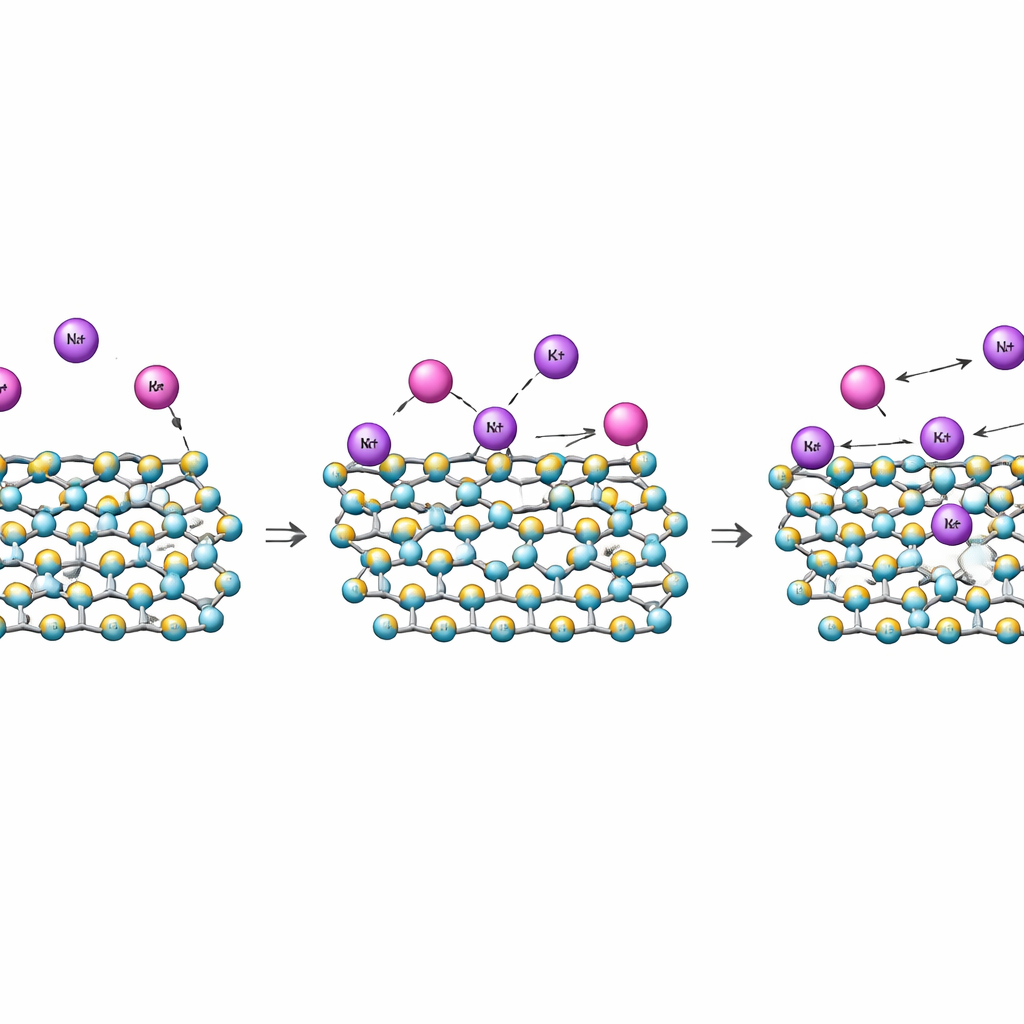
For a rechargeable battery, the anode must welcome incoming metal ions during charging and release them again during discharging, all without falling apart. In the pristine silicon carbide sheet, sodium, potassium, and magnesium atoms do not “like” to stick individually to the surface; the simulations indicate they would rather clump together, which is bad for a smooth, reversible battery reaction. Once the Stone–Wales defect is introduced, however, the picture changes dramatically for sodium and potassium. They are now strongly attracted to sites near the distorted rings, where regions of depleted and concentrated electrons act like tiny landing pads. Electron-density maps show that sodium and potassium transfer charge to the sheet and become tightly anchored, while magnesium still interacts only weakly, making it a poor candidate for this particular surface.
Paths for fast motion and high storage
The study then probes how easily sodium and potassium ions can move across this defect-engineered surface and how many can be stored. By tracking the preferred routes between neighboring low-energy sites, the authors find that ions can hop across the Stone–Wales region with moderate energy hurdles—small enough to allow reasonably fast charging and discharging. As more ions are added, they tend to arrange themselves in an orderly manner: sodium forms a single layer on each side of the sheet, while potassium can form two layers. From these arrangements, the team estimates that the material could store about 300 milliampere-hours per gram for sodium and 600 for potassium, figures that rival or surpass many other proposed anode materials made from tin, sulfur, or related compounds.
Stable structure, stronger electrical response
Another concern for any battery anode is mechanical fatigue: repeated insertion and removal of ions can swell, crack, or chemically degrade the host. The calculations here suggest that the silicon carbide sheet with Stone–Wales defects holds up well. Bond lengths and angles distort only modestly when sodium or potassium ions are inserted and largely recover when the ions are removed, and the defect itself remains intact. At the same time, the added ions transform the sheet’s electronic behavior from semiconducting to metallic, meaning its ability to conduct electrons improves during operation—an advantage for an electrode that must shuttle charge quickly.
What this means for future batteries
Put simply, the work shows that carefully placed atomic-scale “wrinkles” in a flat silicon carbide sheet can turn an otherwise reluctant surface into a promising, high-capacity host for sodium and potassium ions. The defect-engineered material combines strong ion binding, decent ion mobility, good electrical conductivity, and structural resilience, all while using more abundant metals than lithium. While these results are theoretical predictions that still need to be confirmed in the lab, they point to a practical design rule: by tailoring tiny defects in two-dimensional materials, scientists may craft a new generation of affordable, durable anodes for large-scale energy storage beyond today’s lithium-ion batteries.
Citation: Ibrahim, N., Mohammed, L., Umar, S. et al. Tuning the electronic and electrochemical properties of 2D SiC by defect insertion for next-generation metal-ion battery anodes: first principles prediction. Sci Rep 16, 13510 (2026). https://doi.org/10.1038/s41598-026-42130-w
Keywords: sodium-ion batteries, potassium-ion batteries, two-dimensional materials, silicon carbide anodes, defect engineering