Clear Sky Science · en
Adoption of soil and water conservation practices among smallholder farmers in the Somali Regional State of Ethiopia
Why this matters for food and livelihoods
Across much of rural Ethiopia, families depend on thin, fragile soils to grow food and raise animals. In the Somali Regional State, especially the Shabeley district, these soils are being washed and blown away, threatening harvests, pasture, and household income. This study asks a practical question with real stakes: when are smallholder farmers willing and able to use simple soil and water conservation measures that can protect their land, and what holds them back?
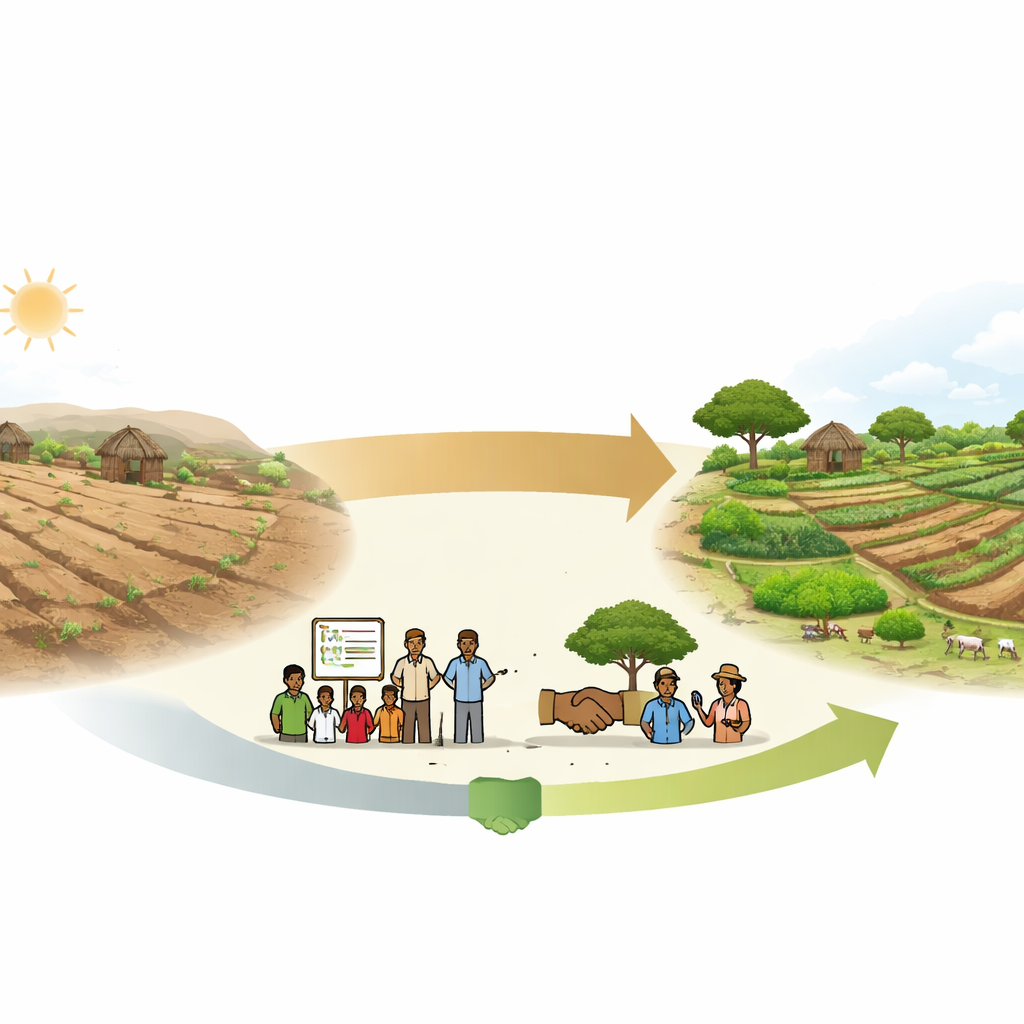
The land and people behind the numbers
The research took place in Shabeley, a semi-arid district near Jigjiga where rain falls in short, intense seasons separated by long dry spells. Most households combine rain-fed crops such as sorghum and maize with livestock herding. The area’s sloping fields and overgrazed rangelands are highly vulnerable to runoff, gully formation, and loss of fertile topsoil. From more than 32,000 households in the district, the authors selected 203 farm households at random from four erosion-prone communities. They combined household surveys with interviews, group discussions, and field walks to understand both the extent of the erosion problem and how farmers respond to it.
How the study was carried out
The team used a mixed approach that blended statistics with on-the-ground observation. A detailed questionnaire captured each household’s age structure, education, income, farm size, years of farming experience, and characteristics of their fields, such as slope and land cover. It also recorded whether they used measures like soil bunds, stone bunds, terracing, check dams, or tree planting. Qualitative discussions explored farmers’ own explanations for erosion and their views on conservation measures. To disentangle which factors most strongly influenced the decision to adopt conservation practices, the researchers applied a binary logistic regression model, which estimates how each factor shifts the odds that a household is an adopter rather than a non-adopter.
What farmers see and how they respond
Farmers reported that erosion is not an abstract threat but a daily reality: many linked it to deep gullies cutting across fields, shrinking farm sizes, compacted soil, poorer harvests, and shortages of animal feed. They blamed frequent heavy rains, cultivation on steep slopes, overgrazing, sparse ground cover, and the absence of protective structures. In response, just over half of the surveyed households (about 52%) had put some form of soil and water conservation in place. The most common were low-cost physical measures such as soil bunds, stone bunds, and stone-faced bunds; fewer households could afford labor- and material-intensive options like check dams, hillside terracing, or larger-scale tree planting. Farmers also emphasized that combining physical structures with vegetation cover works better than using either alone.
Who adopts conservation and why
The statistical analysis showed that adoption is shaped by a blend of social, physical, and institutional conditions. Households led by someone who can read and write were much more likely to conserve their soil, likely because education improves access to information and the confidence to try new methods. Longer farming experience also pushed families toward adoption, as seasoned farmers better recognize the costs of land degradation. Fields on steeper slopes were more often protected, since erosion is visibly worse there. Regular contact with extension agents or support from organizations strongly boosted adoption, highlighting the importance of training and technical help. Fields with grasses, crop residues, or trees already in place were also associated with more conservation structures, suggesting that farmers who invest in cover are more willing to invest in longer-term protection. In contrast, larger farm size was linked to lower adoption, possibly because safeguarding a big area is labor-intensive and competes with grazing needs; gender differences also emerged, reflecting how responsibilities for day-to-day land care differ within households.
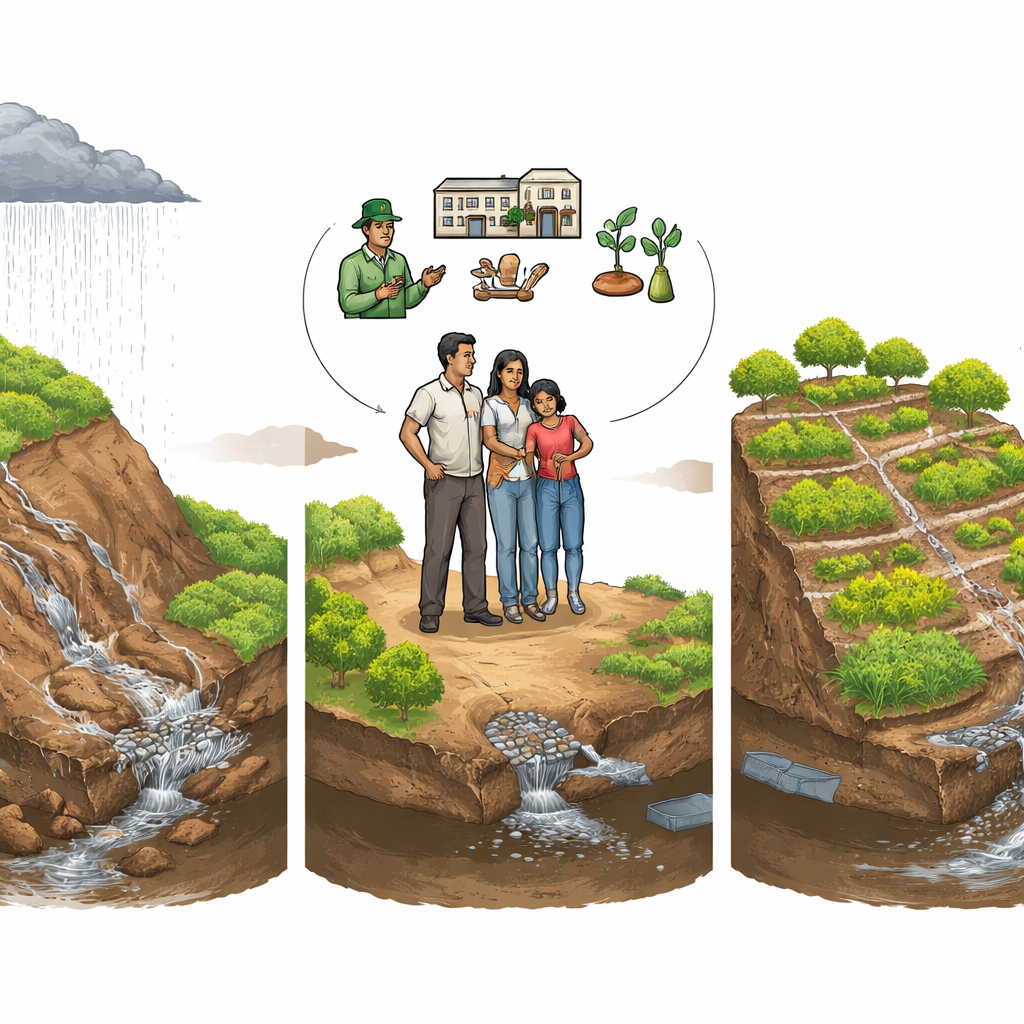
What this means for protecting fragile soils
The study concludes that saving Shabeley’s soils is not just a matter of introducing the right terrace or bund design. Success depends on the people who manage the land—their schooling, experience, access to advice, and the specific shape and cover of their fields. Because only half of the households have adopted proven practices, policies and programs need to focus on the conditions that make adoption feasible: strengthening education and extension services, supporting affordable combinations of physical and vegetative measures, easing labor and cost barriers for larger plots, and ensuring that both men and women are fully involved in planning and decision-making. Taken together, these steps can help smallholder farmers hold onto their soil, stabilize harvests, and secure a more reliable future from the land they depend on.
Citation: Sametar, M.B., Duale, M.M. Adoption of soil and water conservation practices among smallholder farmers in the Somali Regional State of Ethiopia. Sci Rep 16, 10752 (2026). https://doi.org/10.1038/s41598-026-42099-6
Keywords: soil erosion, smallholder farmers, soil and water conservation, Ethiopia, sustainable agriculture