Clear Sky Science · en
Research on dynamic stiffness match form of indirect fastener based on rail high-frequency wear characteristics
Why smoother rails matter to everyday riders
Anyone who has felt a metro train shudder or heard a high-pitched screech through a curve has experienced the hidden physics of wheel and rail wear. Over time, rails can develop ripples and patterns that make rides noisier, rougher, and more expensive to maintain. This study looks deep into a small but crucial part of the track – the elastic fasteners that sit under the rail – to show how their design can quietly decide whether rails stay smooth or wear out quickly.
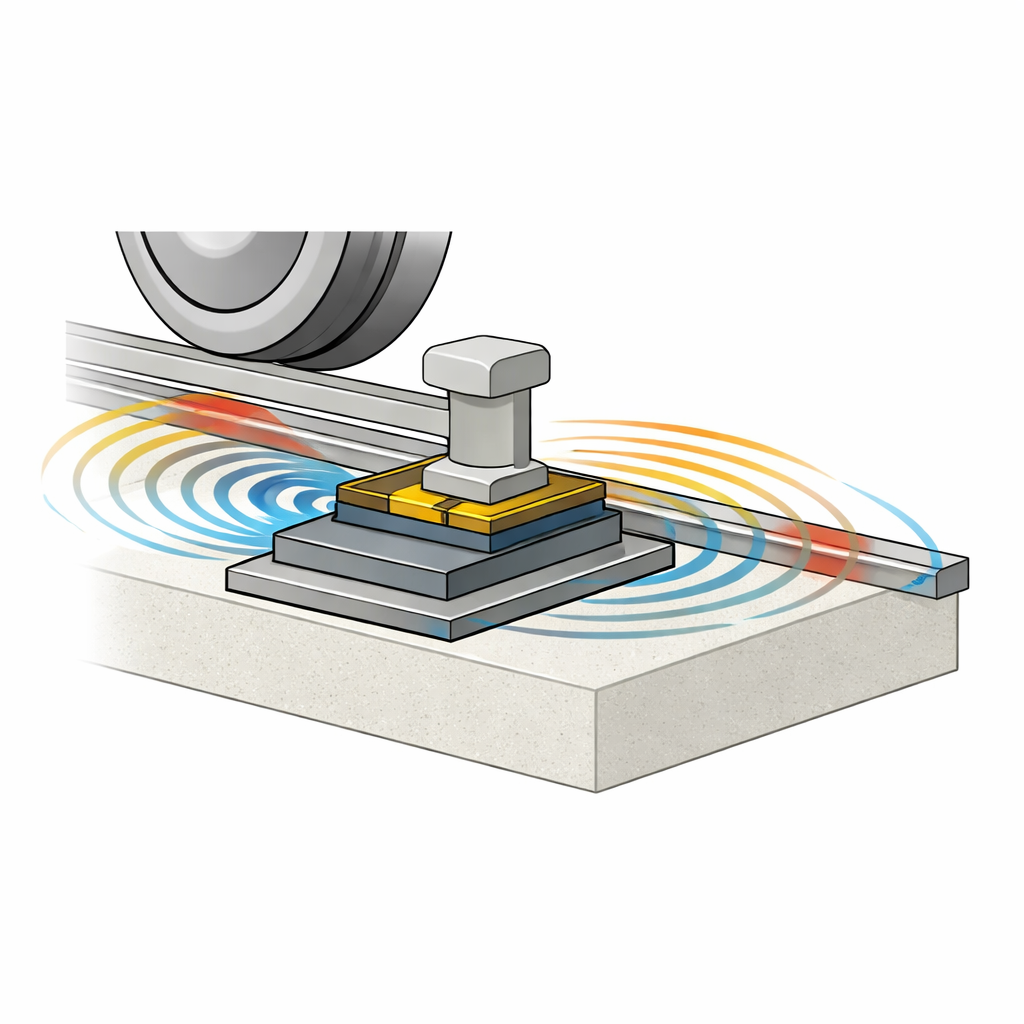
The small parts under the rail
Modern metro systems often use so‑called indirect fasteners on concrete tracks. Instead of one rubber pad under the rail, there are two elastic pads with a steel plate in between. The upper pad sits directly under the rail, the steel “ironbase” lies beneath it, and the lower pad separates the ironbase from the concrete support. This sandwich is meant to give the track the right flexibility, protect the structure from impact, and cut noise and vibration. However, if the two pads do not work together in the right way, the rail and wheels can vibrate strongly at certain tones, which in turn carves regular patterns – corrugation on the rail and polygonal flats on the wheels.
Capturing real-world flexibility and bounce
In real service, these pads and the steel plate behave in a much more complicated way than a simple spring. The ironbase bends because the anchor bolts tighten it at the edges, and the rubber-like pads change stiffness depending on how hard and how fast they are loaded. To capture this, the authors tested real subway fasteners of the DZ III type in the laboratory over a wide range of loads and vibration frequencies. They then built a refined mathematical model that treats the ironbase as a flexible beam and each pad as a material whose stiffness and damping shift with both load and frequency. This detailed fastener model was plugged into a full computer simulation of a train running on curved track, including how the wheel and rail press and slide against each other and how that motion gradually wears away steel.
Checking the model against a working metro line
The team compared their simulations with measurements taken from an operating Chinese metro line that already uses these fasteners. They looked at how much the rail moves up and down, how much it twists, and which vibration tones are strongest up to 1,250 cycles per second. Simpler models that either ignored the second pad or treated the ironbase as completely rigid could not match the real data: in some key cases, the main vibration peaks were off by more than 100 hertz. The new, more realistic model closely matched both the size of the rail movements and the positions of the major resonance bands, cutting the largest error in dominant vibration frequency down to about 20 hertz. This gave confidence that the model can be used to explore how design choices affect long-term wear.
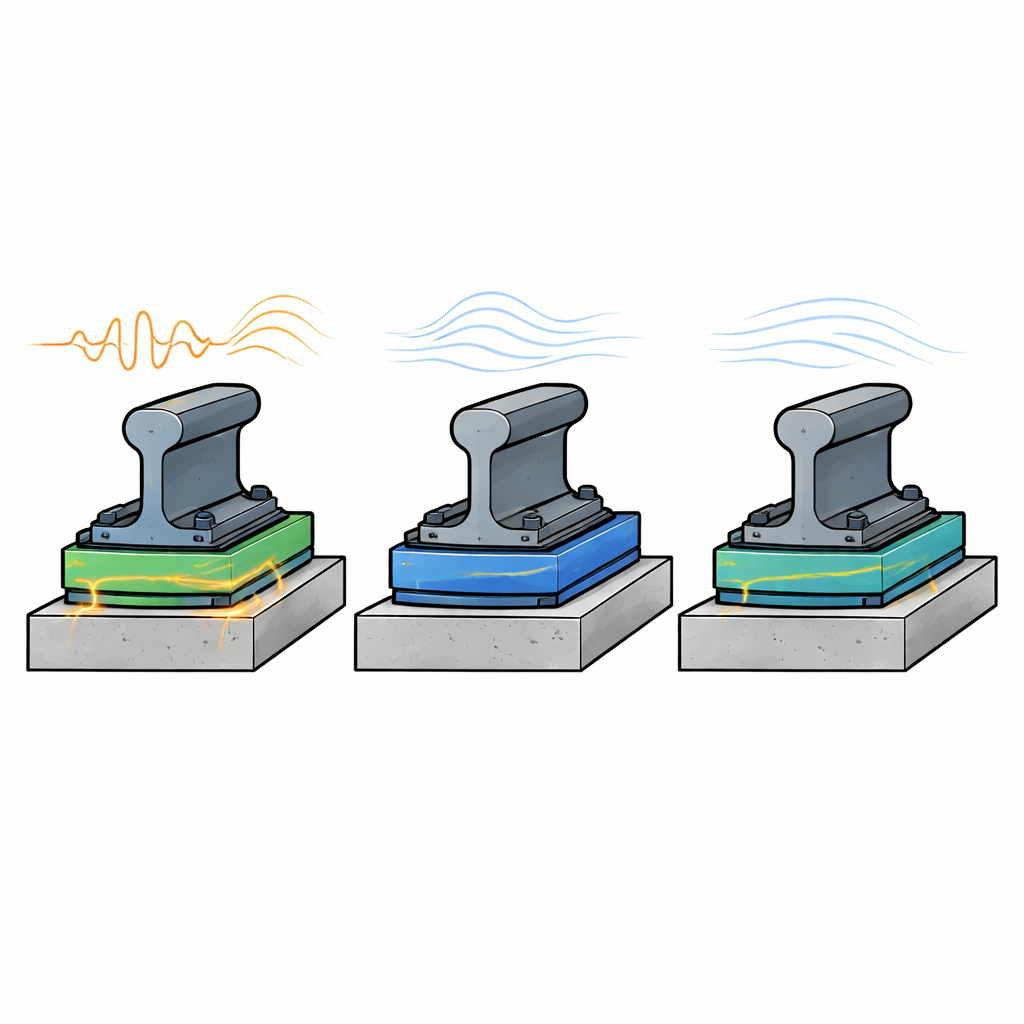
Finding the better pairing of soft and hard pads
With the model validated, the authors tried different ways of pairing pad stiffness while keeping the overall support level under the rail the same. They examined three cases: a soft upper pad on a very stiff lower pad, two pads of similar stiffness, and a stiff upper pad on a softer lower pad. The last option – “hard upper, soft lower” – turned out to be the most beneficial. It did not change the lowest-frequency wheel–rail resonance, but it shifted and weakened several higher-frequency bending tones in the rail, which are closely linked to short-wavelength corrugation. In practice, this combination reduced the intensity of predicted high-frequency rail wear in the bands where damaging vibrations usually accumulate, suggesting that the same nodal stiffness can be achieved in a much more rail-friendly way simply by rearranging how stiffness is distributed between the two pads.
How damping can help or hurt
The study also explored how energy dissipation – damping – in the pads shapes wear. By adjusting model parameters that control how strongly the pads absorb vibration, the authors tested cases with increased damping in just the stiffer pad, just the softer pad, or both. They found that overall damping is largely controlled by the softer pad. Raising damping only in the hard pad could actually make high-frequency wear worse, increasing the height of wear peaks at several resonant bands. In contrast, increasing the damping of both pads together produced the greatest reduction in vibration-driven wear, especially in the troublesome higher-frequency ranges. This highlights that damping design must consider how both layers work together, not just making one component more “lossy.”
What this means for quieter, cheaper metro systems
Put simply, the paper shows that the fine-tuned “give” and “bounce” of the two pads under a rail strongly affect how quickly rails roughen and wheels develop defects. A fastener design that keeps the upper pad relatively hard and the lower pad softer, while boosting damping in both, can cut the damaging high-frequency vibrations that lead to corrugation and noise – all without changing the overall support that engineers must meet by code. For passengers, that translates into smoother, quieter rides; for operators, it means slower wear, fewer grinding and replacement operations, and lower life-cycle costs, all achieved by redesigning a component that is already present but often oversimplified in design rules.
Citation: Wang, X., Wei, K., Pu, Q. et al. Research on dynamic stiffness match form of indirect fastener based on rail high-frequency wear characteristics. Sci Rep 16, 11472 (2026). https://doi.org/10.1038/s41598-026-42061-6
Keywords: rail fasteners, rail corrugation, wheel–rail vibration, metro track design, rail wear modeling