From GPS navigation to financial trades and communications networks, much of modern life depends on atomic clocks that keep time with astonishing precision. Yet even these clocks are not perfectly quiet. Their signals carry random noise from internal physics and the surrounding environment, which slowly limits how accurate our global time scales can be. This study explores a smarter way to clean up those tiny timing errors so that atomic clocks can support even more stable and reliable systems.
Where the extra noise comes from
Atomic clocks work by locking an electronic signal to the energy levels of atoms such as cesium, hydrogen, or rubidium. In principle this creates a steady rhythm, but in reality several kinds of random fluctuations pile on top of the ideal signal. These include rapid jitter, slower wander, and even very slow drifts over hours or days. Engineers describe these patterns using a standard measure called Allan deviation, which shows how stable a clock is at different averaging times. By analyzing this behavior, the authors break the overall noise into several ingredients and estimate how strong each one is for different clocks.
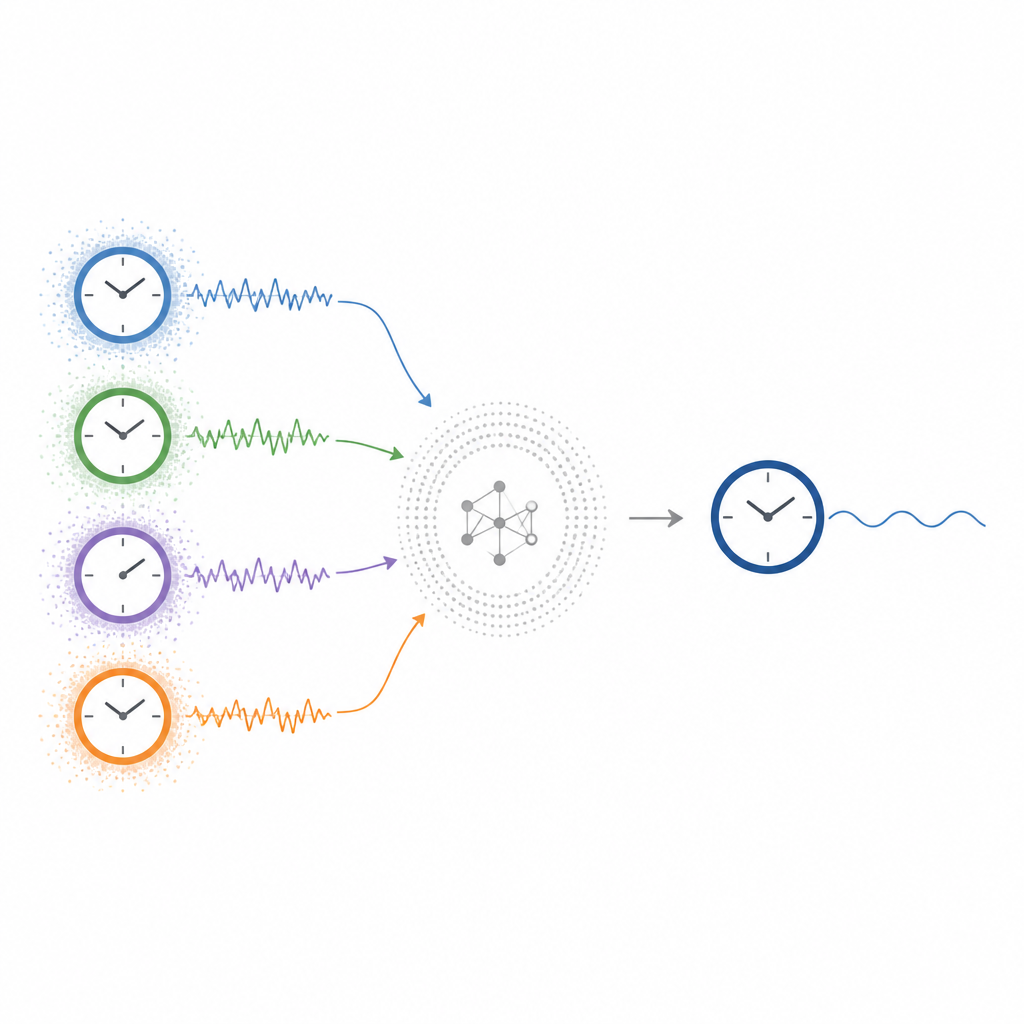
Breaking the signal into layers Figure 1. How smarter filtering turns noisy atomic clock readings into a cleaner, more stable time signal.
To clean the signal without damaging the useful information, the team first applies a tool called empirical mode decomposition. This technique pulls the clock output apart into several layers, or intrinsic mode functions, plus a slow background trend. High frequency layers mostly contain sharp noise, while lower layers carry the meaningful, slowly varying clock behavior. Instead of treating the whole signal at once, the method denoises each layer separately and then puts them back together, which helps target the unwanted fluctuations more precisely.
A smoother way to trim noise
Most wavelet based denoising methods rely on simple rules that either cut off small coefficients suddenly (hard thresholding) or shrink them by a fixed amount (soft thresholding). Hard rules can introduce artificial ripples, while soft rules can blur important details. The authors design a new threshold rule based on a smooth mathematical curve, the hyperbolic tangent. A single smoothing factor allows the behavior to slide continuously between hard and soft styles. For each layer, the method automatically chooses both the threshold level and the smoothing factor by examining several features, such as how strong the noise is, how peaky the data are, how spread out the energy is, and how quickly the signal changes from point to point.
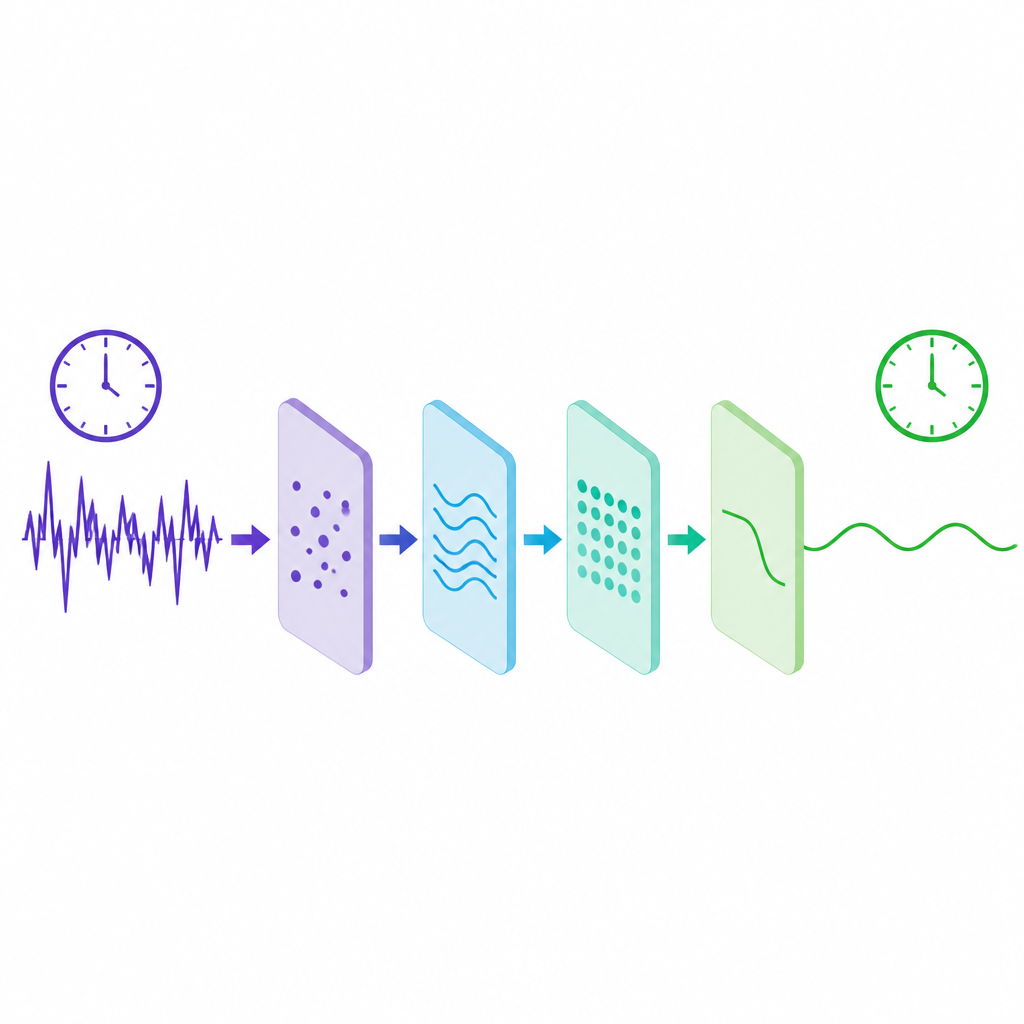
Letting the data choose the right filter Figure 2. Step by step view of a noisy clock signal becoming smoother as it passes through adaptive denoising stages.
Selecting how much to trim is as important as the shape of the rule. The study uses a statistical tool called Stein’s Unbiased Risk Estimate to scan a range of possible thresholds and evaluate how much error each choice would introduce, using only the observed data. Because this estimate can be too cautious when noise is strongly correlated, the authors deliberately shift the chosen threshold slightly higher in a controlled way, especially when the signal to noise ratio is poor. This adaptive strategy means that strong noise is removed more aggressively, while delicate features are protected when the data already look clean.
What the tests reveal in practice
The researchers test their approach on simulated signals from two cesium clocks, two hydrogen clocks, and one rubidium clock, as well as real measurements from a rubidium clock in their laboratory. They compare their method with traditional hard and soft thresholding and with another improved scheme from earlier work. Across all six clocks, the new method delivers the highest signal to noise ratios and the lowest reconstruction errors. For cesium clocks, the cleaned signals gain about 14 percent in signal to noise ratio compared with soft thresholding, while hydrogen clocks gain around 5 percent and rubidium clocks gain up to 26 percent on real data. The root mean square error drops by roughly 28 percent for cesium, 10 percent for hydrogen, and 25 percent for rubidium clocks.
From cleaner clocks to steadier time scales
Beyond individual devices, the authors show that building time scales from multiple clocks using their denoised data produces noticeably better long term stability than using raw signals. Statistical tests on many repeated simulations confirm that the improvements are consistent and not due to chance. In practical terms, the method preserves the genuine timing behavior of the clocks while stripping away more of the random noise. For a lay reader, the main message is that this smoother and more flexible filtering approach helps atomic clocks do an even better job as the heartbeat of modern technology, supporting more accurate navigation, communication, and scientific measurement.
Citation: Liu, Q., Ning, X., Hu, D. et al. Research on the atomic clock signal denoising method based on the hyperbolic tangent smooth threshold function.
Sci Rep16, 14722 (2026). https://doi.org/10.1038/s41598-026-42057-2
Keywords: atomic clock noise, signal denoising, wavelet thresholding, time scale stability, empirical mode decomposition