Clear Sky Science · en
A filtering-enhanced MIMO antenna architecture for next-generation multi-user satellite communication
Why cleaner satellite signals matter
Every year, more wireless gadgets and networks crowd into the same slice of the airwaves. Your phone, home Wi-Fi, car radar, and satellite internet all share limited spectrum, and their signals can collide and interfere. This paper describes a new type of compact antenna that can listen across a very wide range of frequencies while smartly ignoring the noisiest neighbors. It is designed for satellite and next‑generation wireless links, where keeping signals clean is essential for fast, reliable connections to many users at once.
Listening to almost everything, but not quite
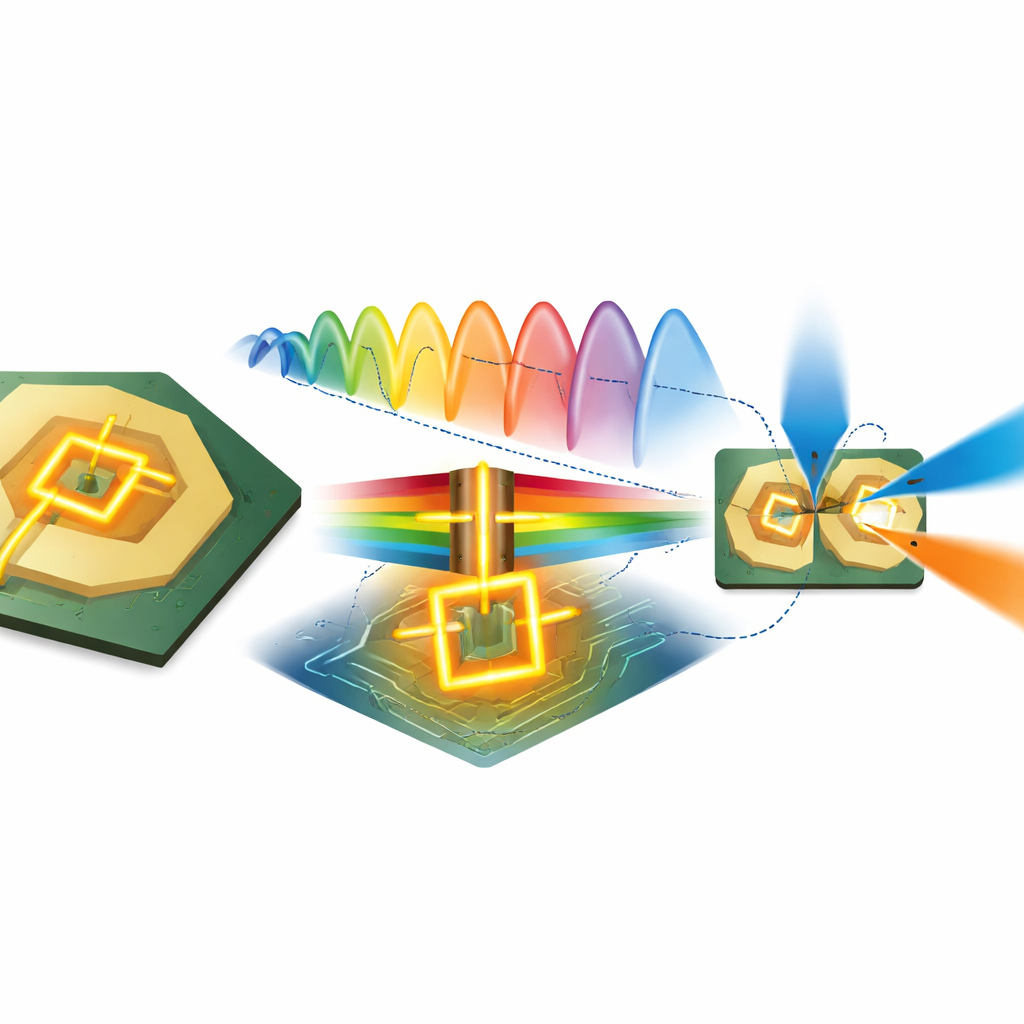
The researchers start from an ultra‑wideband antenna, a small flat metal shape printed on a circuit board that can send and receive radio waves from 3 to 9 gigahertz. That span covers many modern services, from 5G and Wi‑Fi to radar and satellite links. The challenge is that some of these services, like certain 5G and Wi‑Fi bands, may be strong sources of interference when the antenna is used for satellite communication, where the desired signals are much weaker. Instead of adding bulky external filters, the authors shape the antenna itself so that it naturally passes most of this wide range but sharply rejects two troublesome slices.

Carving out noisy bands with tiny rings
To create these “do‑not‑enter” zones, the team etches two special square ring structures into the antenna. One is a complementary split‑ring resonator built into the ground layer of the board; the other is a split‑ring resonator placed near the feed region. These tiny loops behave like miniature tuning forks for radio waves. Each is sized so that it strongly resonates at one narrow frequency band, soaking up and reflecting energy there while leaving the rest of the spectrum largely undisturbed. In this design, one ring blocks signals around 3.7–4.2 gigahertz, where parts of 5G New Radio overlap satellite C‑band, and the other blocks around 5.7–6.2 gigahertz, where newer Wi‑Fi systems operate.
Making a wide ear that stays compact
Achieving this behavior requires careful shaping of both the visible metal patch and the hidden ground beneath it. The authors begin with a hexagonal patch and then adjust the size of the ground plane and cut a V‑shaped slot into it. By studying how currents flow across the surface at different frequencies, they tune the dimensions so that the antenna responds smoothly across the entire 3–9 gigahertz band. Measurements on fabricated prototypes show that the device closely matches simulations: it strongly rejects the two targeted bands while maintaining high efficiency and stable radiation patterns elsewhere. In other words, the antenna behaves like a built‑in filter without sacrificing its broad listening ability.
From a single ear to a multi‑ear array
Modern satellite and wireless systems often use multiple antennas working together, known as MIMO, to increase data rates and link reliability. However, when antennas sit close to each other in a compact device, they tend to “hear” each other, creating unwanted coupling that muddles the signals. To overcome this, the team builds a two‑element version of their antenna and adds simple passive shapes between them: an inverted‑U strip and a square ring. These added pieces capture and redirect stray currents that would otherwise jump from one element to the other. Tests show that this isolation strategy keeps interaction between the two antennas very low across the operating band, while preserving the dual rejection notches and good overall gain.
What this means for future wireless links
For non‑experts, the key message is that this work offers a neat way to build antennas that are at once wide‑listening, selective, and compact. By sculpting small resonant rings and isolation structures directly into a flat printed layout, the authors create a MIMO antenna that can support high‑data‑rate links over a broad range of frequencies, yet automatically ignores two of the noisiest neighbor bands. Such designs could help future 5G, Wi‑Fi 6, radar, and satellite systems share spectrum more peacefully, boosting capacity and reliability without larger hardware. The same approach could later be extended to tunable or reconfigurable versions that adapt their “forbidden” bands on the fly as the radio landscape evolves.
Citation: Bouchouicha, D., Fathallah, W., Al-Rasheed, A. et al. A filtering-enhanced MIMO antenna architecture for next-generation multi-user satellite communication. Sci Rep 16, 11950 (2026). https://doi.org/10.1038/s41598-026-42054-5
Keywords: ultra-wideband antenna, dual-notch filtering, MIMO satellite communication, interference mitigation, 5G and Wi-Fi coexistence