Clear Sky Science · en
Multi-objective optimization design of oil spray cooling system for hairpin motor based on particle swarm optimization-backpropagation-non-dominated sorting genetic algorithm III
Why keeping electric motors cool matters
As electric cars grow more powerful and compact, the motors that drive them are being pushed harder than ever. Inside these motors, tightly packed copper windings can heat up so much that they permanently lose magnetic strength, shortening motor life and wasting energy. This study looks at an advanced way to bathe those windings in cooling oil and then uses smart computer algorithms to redesign the tiny spray ring that delivers the oil, making the motor both cooler and easier to run.
How oil rain protects hardworking motors
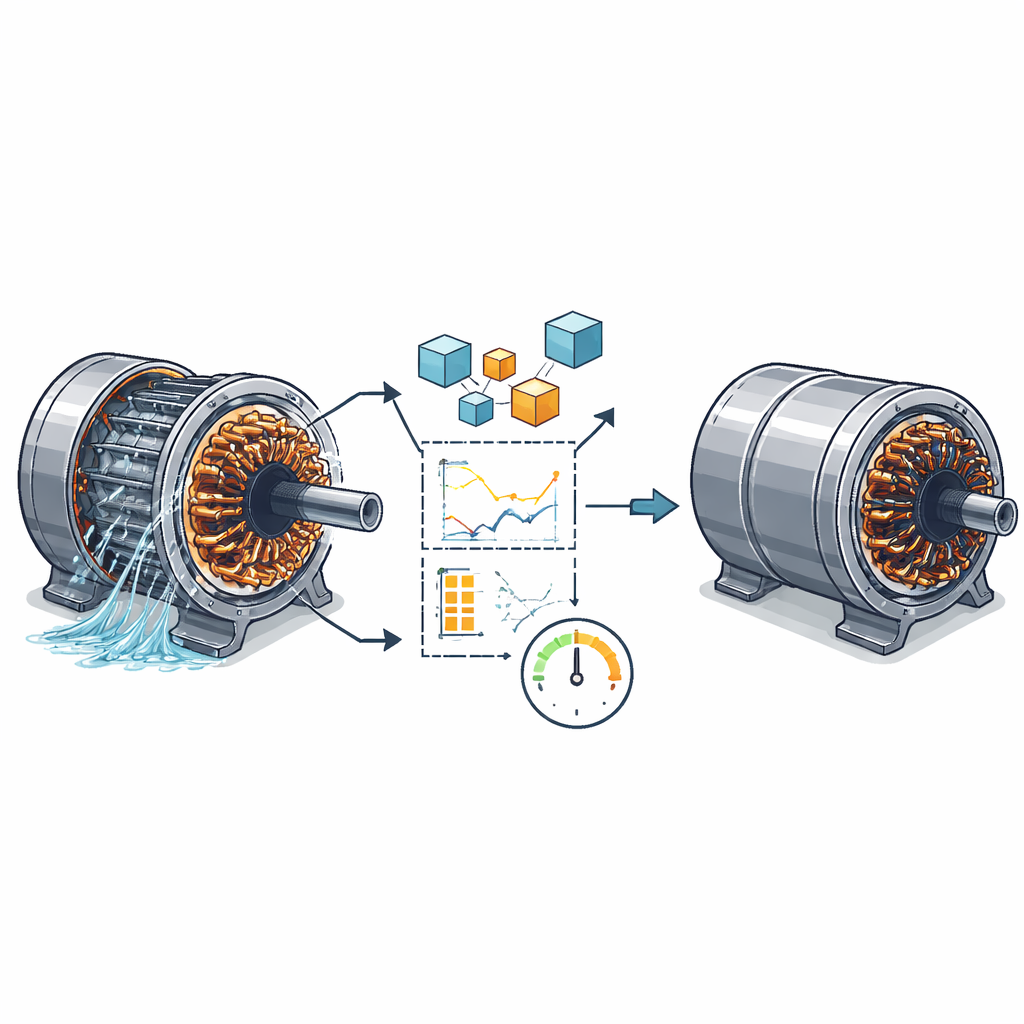
Modern traction motors often use so‑called hairpin windings—rigid copper bars bent into U‑shapes and packed densely around the rotor. These concentrated bundles are great for power, but they are also the hottest parts of the motor. One promising solution is an oil spray cooling system: a hollow ring around the windings sends out multiple oil jets that strike the hot copper, spread into a thin film, and carry heat away before the oil returns to the cooling circuit. The paper focuses on a 230 kW electric motor that already uses such a spray ring, but whose original design left the windings too hot and the oil under relatively high pressure, stressing the cooling system.
Testing different ways to spray the oil
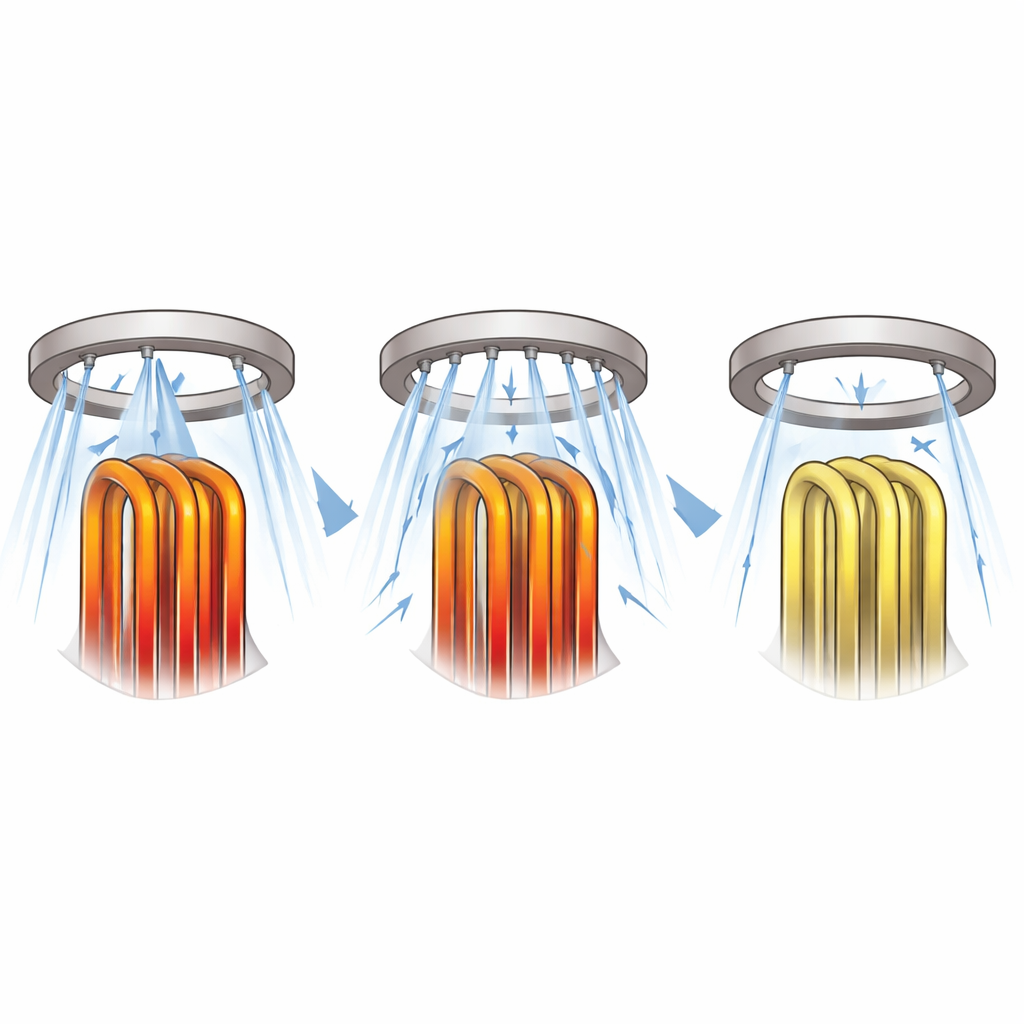
The researchers first asked a basic question: what kind of nozzle shape cools best? They compared three commercial nozzle types—flat spray, full cone, and fan‑shaped—by simulating how each one wets a realistic, unsimplified winding bundle. Using detailed fluid and heat‑flow calculations, they produced temperature “cloud” maps showing where the windings remained hot or cold. The flat spray nozzle tended to soak only the middle of the windings, leaving neighboring conductors hotter. The fan‑shaped nozzle performed somewhat better, but still created sharp temperature jumps between adjacent windings. The full cone nozzle, by contrast, scattered oil more evenly over the surface, producing a smoother temperature field and the lowest peak temperature—about 22% lower than with the flat spray and 5% lower than with the fan nozzle. This nozzle was therefore chosen as the starting point for redesign.
Searching design space with virtual experiments
Next, the team turned to the geometry of the spray ring itself. They identified six key dimensions, including the large and small diameters of each nozzle, the spray angle, how the nozzles are rotated around the ring, how many nozzles are used, and the ring’s axial length. Instead of trying every possible combination, they used an orthogonal design—a structured set of 25 carefully chosen variants—to efficiently explore how these factors affect two targets: the maximum winding temperature and the maximum internal oil pressure. For each variant, advanced computer fluid dynamics (CFD) provided the temperatures and pressures. A sensitivity analysis then revealed that one parameter, the small nozzle diameter, had by far the strongest influence on both cooling and pressure, while the other dimensions still played important supporting roles.
Letting algorithms tune the tiny details
To go beyond these 25 trial designs, the authors trained a neural network to learn the relationship between ring geometry and cooling performance, using the simulation results as its teaching set. They then wrapped this network inside a hybrid optimization scheme that combines particle swarm optimization with a modern multi‑objective genetic algorithm. In simple terms, virtual “particles” and “offspring” roam through design space, proposing thousands of new spray‑ring shapes. The neural network quickly predicts temperature and pressure for each candidate, and the algorithm keeps only those that balance both goals well, forming what engineers call a Pareto front. From this frontier, the team selected one design where the nozzles are slightly smaller but more numerous, and the ring length and spray angle are finely adjusted to produce strong, uniform oil coverage without pushing internal pressure too high.
What the optimized design delivers
Finally, the chosen design was checked again with full CFD simulations. The predicted and simulated peak temperatures and pressures agreed within about 2%, showing that the integrated algorithm was highly accurate. Compared with the original spray ring, the optimized version reduced the maximum winding temperature by 8.5% and cut the peak internal oil pressure by 25.6%. For an electric vehicle motor, that means cooler copper, less risk of magnetic damage, and a lighter load on the oil pump, all without changing the basic motor layout. The work demonstrates how combining realistic flow simulations with intelligent search algorithms can squeeze more performance out of existing hardware, pointing the way toward cooler, more efficient, and more durable high‑power electric drives.
Citation: Liu, Y., Xu, P., Chen, S. et al. Multi-objective optimization design of oil spray cooling system for hairpin motor based on particle swarm optimization-backpropagation-non-dominated sorting genetic algorithm III. Sci Rep 16, 11593 (2026). https://doi.org/10.1038/s41598-026-42028-7
Keywords: electric motor cooling, oil spray cooling, hairpin windings, multi-objective optimization, electric vehicles