Clear Sky Science · en
A fire image transmission method via automatic fire alarm system data bus for remote fire verification in unattended locations: design and experiment
Why smarter fire alarms matter
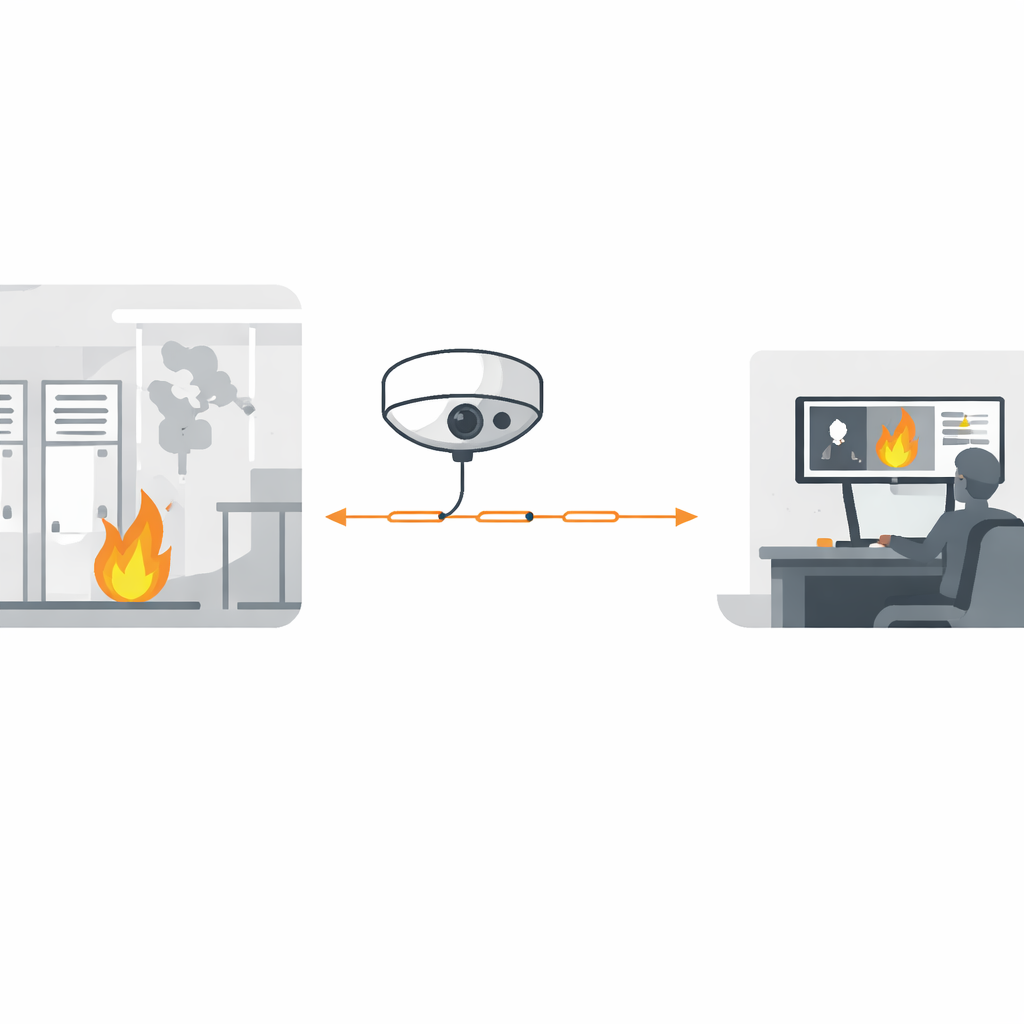
Across modern power grids and industrial sites, more and more equipment runs without people on-site: underground cable tunnels, remote substations, and wind turbines far from towns. When a fire starts in these places, traditional smoke or heat sensors can trigger an alarm, but staff still have to send someone to check whether it is a real fire or a harmless glitch. That delay can mean the difference between a small incident and a major disaster. This study explores a way to send simple but useful fire pictures over the same thin wires that already connect fire detectors to control panels, making it possible to quickly see what is happening in distant, unattended locations.
Fires in places no one is watching
Unattended electrical sites play a quiet but crucial role in our daily lives, moving electricity, stabilizing the grid, and supporting renewable energy. Yet they are also prone to fires from overheating equipment, cable faults, or other failures. Automatic fire alarm systems are already installed in many of these facilities and are known to save lives by detecting fires early. However, most current systems only send simple signals such as “alarm” or “no alarm,” based on smoke or temperature. They do not show what the fire actually looks like. Operators at a distant monitoring center often have to drive out to inspect the situation or risk acting on a false alarm, wasting time and resources.
Sending only what really changes
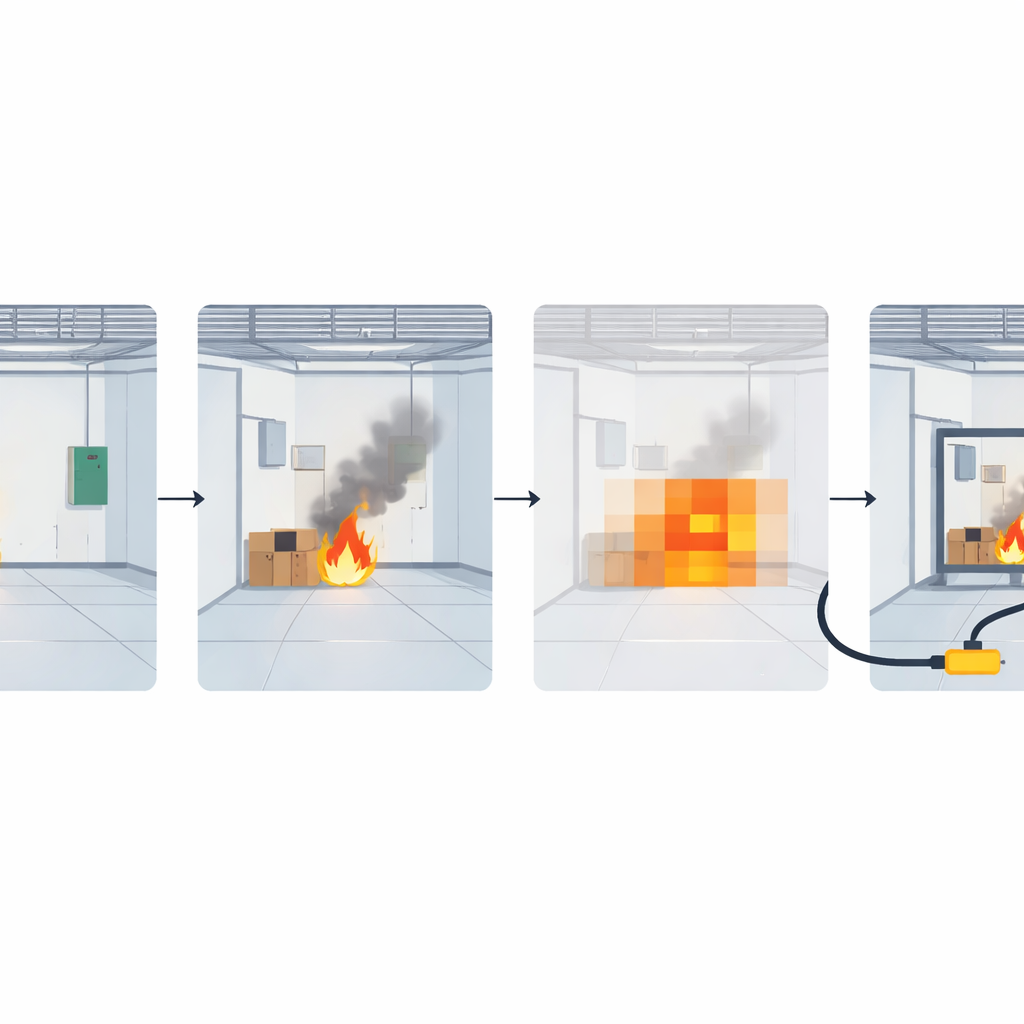
The new method proposed in this paper adds a small camera and image-processing unit inside a standard point-type smoke detector. Instead of constantly streaming full video, the detector occasionally captures a clear “background” image of the room when there is no fire. If a fire signal is later triggered, the detector takes a new image and uses a mathematical technique, based on differences between blurred versions of the two images, to find only the parts that have truly changed—typically where flames or smoke appear. Rather than sending the entire fire image, the detector compresses just these difference regions, along with information about where they belong, and sends this compact package over the existing two-wire data bus to the central controller.
How the system rebuilds a useful picture
At the monitoring center, the controller receives the compact data and reconstructs a full fire image by combining the newly arrived changed regions with the stored background picture. In effect, the center keeps a reference snapshot of the room and “paints in” only the updated areas that show fire or smoke. The study describes how the system first checks that background images are of good quality, cleans up noise using filters, then encodes visual features into a format that works with the fire alarm bus protocol. On the other end, the controller decodes the data, matches small blocks to a built-in feature table, and stitches the blocks back into place. Operators can then view a clear, up-to-date image of the fire scene to decide whether to trigger remote fire suppression or send personnel.
What the experiments revealed
To test the idea, the authors built a working prototype detector and ran 52 experiments in a standard fire test chamber using a controlled polyurethane fire. They examined how quickly images could be delivered under different conditions: varying the camera resolution, changing how large the fire region appeared in the picture, testing simultaneous alarms from two detectors on the same loop, and extending the cable length up to one kilometer. At a typical setup—moderate image resolution, a fire occupying about 30 percent of the image, and a 10-meter cable—the detector could send a usable fire image in about 1.5 seconds. The method proved far less sensitive to image size than traditional full-image transmission, because it only sent changed regions. However, when the changed area became very large, or when cable lengths exceeded 500 meters, transmission times increased noticeably due to more data and signal weakening along the wires.
What this means for real-world safety
For non-specialists, the key takeaway is that the researchers have found a way to give existing fire alarm wiring a new job: carrying simple, timely fire pictures without adding expensive new cables. By cleverly sending only the parts of the image that change when a fire breaks out, the system can keep delays low enough for operators to confirm a real fire and act quickly, even in remote or unattended facilities. While challenges remain—such as handling very long distances and harsh electrical environments—the study shows that picture-based fire verification can be integrated into current alarm infrastructure with modest changes. In the future, this could make fire responses faster, more accurate, and more reliable wherever people cannot be on-site around the clock.
Citation: Li, L., Song, L. & Ma, W. A fire image transmission method via automatic fire alarm system data bus for remote fire verification in unattended locations: design and experiment. Sci Rep 16, 12980 (2026). https://doi.org/10.1038/s41598-026-42023-y
Keywords: remote fire monitoring, unattended substations, image-based fire alarms, industrial fire safety, low-bandwidth image transmission